Ch. 9 - Substitution and Elimination Reactions of Alkyl Halides
Bruice - Organic Chemistry 8th Edition
Bruice8th EditionOrganic ChemistryISBN: 9780135213711Not the one you use?Change textbook
Chapter 10, Problem 50

Why is a cumulated diene not formed in the reaction shown above?
Chemical reaction showing the conversion of a brominated alkene to an acetylide with ammonia and bromide ions.

Verified step by step guidance
1
Step 1: Analyze the starting material, which is 1-chloro-2-methylpropene. This molecule contains a double bond and a chlorine atom attached to the carbon adjacent to the double bond.
Step 2: Consider the reagent used in the reaction, which is the amide ion (NH₂⁻). The amide ion is a strong base and can abstract a proton from the molecule, leading to elimination reactions.
Step 3: In an elimination reaction, the base abstracts a proton from a β-carbon (the carbon adjacent to the carbon bearing the leaving group, Cl⁻). This results in the formation of a new π bond and the departure of the leaving group (Cl⁻).
Step 4: The product formed is propyne (HC≡CCH₃), which is an alkyne. A cumulated diene is not formed because the elimination reaction leads to the formation of a triple bond rather than two adjacent double bonds. This is due to the stability of the alkyne product and the specific geometry of the starting material.
Step 5: Cumulated dienes are less stable than conjugated systems or alkynes due to steric and electronic factors. The reaction pathway favors the formation of the alkyne (propyne) as the major product.

Verified video answer for a similar problem:

This video solution was recommended by our tutors as helpful for the problem above.
Video duration:
4m
Was this helpful?

Key Concepts

Here are the essential concepts you must grasp in order to answer the question correctly.

Alkyne Formation

The reaction depicted involves the formation of an alkyne from a halogenated compound through a nucleophilic substitution mechanism. The base, in this case, the amide ion (NH2-), abstracts a proton from the terminal alkyne, facilitating the elimination of the halide ion (Cl-). This process is crucial for understanding why a cumulated diene is not formed, as the reaction favors the formation of a stable alkyne instead.
Recommended video:
Guided course
09:11
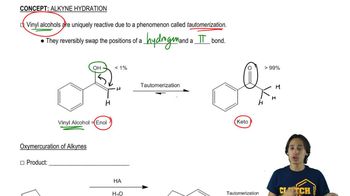
Alkyne Hydration

Nucleophilic Substitution

Nucleophilic substitution is a fundamental reaction mechanism in organic chemistry where a nucleophile replaces a leaving group in a molecule. In this reaction, the amide ion acts as a strong nucleophile, attacking the carbon atom bonded to the chlorine atom, leading to the formation of a new carbon-carbon triple bond. This mechanism is essential for understanding the pathway of the reaction and why alternative products, like cumulated dienes, are not favored.
Recommended video:
Guided course
01:47
Nucleophiles and Electrophiles can react in Substitution Reactions.

Stability of Alkynes vs. Dienes

Alkynes are generally more stable than cumulated dienes due to the presence of a triple bond, which is stronger than the double bonds found in dienes. The formation of a stable alkyne is thermodynamically favored in this reaction, as the energy released from forming the triple bond outweighs the potential formation of less stable cumulated dienes. This stability consideration is key to understanding the product distribution in the reaction.
Recommended video:
Guided course
03:43
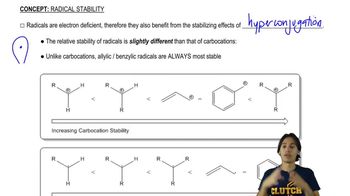
The radical stability trend.