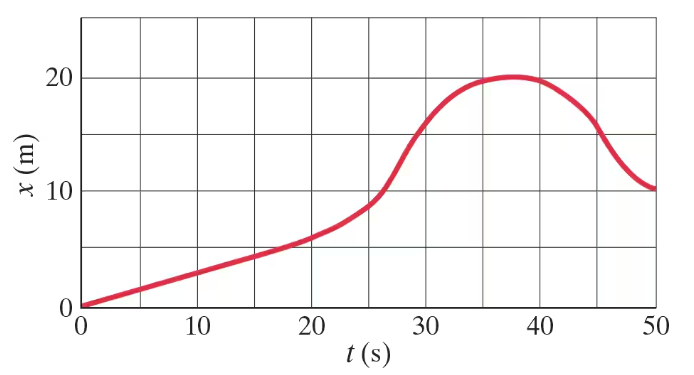
In Fig. 2–40, at what time is the velocity greatest?
Verified step by step guidance
1
Examine the velocity-time graph provided in Fig. 2–40. The velocity is represented on the y-axis, and time is represented on the x-axis. Identify the point where the velocity reaches its maximum value (the highest point on the graph).
Understand that the velocity is greatest at the peak of the curve on the velocity-time graph. This corresponds to the maximum value of the velocity function.
Determine the time coordinate (x-axis value) at which this peak occurs. This is the time at which the velocity is greatest.
If the graph is a mathematical function, you can find the maximum velocity by taking the derivative of the velocity function with respect to time \( \frac{dv}{dt} \), setting it equal to zero, and solving for time \( t \).
Verify your result by checking the graph or function to ensure that the value of \( t \) corresponds to a maximum (not a minimum or inflection point). This can be done by analyzing the second derivative \( \frac{d^2v}{dt^2} \) or by visual inspection of the graph.
Verified video answer for a similar problem:
This video solution was recommended by our tutors as helpful for the problem above
Play a video:
0 Comments
Key Concepts
Here are the essential concepts you must grasp in order to answer the question correctly.
Velocity
Velocity is a vector quantity that refers to the rate of change of an object's position with respect to time. It has both magnitude and direction, which distinguishes it from speed, a scalar quantity. Understanding how velocity changes over time is crucial for analyzing motion, particularly in determining when it reaches its maximum value.
In physics, motion can often be represented graphically, with position, velocity, and acceleration plotted against time. Analyzing these graphs allows us to identify key features such as maximum velocity, which occurs at points where the slope of the position-time graph is steepest. This graphical approach is essential for visualizing and interpreting the dynamics of the system.
Kinematics is the branch of mechanics that deals with the motion of objects without considering the forces that cause the motion. It involves equations and principles that describe how objects move, including concepts like displacement, velocity, and acceleration. Mastery of kinematic equations is vital for predicting the behavior of moving objects and determining when specific conditions, such as maximum velocity, occur.