A small metal sphere, carrying a net charge of μC, is held in a stationary position by insulating supports. A second small metal sphere, with a net charge of μC and mass g, is projected toward . When the two spheres are m apart, , is moving toward with speed m/s (Fig. E). Assume that the two spheres can be treated as point charges. You can ignore the force of gravity. What is the speed of when the spheres are m apart?
Verified step by step guidance
1
Identify the problem as a conservation of energy problem involving electric potential energy and kinetic energy. The initial and final states of the system need to be considered.
Write the expression for the initial total energy of the system when the spheres are 0.800 m apart. This includes the initial kinetic energy of q_2 and the initial electric potential energy between the two charges. Use the formula for kinetic energy: and the formula for electric potential energy: , where k is Coulomb's constant and r is the distance between the charges.
Write the expression for the final total energy of the system when the spheres are 0.400 m apart. This includes the final kinetic energy of q_2 and the final electric potential energy between the two charges. Use the same formulas for kinetic and potential energy as in the previous step, but with the updated distance.
Apply the conservation of energy principle, which states that the initial total energy is equal to the final total energy. Set the initial energy expression equal to the final energy expression: .
Solve the equation for the final speed of q_2, . Rearrange the equation to isolate and substitute the known values for mass, initial speed, charges, and distances to find the final speed.
Verified video answer for a similar problem:
This video solution was recommended by our tutors as helpful for the problem above
Video duration:
11m
Play a video:
0 Comments
Key Concepts
Here are the essential concepts you must grasp in order to answer the question correctly.
Coulomb's Law
Coulomb's Law describes the electrostatic force between two point charges. It states that the force is directly proportional to the product of the magnitudes of the charges and inversely proportional to the square of the distance between them. This law is essential for calculating the force acting on the charges as they move closer together.
The principle of conservation of energy states that the total energy in an isolated system remains constant. In this scenario, the kinetic energy and electric potential energy of the system must be considered. As the spheres move closer, potential energy is converted into kinetic energy, affecting the speed of the moving charge.
Electric potential energy is the energy a charge possesses due to its position in an electric field. It is calculated using the formula U = k * q1 * q2 / r, where k is Coulomb's constant, q1 and q2 are the charges, and r is the distance between them. Understanding this concept is crucial for determining how the potential energy changes as the distance between the charges decreases.


 11:26 minutes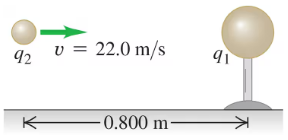
 Verified step by step guidance
 09:52
09:52