Control buttons has been changed to "navigation" mode.
1/40
Terms in this set (40)
How can the capacitance of an air-filled charged capacitor be increased?
The capacitance can be increased by increasing the surface area of the plates, decreasing the distance between the plates, or inserting a material with a higher dielectric constant between the plates.
How can the capacitance of a charged parallel-plate capacitor be halved?
The capacitance can be halved by either doubling the distance between the plates or halving the surface area of the plates.
What happens to the charge on a capacitor immediately after a switch is thrown to connect it to a battery?
Immediately after the switch is thrown, charge begins to accumulate on the plates of the capacitor as electrons flow due to the potential difference provided by the battery.
Where is the energy stored in a capacitor?
The energy is stored in the electric field between the two plates of the capacitor.
What changes can increase the capacitance of a parallel-plate capacitor?
Increasing the plate area, decreasing the distance between the plates, or using a material with a higher dielectric constant between the plates will increase the capacitance.
What is one function a capacitor can perform in an electrical circuit?
A capacitor can store electrical energy and release it when needed, acting as a temporary energy reservoir.
How do you find the equivalent capacitance of four capacitors connected in series?
For capacitors in series, the reciprocal of the equivalent capacitance is the sum of the reciprocals of the individual capacitances: 1/C_eq = 1/C1 + 1/C2 + 1/C3 + 1/C4.
What is the term for the opposition to AC current flow caused by a capacitor?
The opposition to AC current flow caused by a capacitor is called capacitive reactance.
How do you find the equivalent capacitance of three capacitors connected in parallel?
For capacitors in parallel, the equivalent capacitance is the sum of the individual capacitances: C_eq = C1 + C2 + C3.
How do you calculate the charge on each capacitor in a simple circuit with one battery and one capacitor?
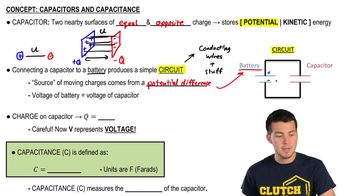
The charge on the capacitor is given by Q = C × V, where C is the capacitance and V is the voltage across the capacitor.
How do you determine the voltage between the plates of a capacitor in a simple circuit?
The voltage between the plates of the capacitor equals the voltage of the battery connected to it.
The capacitance of a parallel-plate capacitor is independent of which quantity?
The capacitance is independent of the charge stored on the plates.
How do you find the equivalent capacitance of a combination of capacitors in series and parallel?
First, combine capacitors in parallel by adding their capacitances, then combine series capacitors using the reciprocal formula, and repeat as needed until a single equivalent capacitance is found.
How do you calculate the capacitance of a parallel-plate capacitor with a dielectric material?
The capacitance is given by C = (κ ε₀ A) / d, where κ is the dielectric constant, ε₀ is the permittivity of free space, A is the plate area, and d is the separation between plates.
What is the unit for capacitance?
The unit for capacitance is the farad (F).
What is the time constant for the discharge of a capacitor in an RC circuit?
The time constant τ is given by τ = R × C, where R is the resistance and C is the capacitance.
How do you find the equivalent capacitance for a circuit with capacitors in series?
For capacitors in series, use 1/C_eq = 1/C1 + 1/C2 + ... + 1/Cn.
When capacitors are wired in series, what quantity must be the same for all capacitors?
The charge on each capacitor must be the same in a series connection.
What is the role of insulation in a capacitor?
Insulation prevents charge from moving directly between the plates, allowing the capacitor to store energy in the electric field.
What is the charge on a capacitor immediately after the switch is closed in a simple circuit?
The charge starts at zero and begins to increase as the capacitor charges according to Q = C × V.
How do you calculate the charge on a capacitor given its capacitance and voltage?
Use the formula Q = C × V, where Q is charge, C is capacitance, and V is voltage.
How do you determine the potential difference across each capacitor in a parallel connection?
In a parallel connection, the potential difference across each capacitor is equal to the voltage of the battery.
How do you calculate the charge on each capacitor in a parallel circuit?
For each capacitor, use Q = C × V, where V is the common voltage across all capacitors.
When capacitors are wired in parallel, what quantity must be the same for all capacitors?
The voltage across each capacitor must be the same in a parallel connection.
What determines which capacitor discharges more quickly after the switch is closed?
A capacitor with a smaller time constant (τ = RC) will discharge more quickly.
How do you find the equivalent capacitance for a combination of series and parallel capacitors?
Combine parallel capacitors by adding their capacitances, and combine series capacitors using the reciprocal formula, repeating as needed.
How do you calculate the charge on a capacitor in a simple circuit?
Use Q = C × V, where Q is the charge, C is the capacitance, and V is the voltage across the capacitor.
Why are the plates in a capacitor parallel to each other?
Parallel plates maximize the uniformity of the electric field and the capacitance for a given area and separation.
What is the basic unit of capacitance?
The basic unit of capacitance is the farad (F).
Which type of device can store large amounts of electricity?
A capacitor can store large amounts of electricity.
What property of objects is best measured by their capacitance?
The ability to store electric charge per unit voltage is best measured by capacitance.
How do you find the equivalent capacitance of three capacitors in parallel?
Add their capacitances: C_eq = C1 + C2 + C3.
How do you find the voltage across the first capacitor in a series circuit?
The voltage across the first capacitor can be found using Q = C × V, where Q is the common charge and C is the capacitance of the first capacitor.
In the steady state, what is the charge on a capacitor connected to a battery?
In steady state, the charge is Q = C × V, where V is the battery voltage.
In a capacitor, which plate is the positive plate?
The plate connected to the positive terminal of the battery is the positive plate.
If a 2 farad capacitor is charged with 40 coulombs, what is the voltage across the capacitor?
The voltage is V = Q / C = 40 C / 2 F = 20 V.
After a switch is closed in a circuit with a capacitor and battery, which plate of the capacitor becomes positively charged?
The plate connected to the positive terminal of the battery becomes positively charged.
How do you find the total capacitance of a combination of capacitors in series and parallel?
Combine parallel capacitors by adding their capacitances, and combine series capacitors using the reciprocal formula, repeating as needed.
How do you rank capacitors based on the charge stored on their positive plates?
The charge stored is Q = C × V; rank capacitors by the product of their capacitance and the voltage across them.
What is the time constant for the discharge of capacitors in an RC circuit?
The time constant is τ = R × C, where R is resistance and C is capacitance.