Capacitors & Capacitance quiz #2 Flashcards

Capacitors & Capacitance quiz #2
Control buttons has been changed to "navigation" mode.
1/10
  • How do you find the capacitance of a parallel-plate capacitor?

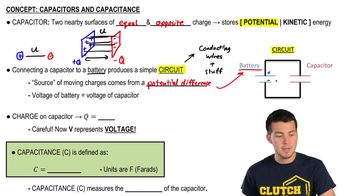
    Use C = (ε₀ A) / d, where ε₀ is the permittivity of free space, A is the plate area, and d is the separation between plates.
  • What is an air-filled parallel plate capacitor?

    It is a capacitor with two parallel plates separated by air, which acts as the dielectric.
  • When the capacitor charge Q is positive, what is the sign of the measured voltage?

    The measured voltage is positive when the charge Q is positive.
  • What property of objects is best measured by their capacitance?

    The ability to store electric charge per unit voltage is best measured by capacitance.
  • How can a cell membrane be modeled as a capacitor?

    A cell membrane can be modeled as a parallel-plate capacitor, with the membrane acting as the dielectric and the inner and outer surfaces as plates.
  • What is the capacitance of a parallel plate capacitor?

    The capacitance is given by C = (ε₀ A) / d, where ε₀ is the permittivity of free space, A is the plate area, and d is the separation.
  • Which capacitor discharges more quickly: one with a larger or smaller time constant?

    A capacitor with a smaller time constant (τ = RC) discharges more quickly.
  • How do you find the net capacitance of a combination of series and parallel capacitors?

    Combine parallel capacitors by adding their capacitances, and combine series capacitors using the reciprocal formula, repeating as needed.
  • How do you calculate the charge on a specific capacitor in a circuit?

    Use Q = C × V, where C is the capacitance and V is the voltage across that capacitor.
  • What is the shape of the plates in a typical parallel plate capacitor?

    The plates are often circular or rectangular and are arranged parallel to each other.