When light interacts with a plane mirror, the law of reflection states that the angle of incidence equals the angle of reflection. However, understanding how we see everyday objects in mirrors requires exploring how light rays scatter and reflect. Objects like pencils or hands emit light rays in many directions, and some of these rays reflect off the mirror and enter our eyes, allowing us to perceive the reflected image.
In geometric optics, ray diagrams help visualize this process. For extended objects—those with physical size—typically two or three rays are drawn from the top of the object to determine the location of the image formed by the mirror. One common ray travels toward the mirror and reflects off at an angle equal to its incidence, while another may strike the mirror perpendicularly. The reflected rays appear to originate from a point behind the mirror, where the image is formed. This image is called a virtual image because the light rays do not actually converge there; instead, they only appear to do so when traced backward.
It is important to note that virtual images are visible and appear as if they are located inside the mirror. For example, your reflection in a bathroom mirror is a virtual image. The brain interprets the reflected rays as if they come from behind the mirror, creating the perception of an image inside it.
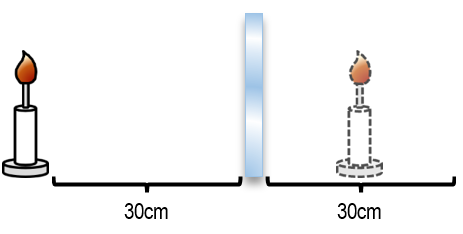
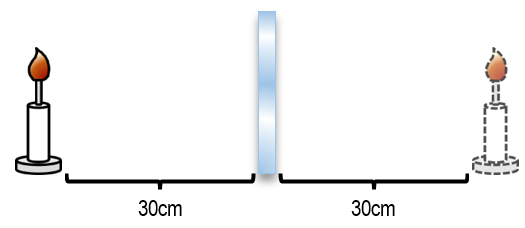
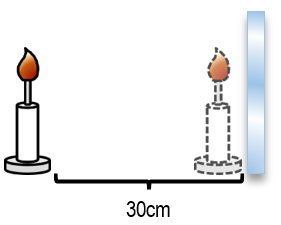
The distances involved in image formation by a plane mirror follow a simple geometric relationship. The distance from the object to the mirror, denoted as dO, is equal in magnitude to the distance from the mirror to the image, denoted as dI. This relationship is expressed as:
\[d_{O} = -d_{I}\]The negative sign indicates that the image distance is measured in the opposite direction behind the mirror. This equality means that if an object is placed 2 inches in front of a mirror, its image appears 2 inches behind the mirror.
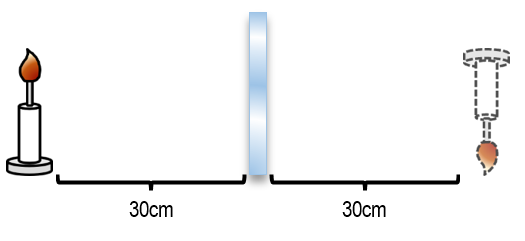
Several key properties characterize images formed by plane mirrors. First, the image is always upright, maintaining the same orientation as the object. Second, the image is laterally inverted, meaning left and right are reversed; for instance, raising your right hand in front of a mirror makes the reflection appear to raise its left hand. Third, the size of the image is equal to the size of the object, which corresponds to a magnification factor M of 1:
\[M = 1\]This magnification indicates that plane mirrors do not enlarge or reduce the size of the reflected image.
Applying these principles to practical problems often involves geometric reasoning. For example, consider a meter stick placed 30 centimeters in front of a plane mirror. To find the distance between the 50-centimeter mark on the meter stick and the mirror image of the 40-centimeter mark, one must account for the distances from the object to the mirror and from the mirror to the image. Since the image is laterally inverted, the 40-centimeter mark’s reflection appears on the opposite side behind the mirror. Adding the distances yields the total separation:
\[\text{Distance} = 50\, \text{cm} + 30\, \text{cm} + 30\, \text{cm} + 60\, \text{cm} = 170\, \text{cm}\]Understanding image formation in plane mirrors through ray diagrams and geometric relationships enhances comprehension of everyday optical phenomena. This foundation is essential for further exploration of geometric optics and the behavior of light with various reflective surfaces.