 Back
Back1D Motion and Kinematics: Study Notes
Study Guide - Smart Notes
 Tailored notes based on your materials, expanded with key definitions, examples, and context.
1D Motion with Constant Acceleration
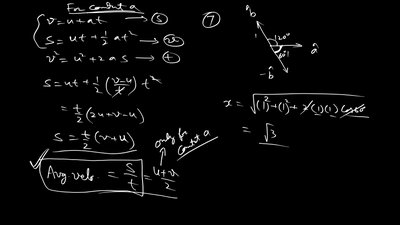
Kinematic Equations
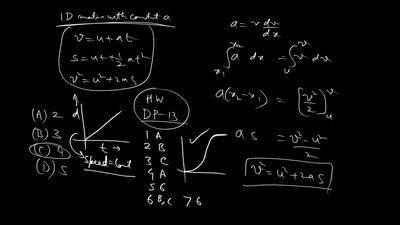
One-dimensional motion with constant acceleration is a fundamental topic in introductory physics. The following equations describe the relationships between displacement, velocity, acceleration, and time:
First Equation: Where v is final velocity, u is initial velocity, a is acceleration, and t is time.
Second Equation: Where s is displacement.
Third Equation: This relates velocity and displacement directly.
These equations are derived from calculus and algebraic manipulation of the definitions of velocity and acceleration.
Calculus Approach to Kinematics
Acceleration is defined as the rate of change of velocity with respect to time:
Velocity is the rate of change of displacement:
Integrating acceleration gives velocity:
Integrating velocity gives displacement:
Graphical Analysis of Motion
Position, Velocity, and Acceleration Graphs
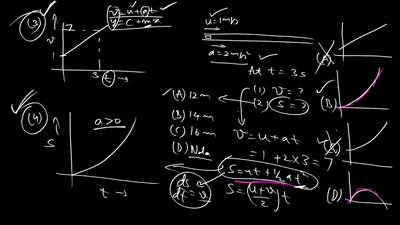
Graphical representations help visualize how position, velocity, and acceleration change over time:
Position vs Time (s-t): For constant acceleration, the graph is a parabola.
Velocity vs Time (v-t): For constant acceleration, the graph is a straight line.
Acceleration vs Time (a-t): For constant acceleration, the graph is a horizontal line.
Solving Kinematics Problems
Step-by-Step Approach
To solve problems involving 1D motion:
Identify known and unknown variables (u, v, a, t, s).
Select the appropriate kinematic equation.
Substitute values and solve for the unknown.
Check units and physical meaning of the answer.
Example Problem
Example: An object starts from rest (u = 0) and accelerates at 2 m/s2 for 3 seconds. Find its displacement.
Use
m
Projectile Motion and Negative Acceleration
Motion Under Gravity
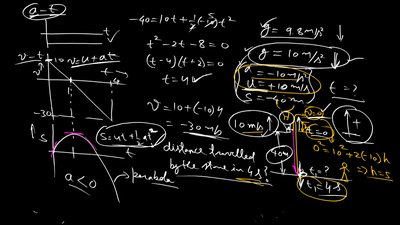
When an object is thrown upwards, it experiences negative acceleration due to gravity:
Acceleration due to gravity: m/s2
Velocity decreases until it reaches zero at the peak.
Displacement and velocity equations apply, but with negative acceleration.
Average Speed and Velocity
Definitions and Calculations
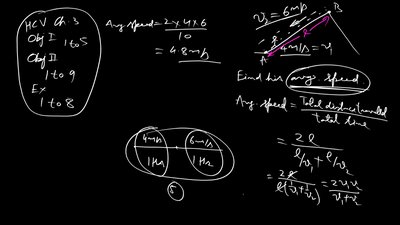
Average speed is the total distance traveled divided by the total time taken. Average velocity is the total displacement divided by the total time.
For motion in two segments with different speeds:
(when equal distances are covered at speeds and )
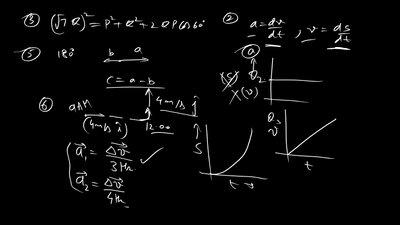
Vectors in Kinematics
Vector Addition and Subtraction
Vectors are used to represent quantities with both magnitude and direction. In kinematics, displacement, velocity, and acceleration are vectors.
Vector addition:
Vector subtraction:
Resultant vector magnitude:
Summary Table: Kinematic Equations
The following table summarizes the main kinematic equations for 1D motion with constant acceleration:
Equation | Variables | Use |
|---|---|---|
v, u, a, t | Find final velocity | |
s, u, a, t | Find displacement | |
v, u, a, s | Relate velocity and displacement | |
s, u, v, t | Find displacement (average velocity) |
Additional info:
Some content was inferred for completeness, such as the step-by-step problem-solving approach and the summary table. The last image (image_7) contains QR codes for social media channels and is not directly relevant to physics content, so it was not included.
