 Back
BackAP Physics 1 Rotational Motion Review – Step-by-Step Study Guidance
Study Guide - Smart Notes
 Tailored notes based on your materials, expanded with key definitions, examples, and context.
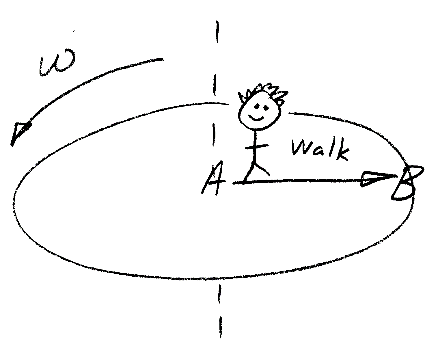
Q2. A child stands on a rotating platform at point A as shown in the figure. The platform is rotating at a constant rate of ω when the child begins walking along the radius of the platform to point B. Which of the following statements explains the changes in the rotational velocity of the platform?
Background
Topic: Conservation of Angular Momentum
This question tests your understanding of how the distribution of mass (rotational inertia) affects the rotational velocity of a system when no external torques act on it. It is a classic example of the conservation of angular momentum in rotational dynamics.
Key Terms and Formulas
Rotational Inertia (Moment of Inertia, I): A measure of how mass is distributed relative to the axis of rotation. For a point mass, .
Angular Velocity (ω): The rate at which an object rotates, measured in radians per second.
Conservation of Angular Momentum: If no external torque acts on a system, its angular momentum remains constant: , where .
Step-by-Step Guidance
Recognize that the child and platform together form an isolated system (no external torques), so angular momentum is conserved.
Recall the formula for angular momentum: .
As the child walks from point A (closer to the center) to point B (farther from the center), the child's distance from the axis increases, which increases the system's rotational inertia .
Since must remain constant and increases, consider what must happen to (the rotational velocity) to keep $L$ unchanged.
Try solving on your own before revealing the answer!
