 Back
BackApplying Newton’s Laws: Equilibrium, Dynamics, and Friction
Study Guide - Smart Notes
 Tailored notes based on your materials, expanded with key definitions, examples, and context.
Applying Newton’s Laws
Introduction
Newton’s laws of motion provide the foundation for analyzing forces and motion in physical systems. This chapter focuses on applying these laws to solve problems involving equilibrium, dynamics, and friction. Understanding these concepts is essential for predicting the behavior of objects under various force conditions.
Equilibrium of Objects
Necessary Condition for Equilibrium
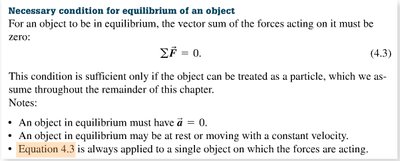
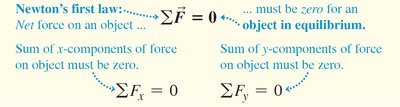
An object is in equilibrium when the vector sum of all forces acting on it is zero. This means the object is either at rest or moving with constant velocity in an inertial frame of reference.
Mathematical Condition:
Implications: The object must have zero acceleration ().
Application: Equation 4.3 is applied to a single object treated as a particle.
Equilibrium Conditions in Component Form
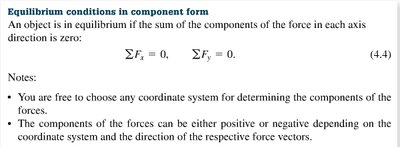
Equilibrium can be analyzed by considering the sum of force components along each axis:
Coordinate systems can be chosen freely; force components may be positive or negative depending on direction.
Example: One-Dimensional Equilibrium
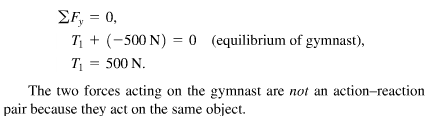
Consider a gymnast hanging from a rope connected to an O-ring bolted to the ceiling. The weights of the gymnast, rope, and O-ring are 500 N, 100 N, and 50 N, respectively. The problem is to find the tensions at both ends of the rope.
Draw free-body diagrams for each object.
Apply equilibrium conditions to solve for tensions.
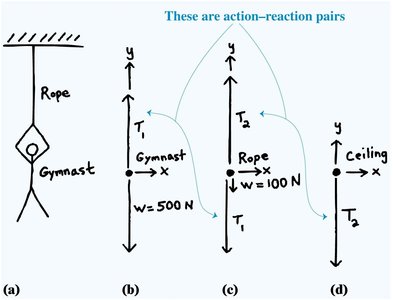
For the gymnast: ,
Example: Two-Dimensional Equilibrium
A car engine with weight hangs from a chain linked at point O to two other chains, one fastened to the ceiling and the other to the wall. The task is to find the tension in each chain.
Draw free-body diagrams for the engine and ring O.
Resolve forces into components and apply equilibrium conditions.
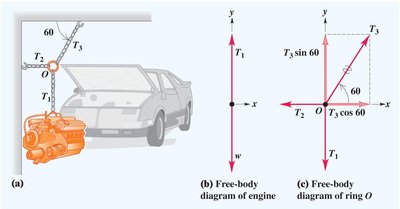
Equilibrium equations:
Since ,
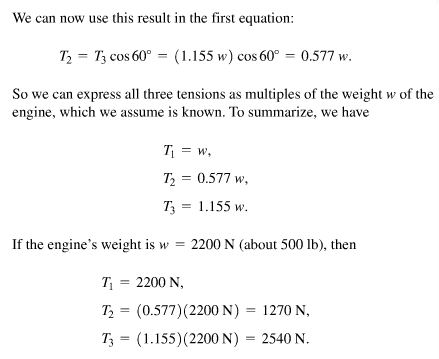
If :
Newton’s Second Law: Dynamics of Particles
Newton’s Second Law
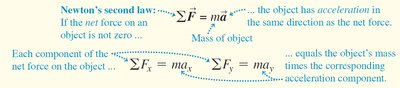
When the net force on an object is not zero, the object accelerates in the direction of the net force. Newton’s second law relates force, mass, and acceleration:
Component form: ,
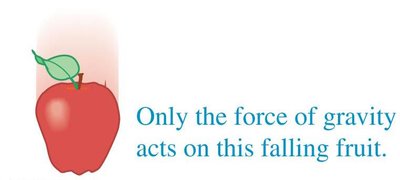
Free-Body Diagrams in Dynamics
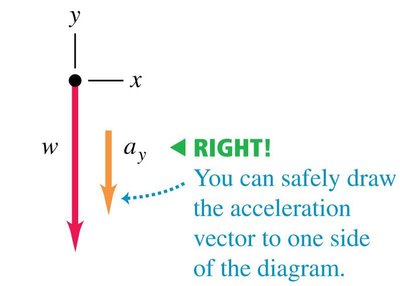
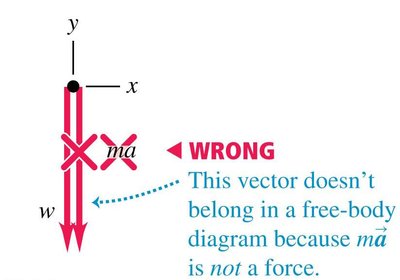
Free-body diagrams are essential for visualizing forces acting on an object. The acceleration vector can be shown separately, but is not a force and should not be included as a force vector.
Correct: Draw all forces acting on the object.
Incorrect: Do not include as a force.
Example: Toboggan on an Inclined Plane
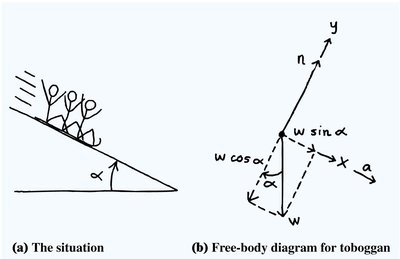
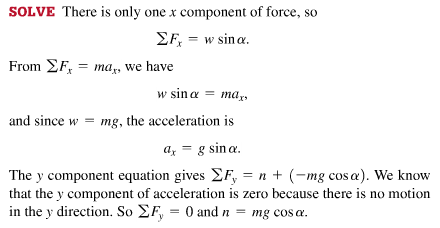
A toboggan slides down an incline at angle . The free-body diagram shows the weight resolved into components parallel and perpendicular to the incline.
Parallel component:
Perpendicular component:
Acceleration:
Normal force:
Apparent Weight and Weightlessness
When an object is accelerating vertically, its apparent weight changes. For example, in an elevator:
Apparent weight:
In free fall (): (apparent weightlessness)
Astronauts in orbit experience apparent weightlessness due to continuous free fall.

Frictional Forces
Nature of Friction
Friction is a force that opposes relative motion between surfaces in contact. It arises from microscopic interactions between molecules on the surfaces.
Friction is essential for movement, such as walking or climbing.
Frictional force is parallel to the surface.

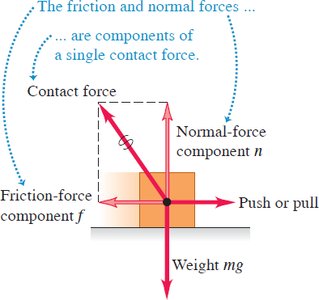
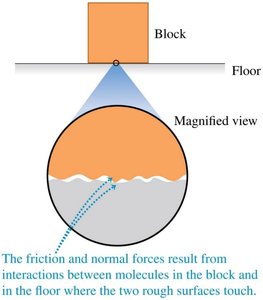
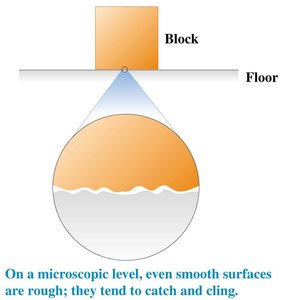
Kinetic and Static Friction
There are two main types of friction:
Kinetic friction: Acts when an object slides over a surface.
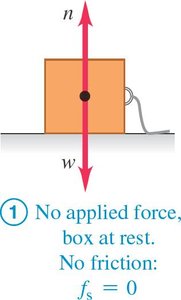
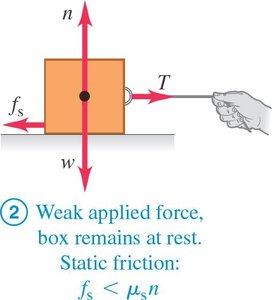
Static friction: Acts when there is no relative motion.
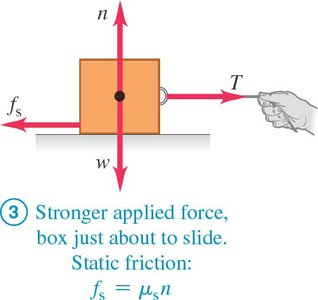
Static friction adjusts up to a maximum value before motion begins.
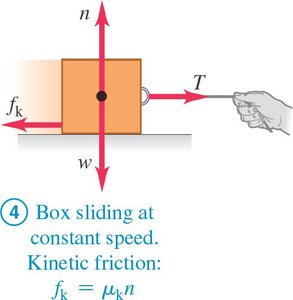
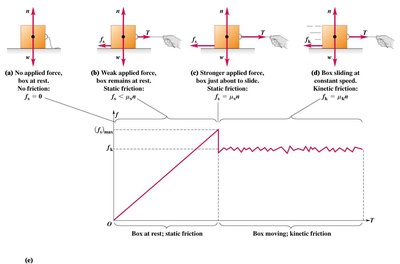
Relationship Between Normal Force and Maximum Static Friction
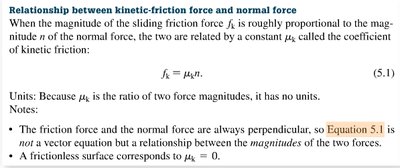
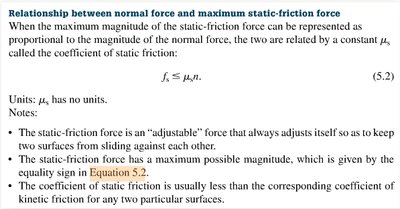
The maximum static friction force is proportional to the normal force:
The coefficient of static friction () is usually less than the coefficient of kinetic friction () for the same surfaces.
Summary Table: Coefficients of Friction
The coefficients of static and kinetic friction depend on the materials in contact. Typical values are shown below:
Materials | Coefficient of Static Friction () | Coefficient of Kinetic Friction () |
|---|---|---|
Steel on steel | 0.74 | 0.57 |
Aluminum on steel | 0.61 | 0.47 |
Copper on steel | 0.53 | 0.36 |
Brass on steel | 0.51 | 0.44 |
Zinc on cast iron | 0.85 | 0.21 |
Copper on cast iron | 1.05 | 0.29 |
Glass on glass | 0.94 | 0.40 |
Copper on glass | 0.68 | 0.53 |
Teflon on Teflon | 0.04 | 0.04 |
Teflon on steel | 0.04 | 0.04 |
Rubber on concrete (dry) | 1.0 | 0.8 |
Rubber on concrete (wet) | 0.30 | 0.25 |
Conclusion
Applying Newton’s laws allows us to analyze and solve a wide range of problems involving equilibrium, dynamics, and friction. Mastery of these concepts is fundamental for further study in physics and engineering.
