 Back
BackApplying Newton’s Laws: Equilibrium, Dynamics, and Friction
Study Guide - Smart Notes
 Tailored notes based on your materials, expanded with key definitions, examples, and context.
Applying Newton’s Laws
Introduction
This chapter focuses on using Newton’s laws to analyze equilibrium and dynamics problems, including the effects of friction, drag, and interactions between objects. The concepts are illustrated with practical examples and problem-solving strategies.
Equilibrium
Static and Dynamic Equilibrium
Equilibrium occurs when the net force on an object is zero. There are two types:
Static equilibrium: The object is at rest.
Dynamic equilibrium: The object moves in a straight line at constant speed (a = 0).
In both cases, the sum of the forces in each direction is zero:
To solve equilibrium problems:
Check if the object is in equilibrium (is a = 0?).
Identify all forces and draw a free-body diagram.
Write Newton’s second law for each direction and solve for unknowns.
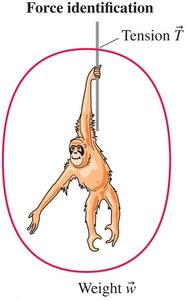
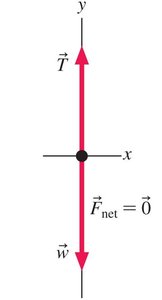
Example: Orangutan Hanging from a Rope
The orangutan is at rest, so the tension in the rope equals its weight.
Forces: upward tension T, downward weight w.
Equilibrium:
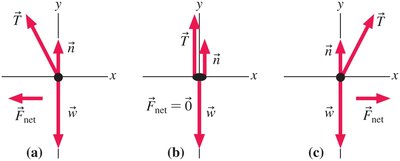
Example: Equilibrium on a Frictionless Surface
Forces must balance in both x and y directions.
Only a vertical string (no horizontal component) can keep a rod at rest on frictionless ice.
Dynamics and Newton’s Second Law
Newton’s Second Law
Newton’s second law relates the net force on an object to its acceleration:
In component form:
To solve dynamics problems:
Identify all forces and draw a free-body diagram.
Write Newton’s second law in components.
Solve for acceleration or unknown forces as needed.
Use kinematics if required to find positions or velocities.
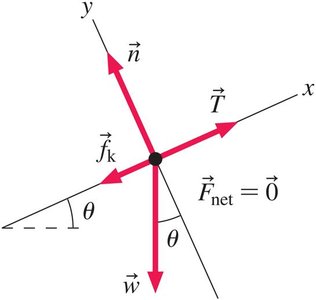
Example: Towing a Car at an Angle
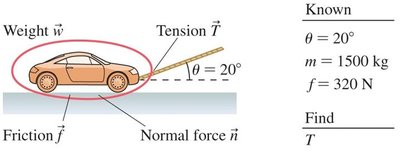
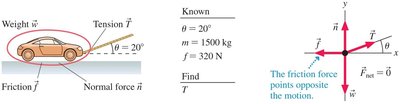
A car is towed at a steady speed by a rope at 20° above the horizontal, with friction opposing motion.
Forces: tension T, friction f, normal force n, weight w.
Equilibrium in x:
Solve for tension:
Mass and Weight
Definitions
Mass (m): A measure of an object’s inertia; does not change with location.
Weight (w): The gravitational force on an object:
Weight varies with gravitational field strength; mass does not.
Apparent Weight
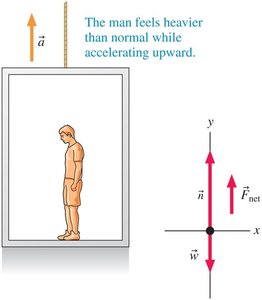
The force you feel (e.g., on a scale) is your apparent weight.
When accelerating upward:
When accelerating downward:
Weightlessness
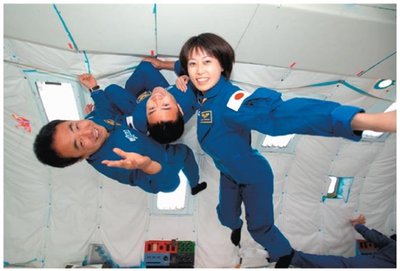
In free fall, apparent weight is zero, but true weight (gravitational force) remains.

Normal Forces
Definition and Properties
The normal force is the perpendicular contact force exerted by a surface.
It adjusts to balance other forces and prevent penetration of the surface.
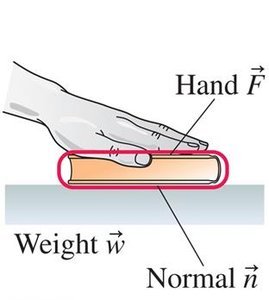
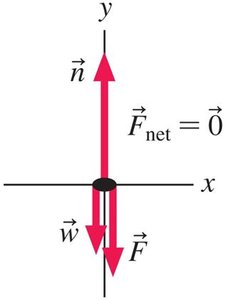
Example: Book Pressed on a Table
Forces: weight, normal force, and downward force from a hand.
Normal force:
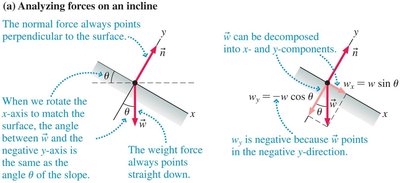
Normal Force on an Incline
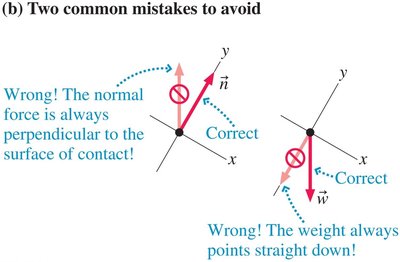
The normal force is always perpendicular to the surface.
On an incline,
Friction
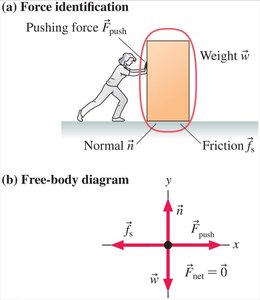
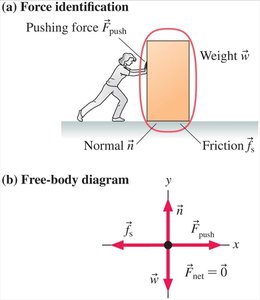
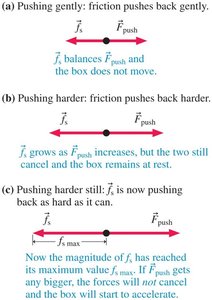
Static Friction
Prevents relative motion between surfaces in contact.
Adjusts up to a maximum value:
Direction opposes impending motion.
Kinetic Friction
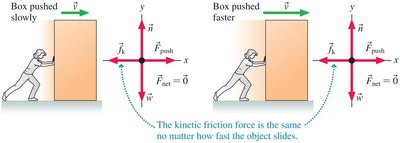
Acts when surfaces slide past each other.
Magnitude:
Direction opposes motion; independent of speed.
Rolling Friction
Occurs when an object rolls over a surface.
Much smaller than kinetic friction:
Coefficients of Friction (Selected Values)
Material | Static (\(\mu_s\)) | Kinetic (\(\mu_k\)) | Rolling (\(\mu_r\)) |
|---|---|---|---|
Rubber on concrete | 1.00 | 0.80 | 0.02 |
Steel on steel (dry) | 0.80 | 0.60 | 0.002 |
Wood on wood | 0.50 | 0.20 | - |
Ice on ice | 0.10 | 0.03 | - |
Drag Forces
Definition and Reynolds Number
Drag force opposes motion through a fluid and increases with speed.
The Reynolds number (Re) distinguishes between inertial and viscous drag:
High Re (>1000): Inertial drag dominates; drag force
Low Re (<1): Viscous drag dominates; drag force
High Reynolds Number Drag
Drag force:
is the drag coefficient, is cross-sectional area, is fluid density.
Terminal Speed
Terminal speed is reached when drag force equals weight:
At terminal speed, acceleration is zero.
Low Reynolds Number Drag (Stokes’ Law)
For small, slow-moving objects:
Applies to microscopic particles in fluids.
Interacting Objects, Ropes, and Pulleys
Newton’s Third Law
For every action, there is an equal and opposite reaction.
Action/reaction pairs act on different objects.
Objects in Contact
Draw separate free-body diagrams for each object.
Write Newton’s second law for each object.
Action/reaction forces have equal magnitude and opposite direction.
Objects in contact have the same acceleration.
Ropes and Pulleys
The tension in a massless rope is the same throughout its length.
For a massless, frictionless pulley, tension is unchanged as the rope passes over it.
Summary Table: Key Forces and Equations
Force | Equation | Direction |
|---|---|---|
Weight | Downward | |
Normal | From Newton’s laws | Perpendicular to surface |
Static friction | Opposes impending motion | |
Kinetic friction | Opposes motion | |
Rolling friction | Opposes motion | |
Drag (high Re) | Opposes motion | |
Drag (low Re) | Opposes motion |
Problem-Solving Strategies
Draw clear free-body diagrams for each object.
Write Newton’s second law in component form.
Identify all forces, including friction, drag, and tension.
Check units and reasonableness of answers.
