 Back
BackApplying Newton’s Laws: Friction, Connected Objects, and Inclined Planes
Study Guide - Smart Notes
 Tailored notes based on your materials, expanded with key definitions, examples, and context.
Chapter 5: Applying Newton’s Laws of Motion
Connected Objects and Force Transmission
Connected objects, such as blocks linked by strings and pulleys, are common in physics problems. Strings transmit pulling forces, while pulleys redirect these forces, allowing for complex systems to be analyzed using Newton's laws.
String: Transmits tension force between objects.
Pulley: Changes the direction of the tension force without altering its magnitude (ideal pulley).
Free-body diagrams: Essential for visualizing all forces acting on each object in the system.
Force Equilibrium: For static systems, the sum of forces in each direction is zero.
Example: A block suspended by three strings requires analysis of tensions and gravity.
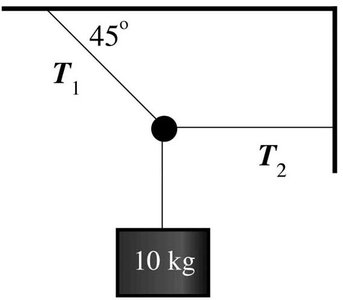
Free-Body Diagrams for Connected Systems
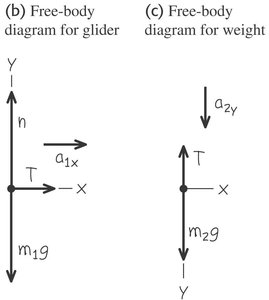
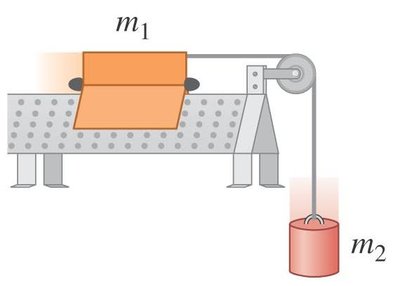
Free-body diagrams help identify all forces acting on each object, including tension, gravity, and normal forces. For a system with a glider and a hanging mass connected by a string and pulley:
Glider: Experiences tension, normal force, and gravity.
Hanging mass: Experiences tension and gravity.
Equations: Newton's second law applies to each object separately.
Frictional Forces
Friction is a force that opposes motion between surfaces in contact. It arises from molecular interactions and is classified into three main types:
Static Friction (\(f_s\)): Prevents relative motion up to a maximum value \(f_{s,\text{max}} = \mu_s N\).
Kinetic Friction (\(f_k\)): Acts when objects slide, given by \(f_k = \mu_k N\).
Rolling Friction (\(f_r\)): Occurs when objects roll, typically much smaller than static or kinetic friction.
Coefficients: \(\mu_s\) (static), \(\mu_k\) (kinetic), \(\mu_r\) (rolling); generally \(\mu_s > \mu_k > \mu_r\).
Formulas:
Static and Kinetic Friction: Conditions and Examples
Static friction adjusts to match the applied force up to its maximum. Once motion begins, kinetic friction takes over and remains constant for a given pair of surfaces.
Static friction: (before slipping)
Kinetic friction: (during sliding)
On the verge of slipping:
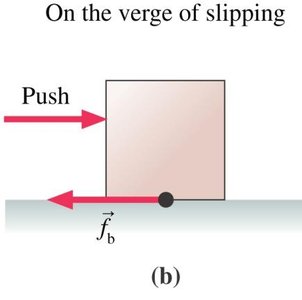
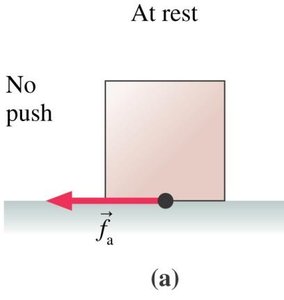
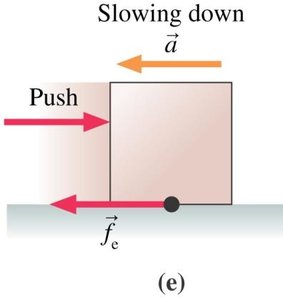
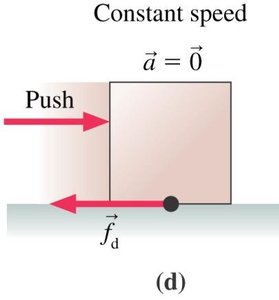
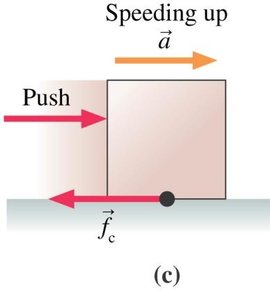
Example: Friction Force Calculation
Consider a crate of mass 50.0 kg at rest on a rough surface with \(\mu_s = 0.40\) and \(\mu_k = 0.20\). If a horizontal force of 150 N is applied:
Normal force:
Maximum static friction:
Since applied force (150 N) < , friction force = 150 N (object remains at rest).
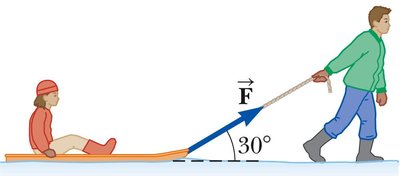
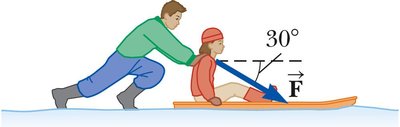
Pulling vs. Pushing a Sled: Effect on Friction
The direction of the applied force affects the normal force and thus the friction. Pulling at an angle reduces the normal force, while pushing increases it.
Pulling: has an upward component, reducing and .
Pushing: has a downward component, increasing and .
Result: Friction is less when pulling than when pushing at the same angle and force.
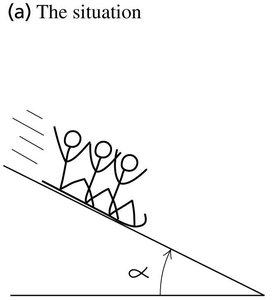
Inclined Planes and Friction
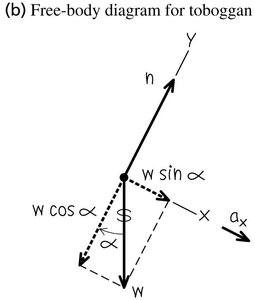
Objects on inclined planes experience forces due to gravity, normal force, and friction. The force of gravity is resolved into components parallel and perpendicular to the incline.
Parallel component:
Perpendicular component:
Normal force:
Kinetic friction:
Net force:
Acceleration:
Complex Systems: Block and Pulley on Inclined Plane
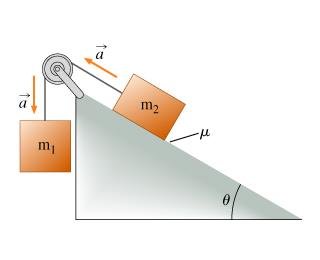
When a block on an inclined plane is connected via a string and pulley to a hanging block, force diagrams and equations must be written for each block. The criterion for motion depends on the balance of forces, including friction.
Block on incline: Gravity, normal force, friction, tension.
Hanging block: Gravity, tension.
Criterion for motion: The tension must overcome friction and the component of gravity along the incline.
Maximum Acceleration Before Slipping
For a block sitting on a slab, the maximum acceleration before slipping is determined by the maximum static friction force:
Maximum static friction:
Maximum acceleration:
Summary Table: Types of Friction
Type | Formula | Condition |
|---|---|---|
Static | Object at rest | |
Kinetic | Object sliding | |
Rolling | Object rolling |
Key Concepts and Applications
Free-body diagrams: Fundamental for analyzing forces in any system.
Friction: Must be considered in all real-world applications involving contact surfaces.
Inclined planes: Require decomposition of forces and careful application of Newton’s laws.
Connected objects: Tension and force transmission are central to understanding their motion.
Additional info: Academic context was added to clarify the derivation of friction formulas, the effect of pulling/pushing angles, and the analysis of complex systems involving pulleys and inclined planes.
