 Back
BackAtomic Structure and Quantum Physics: Foundations and Models
Study Guide - Smart Notes
 Tailored notes based on your materials, expanded with key definitions, examples, and context.
Atomic Structure
Microscopic Evidence for Atomic Structure
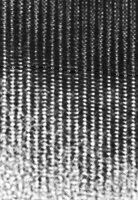
Modern electron microscopes provide direct visual evidence of atomic structure by revealing the arrangement of atoms and the spaces between them. For example, high-resolution images of mica show the positions of potassium atoms and the tunnels between silicon-oxygen tetrahedrons, confirming the particulate nature of matter.
Historical Development of Atomic Theory
The concept of the atom has evolved from philosophical ideas to scientific theory:
Early Greeks: Believed all matter was composed of four elements: earth, air, fire, and water.
Democritus and Leucippus: Proposed that matter is discontinuous and made of indivisible particles called atoms.
Robert Boyle (1661): Defined an element as a substance that cannot be broken down into simpler substances, supporting the idea of discrete particles.
Law of Definite Proportions and Atomic Mass
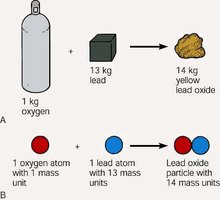
Elements combine in fixed ratios by mass, supporting the atomic theory. For example, lead and oxygen combine in a 13:1 mass ratio to form lead oxide, implying that a lead atom is 13 times more massive than an oxygen atom.
Discovery of Subatomic Particles
Discovery of the Electron
J.J. Thomson's cathode ray experiments (1897) demonstrated the existence of negatively charged particles (electrons). Cathode rays were deflected by electric and magnetic fields, indicating they were not light but particles with negative charge.
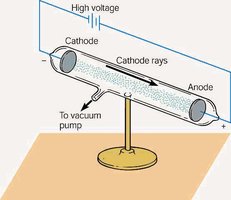

Cathode Ray: A stream of electrons moving from the negative cathode to the positive anode in a vacuum tube.
Key Properties: Deflected by electric and magnetic fields, attracted to positive plates, and repelled by negative plates.
Measurement of Electron Charge
Robert Millikan (1906) measured the charge of the electron using the oil drop experiment. He found that the smallest charge on any oil droplet was coulombs, and larger charges were integer multiples of this value.
Oil Drop Experiment: Balanced gravitational and electric forces on tiny oil droplets to determine the fundamental unit of electric charge.
The Nucleus and Atomic Structure
Ernest Rutherford's gold foil experiment revealed that atoms have a small, dense, positively charged nucleus surrounded by electrons. Most of the atom's mass is in the nucleus, while most of its volume is empty space.
Nucleus Radius: About cm
Atom Radius: About cm
Volume Ratio: The atom is about 100,000 times larger in radius than the nucleus, similar to the ratio of a dime to a football field.

Quantum Concepts and Atomic Models
The Quantum Concept
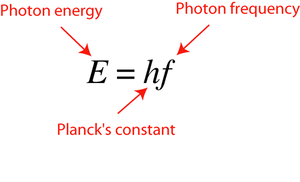
Max Planck (1900) introduced the idea that energy is emitted or absorbed in discrete units called quanta. Albert Einstein (1905) extended this to light, proposing that light consists of particles called photons. The energy of a photon is proportional to its frequency:
= energy of the photon
= Planck's constant
= frequency of the photon
Atomic Spectra
Atoms emit and absorb light at specific frequencies, producing characteristic spectra:
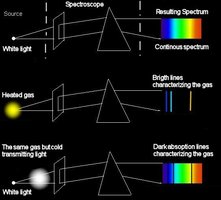
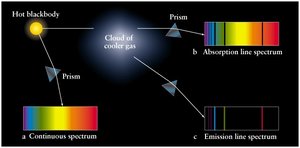
Continuous Spectrum: Produced by solids, liquids, or dense gases; contains all visible wavelengths.
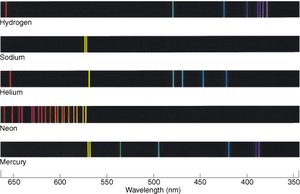
Emission Spectrum: Produced by excited gases; shows bright lines at specific wavelengths unique to each element.
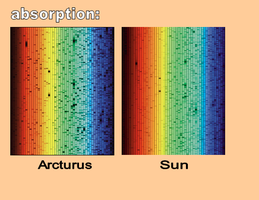
Absorption Spectrum: Produced when a cold gas absorbs certain wavelengths from white light, resulting in dark lines.
Examples of Emission Spectra
Excited gases such as neon (in signs) and atmospheric gases (in auroras) produce characteristic emission spectra.


Line Spectra of Elements
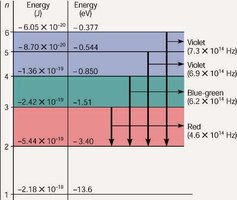
Each element has a unique emission spectrum, which can be used to identify it. For example, hydrogen emits lines in the ultraviolet, visible, and infrared regions, with visible lines in the red, blue-green, and violet regions.
Bohr Model of the Atom
Bohr's Postulates
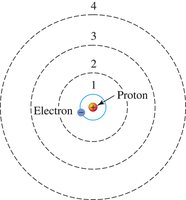
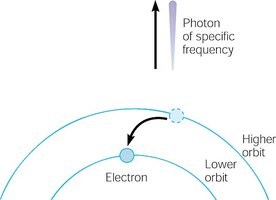
Niels Bohr proposed a model in which electrons orbit the nucleus in specific, allowed orbits without radiating energy. Electrons can only gain or lose energy by jumping between these orbits, emitting or absorbing photons of specific energy (quantum leaps).
Ground State: The lowest energy state of an electron.
Excited State: Any higher energy state above the ground state.
Energy Levels in Hydrogen
The energy levels of the hydrogen atom are quantized. When an electron transitions from a higher to a lower energy level, it emits a photon with energy equal to the difference between the two levels. The color and frequency of the emitted photon correspond to the energy difference.
Fluorescence and Quantum Leaps
In devices like fluorescent lamps, electrons in mercury atoms are excited by electric current, then drop to lower energy levels, emitting ultraviolet photons. These photons excite a fluorescent coating, which emits visible light.

Quantum Mechanics and Wave-Particle Duality
Wave-Particle Duality
Quantum mechanics describes both light and matter as having dual wave-particle nature. Louis de Broglie proposed that particles such as electrons have wavelengths given by:
= wavelength
= Planck's constant
= mass of the particle
= velocity of the particle
Allowed and Forbidden Orbits
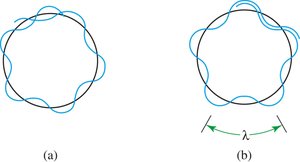
Only orbits where the electron's wavelength fits exactly into the circumference are allowed (standing waves). Orbits that do not satisfy this condition are forbidden.
Schrödinger's Wave Mechanics
Erwin Schrödinger developed a mathematical model describing electrons as wavefunctions. The probability of finding an electron in a particular region is given by the square of the wavefunction's amplitude. This leads to the concept of orbitals—regions where electrons are likely to be found.
Quantum Numbers and the Pauli Exclusion Principle
Quantum mechanics uses four quantum numbers to describe the state of an electron:
Principal quantum number (n): Energy level (distance from nucleus)
Angular momentum quantum number (l): Sublevel (s, p, d, f, ...)
Magnetic quantum number (m): Orientation of the orbital
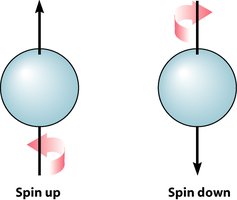
Spin quantum number (s): Direction of electron spin
The Pauli Exclusion Principle states that no two electrons in an atom can have the same set of quantum numbers.
Atomic Orbitals
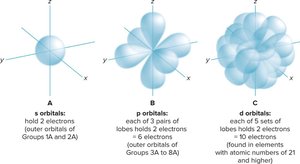
Electrons occupy orbitals with specific shapes and capacities:
s orbitals: Spherical, hold 2 electrons
p orbitals: Dumbbell-shaped, 3 pairs (6 electrons)
d orbitals: More complex shapes, 5 sets (10 electrons)
Periodic Table and Chemical Properties
Electron Configuration and Chemical Properties
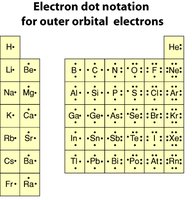
The arrangement of electrons in atomic orbitals determines the chemical properties of elements. The periodic table organizes elements by their electron configurations:
Rows (Periods): Correspond to principal energy levels
Columns (Groups/Families): Elements with similar outer electron configurations and chemical properties

Metals, Nonmetals, and Semiconductors
Elements are classified based on their tendency to lose or gain electrons:
Metals: 1-3 outer electrons, tend to lose electrons and form positive ions
Nonmetals: 5-7 outer electrons, tend to gain electrons and form negative ions
Noble Gases: Filled outer shells, chemically inert
Semiconductors: Properties intermediate between metals and nonmetals

Wave-Particle Duality and Quantum Experiments
Double-Slit Experiment
The double-slit experiment demonstrates the wave-particle duality of electrons and photons. Particles passing through two slits produce an interference pattern, a hallmark of wave behavior. Increasing the number of slits changes the pattern, sometimes resulting in less light at certain points due to destructive interference.

Technological Applications
Modern technology, such as the scanning tunneling microscope, allows for the manipulation and imaging of individual atoms, demonstrating the practical impact of quantum physics.
