 Back
BackCalorimetry: Principles, Types, and Applications
Study Guide - Smart Notes
 Tailored notes based on your materials, expanded with key definitions, examples, and context.
Calorimetry
Introduction to Calorimetry
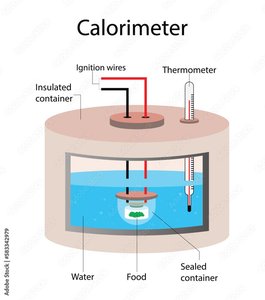
Calorimetry is the science of measuring heat exchange between a system and its surroundings, allowing calculation of energy changes during physical and chemical processes. The term is derived from Latin calor (heat) and Greek metron (measure), meaning "measuring heat." Calorimetry is essential for determining thermochemical quantities such as enthalpy, heat capacity, and stability, and is widely used in both scientific research and practical applications.
Definition: Calorimetry measures the heat produced or absorbed during a chemical reaction.
Applications: Used to determine whether a reaction is exothermic (releases heat) or endothermic (absorbs heat).
Daily Impact: Regulates human metabolic rates and helps maintain body temperature.
Principle of Calorimetry
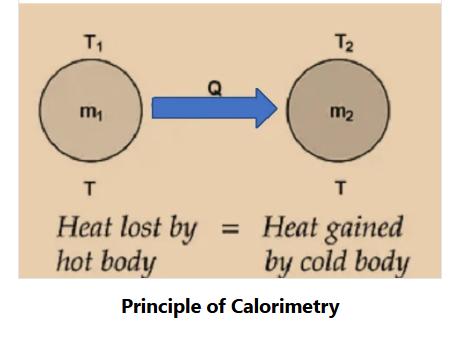
The principle of calorimetry is based on the conservation of thermal energy: when a hot body and a cold body are combined, the heat lost by the hot body equals the heat gained by the cold body. This exchange continues until thermal equilibrium is reached.
Heat Transfer Formula: where:
= heat transfer (J)
= mass (kg or g)
= specific heat capacity (J/kg·K or J/g·°C)
= change in temperature (K or °C)
Mixing Two Substances: If two substances with masses and , specific heats and , and initial temperatures and () are mixed, the equilibrium temperature is found using:
Assumptions in Calorimetry
No heat transfer between the calorimeter and the surroundings.
No heat absorbed or released by calorimeter materials.
Pure water is assumed to have the same density and specific heat capacity as dilute aqueous solutions.
Types of Calorimetry
Direct Calorimetry
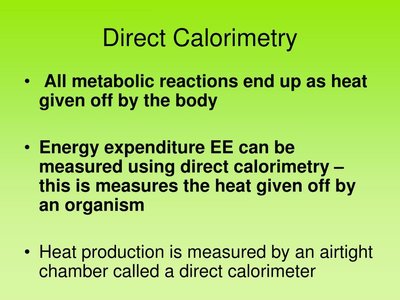
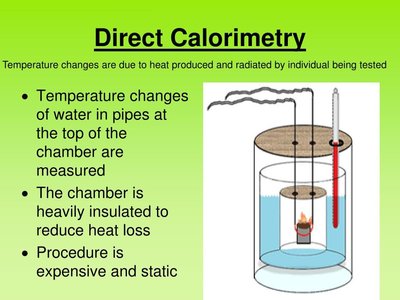
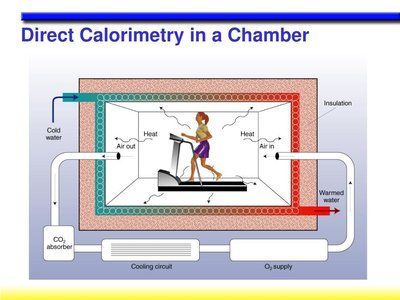
Direct calorimetry measures the heat change of a chemical reaction by directly observing the temperature change it causes. It is commonly used to measure metabolic heat production in organisms.
Measurement: Heat production is measured in an airtight chamber.
Applications: Used for energy expenditure studies and metabolic rate determination.
Indirect Calorimetry
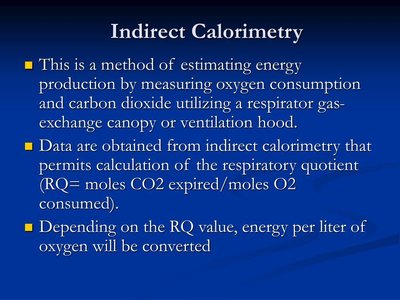
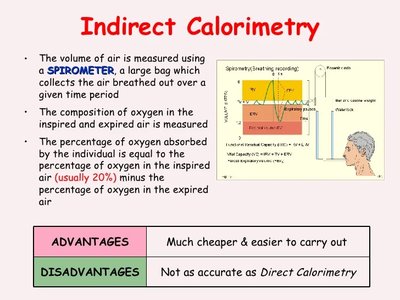
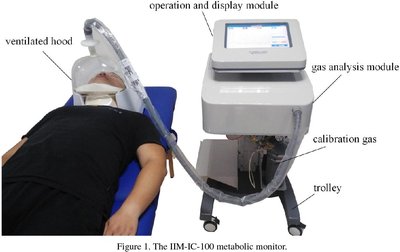
Indirect calorimetry estimates energy production by measuring oxygen consumption and carbon dioxide production. It is often used in biological and medical studies.
Measurement: Uses a gas-exchange canopy or ventilated hood to monitor respiratory gases.
Respiratory Quotient (RQ):
Advantages: Cheaper and easier to carry out than direct calorimetry.
Disadvantages: Less accurate than direct calorimetry.
Differential Scanning Calorimetry (DSC)
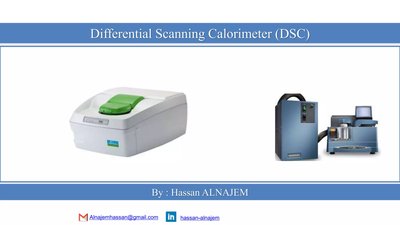
Differential scanning calorimetry is a technique for determining the energy required to raise the temperature of a sample and a reference by the same amount. It is widely used in biology and materials science to study heat transfer in organisms and materials.
Applications: Used to determine specific heat capacity, melting temperature, and denaturation temperature of proteins and polymers.
Applications of Calorimetry
Calculating enthalpy changes during reactions.
Investigating thermal properties of drugs, biological molecules, and polymers.
Determining calorie content of foods in food laboratories.
Characterizing fuels, metals, and oils.
Calculating Enthalpy Change Using Calorimetry
Polystyrene Cup Calorimeter
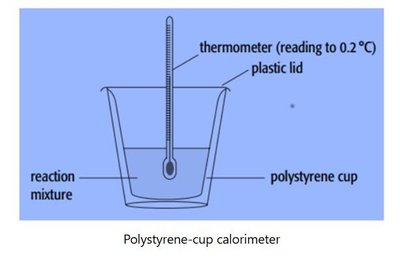
A polystyrene cup can serve as a simple calorimeter for determining enthalpy changes in solution reactions. Known amounts of reactants and liquids are used, and temperature changes are tracked.
Formula: where:
= enthalpy change (J)
= mass of water (g)
= specific heat capacity (J g–1 °C–1)
= temperature change (°C)
Procedure:
Weigh empty polystyrene cup.
Add 100 cm3 water and weigh again.
Measure initial temperature.
Add solute (e.g., sodium hydroxide pellets).
Stir and record temperature at intervals.
Continue recording after maximum temperature is reached.
Weigh cup and contents to determine solute mass.
Combustion Calorimetry
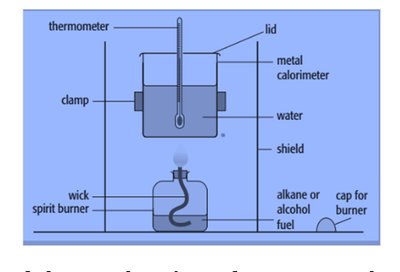
Enthalpy change of combustion is determined by burning a known mass of material and using the heat generated to raise the temperature of a known mass of water. A metal calorimeter and spirit burner are used.
Formula:
Procedure:
Weigh spirit burner with fuel.
Add 100 cm3 water to calorimeter.
Measure initial temperature.
Light burner and heat water until temperature rises by 10°C.
Reweigh burner after heating.
Calculate energy released using mass of water, specific heat, and temperature change.
Limitations of Calorimetry
Heat loss to the environment can affect accuracy.
Assumptions about solution properties may not always hold.
Incomplete reactions or heat absorption by apparatus can introduce errors.
Evaporation of fuel may occur during combustion experiments.
Worked Examples
Example 1: Calorimetry with a Phase Change
500 mL soda at 20°C is mixed with 100 g ice at –20°C. Does all the ice melt? If so, what is the final temperature?
Calculations:
Ice warming:
Soda cooling:
If , all ice melts and .
Final temperature found by solving: K
Example 2: Three Interacting Systems
200 g iron at 120°C, 150 g copper at –50°C, and 300 g ethyl alcohol at 20°C are mixed. What is the final temperature?
Calculations:
Exercises
30 g copper pellets at 300°C dropped into 100 mL water at 20°C. Find new water temperature.
750 g aluminum pan plunged into 10.0 L water at 20.0°C, water rises to 24.0°C. Find initial pan temperature in °C and °F.
40 g thermometer (specific heat 750 J/kg·K) measures 150 mL water. Reads 22.0°C, stabilizes at 70.5°C. Find actual water temperature before measurement.
450 g metal sphere at 250°C dropped into 330 cm3 mercury at 24°C, stabilizes at 95.0°C. Identify the metal.
55 cm3 iron block at 850°C dropped into 240 mL water at 25°C. What fraction of water boils away?
Summary Table: Types of Calorimetry
Type | Principle | Applications | Advantages | Limitations |
|---|---|---|---|---|
Direct Calorimetry | Measures heat directly via temperature change | Metabolic studies, reaction enthalpy | Accurate | Expensive, static |
Indirect Calorimetry | Estimates heat via gas exchange (O2, CO2) | Biological, medical studies | Cheaper, easier | Less accurate |
Differential Scanning Calorimetry | Compares sample and reference heating | Material science, biology | Precise for small samples | Specialized equipment |
Additional info: Academic context and formulas have been expanded for clarity and completeness.
