 Back
BackCapacitance and Dielectrics: Structured Study Notes
Study Guide - Smart Notes
 Tailored notes based on your materials, expanded with key definitions, examples, and context.
Capacitance and Dielectrics
Introduction to Capacitors
Capacitors are fundamental components in electrical circuits, used to store electric potential energy. They consist of two conductors separated by an insulator (dielectric). The ability of a capacitor to store charge is quantified by its capacitance.
Capacitance (C): Defined as , where Q is the charge stored and is the potential difference between the plates.
Energy Storage: The energy is stored in the electric field between the plates.
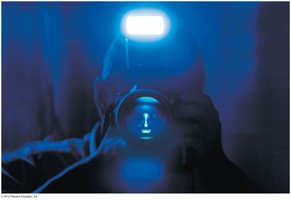
Applications: Capacitors are used in devices such as condenser microphones and camera flashes.

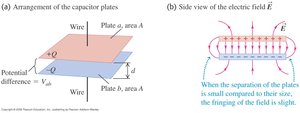
Parallel-Plate Capacitor
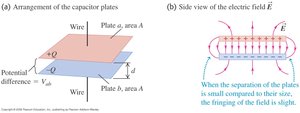
A parallel-plate capacitor consists of two parallel conducting plates separated by a small distance. The capacitance depends on the area of the plates and the separation between them.
Capacitance Formula: , where is the permittivity of free space, A is the plate area, and d is the separation.
Electric Field: , where is the surface charge density.
Potential Difference:
Spherical Capacitor
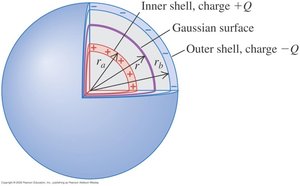
Spherical capacitors consist of two concentric spherical conducting shells separated by a vacuum or dielectric.
Capacitance Calculation: For radii and , the capacitance is .
Capacitor Networks: Series and Parallel
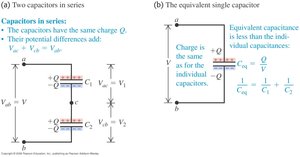
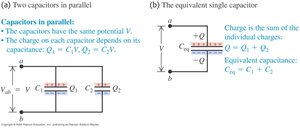
Capacitors can be combined in series or parallel to achieve desired capacitance values.
Series Combination:
Parallel Combination:
Charge and Voltage: In series, charge is the same on all capacitors; in parallel, voltage is the same across all capacitors.
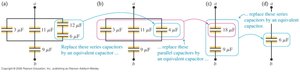
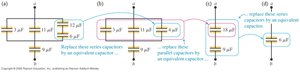
Example: Five-Capacitor Network
To find the equivalent capacitance, reduce the network stepwise using series and parallel rules.
Energy Stored in a Capacitor
The energy stored in a capacitor is a function of the charge, voltage, and capacitance.
Potential Energy:
Energy Density: The energy per unit volume in the electric field is
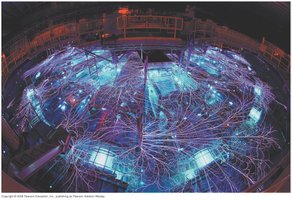
Example: Z Machine
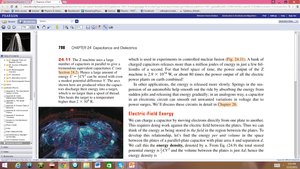
The Z machine uses capacitors in parallel to generate extremely high power for research in nuclear fusion and material science.
Dielectrics and Capacitance
Dielectrics are nonconducting materials placed between capacitor plates to increase capacitance.
Dielectric Constant (K): , where is the capacitance without dielectric.
Effect on Capacitance: Capacitance increases by a factor of K.
Effect on Electric Field: , where is the field without dielectric.
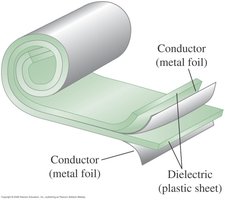
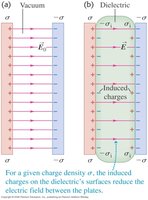
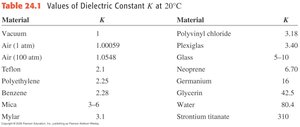
Table: Dielectric Constants
Dielectric constants vary by material and affect the capacitance of capacitors.
Material | K |
|---|---|
Vacuum | 1 |
Air (1 atm) | 1.00059 |
Teflon | 2.1 |
Polyethylene | 2.25 |
Water | 80.4 |
Strontium titanate | 310 |
Molecular Model of Dielectrics
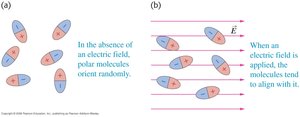
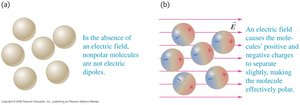
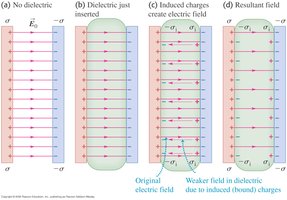
Dielectrics respond to electric fields by polarizing, which reduces the effective field between capacitor plates.
Polar Molecules: Align with the field, increasing capacitance.
Nonpolar Molecules: Become effectively polar in an electric field.
Induced Charge and Polarization
Induced charges on the dielectric surfaces reduce the magnitude of the resultant electric field.
Dielectric Breakdown
If the electric field exceeds a material's dielectric strength, the dielectric becomes conductive, leading to breakdown.
Dielectric Strength: Maximum field a material can withstand before breakdown.
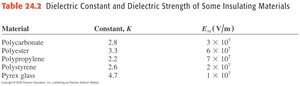
Table: Dielectric Strengths
Material | Constant, K | Dielectric Strength (V/m) |
|---|---|---|
Polycarbonate | 2.8 | |
Polyester | 3.3 | |
Polypropylene | 2.2 | |
Polystyrene | 2.6 | |
Pyrex glass | 4.7 |
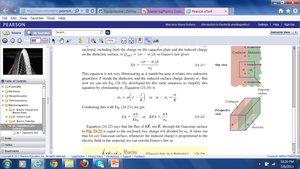
Gauss's Law in Dielectrics
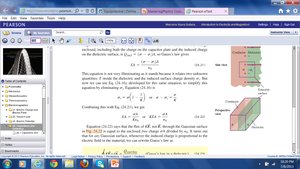
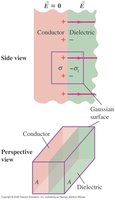
Gauss's law is modified in the presence of dielectrics, accounting for the reduced electric field and induced charges.
Modified Field:
Flux:
Summary Table: Capacitance Formulas
Capacitor Type | Capacitance Formula |
|---|---|
Parallel-Plate | |
Spherical | |
Cylindrical |
Key Concepts and Applications
Capacitors store energy in electric fields.
Dielectrics increase capacitance and reduce electric field strength.
Capacitor networks can be analyzed using series and parallel rules.
Dielectric breakdown limits the maximum voltage a capacitor can withstand.
Example Applications
Camera flashes use capacitors to store and release energy rapidly.
Condenser microphones rely on variable capacitance to convert sound to electrical signals.
Touch screen panels utilize capacitors in series for sensing.

Additional info:
Some formulas and explanations were expanded for clarity and completeness.
Tables were recreated based on the provided data and standard physics references.
