 Back
BackChapter 13: Liquids – Pressure, Buoyancy, and Surface Phenomena
Study Guide - Smart Notes
 Tailored notes based on your materials, expanded with key definitions, examples, and context.
Liquids: Properties and Principles
Pressure
Pressure is a fundamental concept in fluid mechanics, defined as the force exerted per unit area. It is crucial in understanding how liquids interact with objects and surfaces.
Definition: Pressure () is given by , where is force and is area.
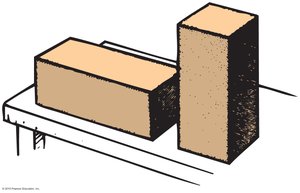
Key Point: For the same mass, a smaller area results in higher pressure.
Example: A brick standing on its end exerts more pressure than when lying flat, due to the smaller contact area.
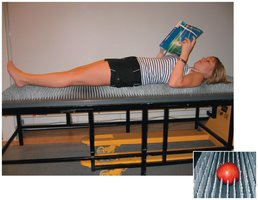
Application: A person lying on a bed of nails is unharmed because the force is distributed over many nails, reducing the pressure on each nail.
Pressure in a Liquid
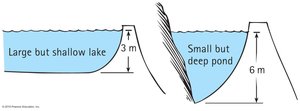
Pressure in a liquid depends on depth, not volume. The deeper you go, the greater the pressure due to the weight of the liquid above.
Formula: , where is the density of the liquid, is acceleration due to gravity, and is depth.
Key Point: Pressure increases with depth, regardless of the total volume of liquid.
Example: A small but deep pond exerts more pressure at the bottom than a large but shallow lake.
Pressure acts equally in all directions: This is why your ears feel the same pressure underwater, regardless of orientation.
Demonstration: Water levels in connected tubes are equal, showing pressure is transmitted throughout the liquid.
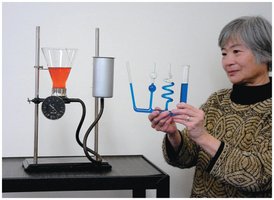
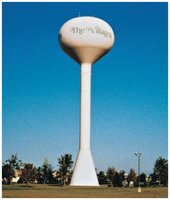
Water towers: The pressure provided by a water tower depends on its height, not the amount of water it holds.
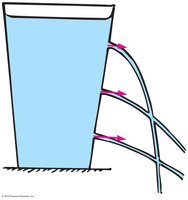
Effects of water pressure: Liquid spurts at right angles from holes in a container, and the speed increases with depth.
Buoyancy in a Liquid
Buoyancy is the apparent loss of weight of a submerged object, caused by the upward force exerted by the liquid.
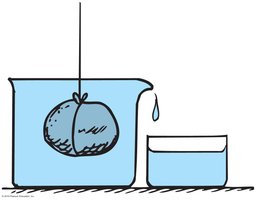
Displacement Rule: A completely submerged object displaces a volume of liquid equal to its own volume.
Example: Placing a stone in a brimful container causes water to overflow equal to the stone's volume.
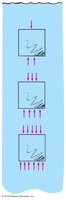
Buoyant Force: The net upward force equals the weight of the liquid displaced.
Formula:
Example: The difference in upward and downward forces on a submerged block is constant at any depth.
Archimedes' Principle
Archimedes' Principle states that an immersed body is buoyed up by a force equal to the weight of the fluid it displaces. This principle applies to both liquids and gases.
Formula:
Apparent Weight: The apparent weight of a submerged object is its weight out of water minus the buoyant force.
Example: A 3-kg block submerged in water appears to weigh 1 kg; the buoyant force is 2 kg.
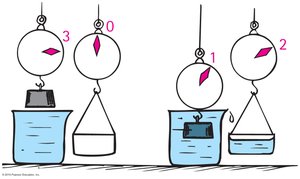
Sink or Float: Density and Buoyancy
Whether an object sinks or floats depends on its density relative to the fluid and the volume of fluid displaced.
Rules:
An object more dense than the fluid sinks.
An object less dense than the fluid floats.
An object with equal density neither sinks nor floats.
Principle of Flotation: A floating object displaces a weight of fluid equal to its own weight.
Example: A solid iron block sinks, but shaped as a bowl, it floats by displacing more water.
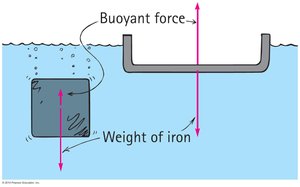
Flotation and Real-World Applications
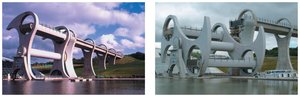
Flotation is illustrated in practical scenarios, such as the Falkirk Wheel, which uses the principle that caissons full of water weigh the same whether or not they contain boats.
Example: The weight of a floating object equals the weight of water displaced.
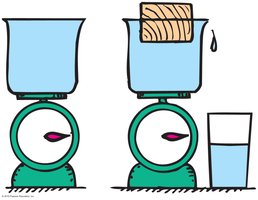
Buoyancy in Air
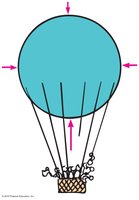
Archimedes' Principle also applies to gases. The more air an object displaces, the greater the buoyant force.
Example: A hot air balloon rises when it displaces a weight of air equal to its own weight.
Pascal's Principle
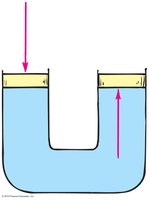
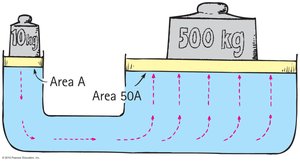
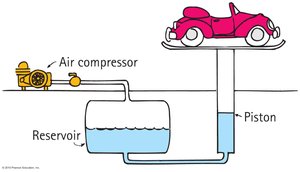
Pascal's Principle states that a change in pressure at any point in an enclosed fluid is transmitted undiminished to all points in the fluid. This principle is the basis for hydraulic systems.
Formula: (Pressure change is transmitted throughout the fluid)
Application: Hydraulic presses and auto lifts use this principle to multiply force.
Example: A small force applied to a small piston can lift a much larger load on a larger piston.
Surface Tension
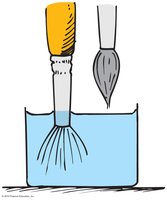
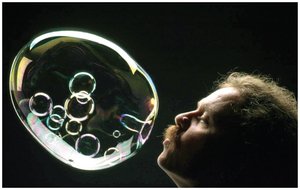
Surface tension is the contractive tendency of the surface of liquids, caused by molecular attractions. It explains why drops and bubbles are spherical and why certain objects can float on water.
Examples:
Paintbrush hairs stick together when removed from water.
Bubbles and drops form spheres due to surface tension.
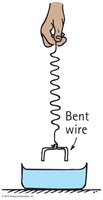
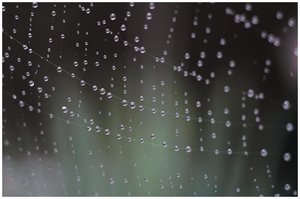
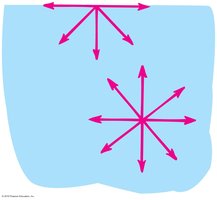
Molecular Explanation: Molecules at the surface are pulled inward, creating tension.
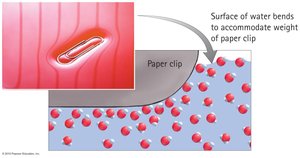
Factors Affecting Surface Tension:
Type of liquid (water has higher surface tension than oil)
Presence of solutes (soapy water has lower surface tension)
Temperature (hot liquids have lower surface tension)
Capillarity
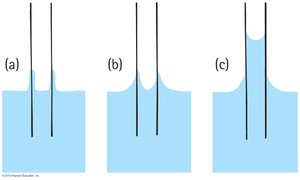
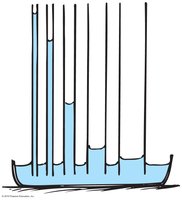
Capillarity is the rise of a liquid in a narrow tube or space, caused by adhesion and surface tension. It is important in biological and practical systems.
Explanation: Adhesion draws liquid into the tube, and surface tension contracts the surface, raising the liquid.
Factors:
The lighter the liquid, the higher the rise.
The narrower the tube, the higher the rise.
Examples: Oil rises in a wick, hair gets wet in a bathtub, insects struggle to escape water.
Summary Table: Key Properties of Liquids
Property | Definition | Formula | Example/Application |
|---|---|---|---|
Pressure | Force per unit area | Standing on one foot increases pressure | |
Liquid Pressure | Pressure due to depth | Water tower pressure depends on height | |
Buoyancy | Upward force on submerged object | Floating and sinking objects | |
Archimedes' Principle | Buoyant force equals weight of displaced fluid | Ships float by displacing water | |
Pascal's Principle | Pressure change transmitted undiminished | Hydraulic lifts | |
Surface Tension | Contractive tendency of liquid surface | N/A | Bubbles, drops, floating paper clip |
Capillarity | Rise of liquid in narrow tube | N/A | Oil in wick, water in plant stems |
Additional info: Academic context and examples have been expanded for clarity and completeness.
