Back
BackChapter 14: Gases – Physics Study Notes
Study Guide - Smart Notes
 Tailored notes based on your materials, expanded with key definitions, examples, and context.
Gases
The Atmosphere
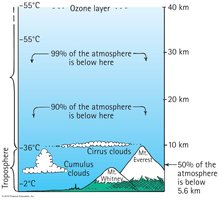
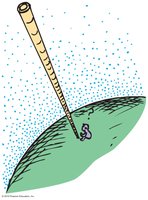
The Earth's atmosphere is an ocean of air that exerts pressure on everything at its surface. The density of the atmosphere decreases with altitude, meaning most of the atmospheric mass is concentrated near the ground.
Atmosphere: The layer of gases surrounding Earth, primarily composed of nitrogen and oxygen.
Pressure: The force exerted per unit area by the weight of air above.
Density: Decreases with altitude; 50% of the atmosphere is below 5.6 km, 90% below 20 km, and 99% below 30 km.
Temperature: Varies with altitude, affecting atmospheric layers.
Atmospheric Pressure
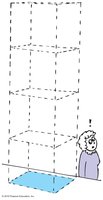
Atmospheric pressure is caused by the weight of air pressing down from above. It is not uniform and varies with location and altitude. Atmospheric pressure is crucial for weather prediction and everyday phenomena.
Standard atmospheric pressure at sea level: 101 kPa (kilopascals) or approximately .
Pressure at sea level: The weight of air pressing down on 1 m2 is about 100,000 N.
Pressure equivalence: The pressure at the bottom of a column of air is equal to the pressure at the bottom of a 10.3 m column of water.
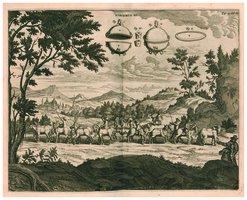
Atmospheric pressure demonstration: The Magdeburg hemispheres experiment showed the strength of atmospheric pressure.
The Barometer
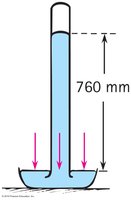
A barometer is a device used to measure atmospheric pressure. The most common type is the mercury barometer, which uses a column of mercury to indicate pressure. The height of the mercury column is proportional to atmospheric pressure.
Mercury barometer: Consists of a mercury-filled tube inverted in a dish of mercury.
Principle: Atmospheric pressure supports the mercury column; the height (typically 760 mm) indicates pressure.
Density of mercury: .
Water barometer: Would need to be 13.6 times taller than a mercury barometer (about 10.3 m), making it impractical.
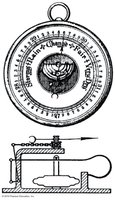
Aneroid barometer: Uses a flexible metal box; changes in atmospheric pressure bend the lid, which is indicated on a scale. Also used as an altimeter.
Boyle's Law
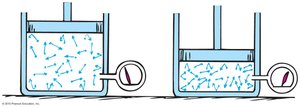
Boyle's Law describes the relationship between the pressure and volume of a gas at constant temperature. It states that pressure and volume are inversely proportional: as one increases, the other decreases.
Mathematical expression:
Example: If the volume of a gas is tripled, its pressure becomes one-third of the original value.
Applications: Used in understanding gas behavior in pumps, syringes, and breathing.
Buoyancy in Air
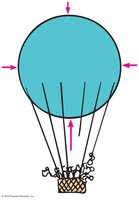
Archimedes' principle applies to gases as well as liquids. An object in air is buoyed up by a force equal to the weight of the air it displaces. This principle explains why balloons and other lighter-than-air objects rise.
Buoyant force: Equal to the weight of displaced air.
Conditions:
If displaced air's weight > object's weight, it rises.
If displaced air's weight = object's weight, it hovers.
If displaced air's weight < object's weight, it sinks.
Gas-filled balloons: Use hydrogen (best buoyancy, but flammable), helium (safer), or heated air.
Ascent limit: Balloon rises until the weight of displaced air equals the total weight of the balloon.
Bernoulli's Principle
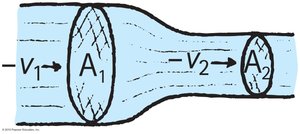
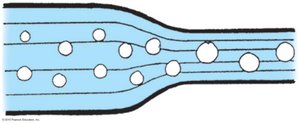
Bernoulli's Principle states that in a fluid flow, where the speed increases, the internal pressure decreases. This principle applies to smooth, steady (laminar) flows and has many practical applications.
Mathematical expression:
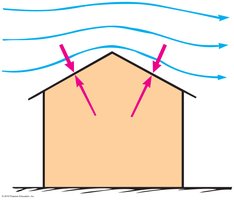
Streamlines: Represent fluid motion; closer streamlines indicate higher speed and lower pressure.
Laminar flow: Smooth, steady flow.
Turbulent flow: Chaotic flow at high speeds.
Applications:
Paper rises when air is blown over it.
Convertible car roof puffs upward.
Wind can lift a house roof.
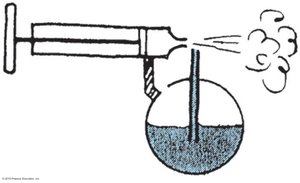
Perfume atomizer uses pressure difference to draw liquid.
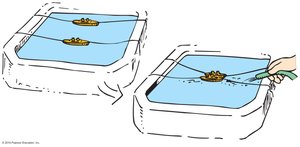
Trucks and ships are drawn together due to reduced pressure between them.

Plasma
Plasma is the fourth state of matter, consisting of ionized gas with free electrons. It is rare on Earth but abundant in stars and certain atmospheric phenomena.
Definition: Electrified gas with ionized atoms and free electrons.
Occurrence: Sun, stars, auroras, fluorescent lamps, neon signs, plasma TVs.
Plasma lamps: High voltage ionizes gas, forming plasma that conducts electricity and emits light.
Plasma TVs: Use cells containing different gases; electric currents create plasma, emitting ultraviolet light that stimulates phosphors to produce visible colors.
Plasma power: High-temperature plasma in jet engine exhaust can generate electricity via Magneto Hydro Dynamic (MHD) power.