 Back
BackChapter 15: Temperature, Heat, and Expansion – Study Notes
Study Guide - Smart Notes
 Tailored notes based on your materials, expanded with key definitions, examples, and context.
Temperature, Heat, and Expansion
Introduction
This chapter explores the fundamental concepts of temperature, heat, specific heat capacity, and thermal expansion. Understanding these topics is essential for analyzing thermal phenomena in physics and their applications in everyday life and engineering.
Temperature
Definition and Measurement
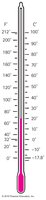
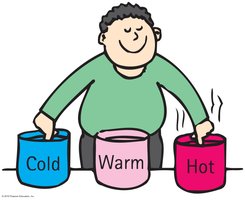
Temperature is a numerical measure that corresponds to the warmth or coldness of an object. It is a per-particle property and is measured using thermometers. There is no upper limit to temperature, but there is a definite lower limit (absolute zero).
Thermometer: Measures temperature by the expansion or contraction of a liquid (e.g., mercury or colored alcohol).
Reading is taken when thermal equilibrium is reached between the thermometer and the object.
Infrared thermometers sense IR radiation to measure temperature without contact.
Temperature and Kinetic Energy
Temperature is proportional to the average translational kinetic energy per particle in a substance:
Gases: Related to how fast particles bounce to and fro.
Liquids: Related to how fast particles slide and jiggle past one another.
Solids: Related to how fast particles vibrate and jiggle in place.
Thermal Equilibrium
Thermal equilibrium is achieved when two objects in contact reach the same average kinetic energy per particle, resulting in no net heat flow between them.
Key Concept Check
Doubling the amount of boiling water doubles the total molecular kinetic energy, but the temperature (average kinetic energy per particle) remains the same.
Higher temperature means higher kinetic energy per particle, not necessarily more internal energy or mass.
Heat
Definition and Direction of Flow
Heat is the internal energy transferred from one object to another due to a temperature difference. It is energy in transit, always flowing from a higher-temperature substance to a lower-temperature substance until thermal equilibrium is reached. Heat never flows unassisted from cold to hot.
Units of Heat
Joule (J): SI unit of energy.
Calorie (cal): Amount of heat needed to raise the temperature of 1 gram of water by 1°C.
Conversion:
Calorie (food label): Actually a kilocalorie (kcal), the heat needed to raise 1 kg of water by 1°C.

Heat and Temperature Change
Adding the same quantity of heat to different masses of water results in a greater temperature increase for the smaller mass.
Example: Heating a half-cup of tea raises its temperature more than heating a full cup with the same amount of heat.
Specific Heat Capacity
Definition
Specific heat capacity is the quantity of heat required to change the temperature of a unit mass of a substance by 1°C. It is a measure of a substance's resistance to temperature change (thermal inertia).
Formula: Where is heat added, is mass, is specific heat capacity, and is temperature change.
Comparison of Substances
Different substances require different amounts of heat for the same temperature change.
Water has a much higher specific heat capacity than metals like iron or silver.
Example: 1 g of water requires 1 cal to raise its temperature by 1°C, while 1 g of iron requires only 1/8 as much energy.
Importance of Water's High Specific Heat
Water can absorb or release large amounts of heat with little temperature change.
This property moderates Earth's climate and stabilizes temperatures in organisms and environments.
Energy absorbed by water increases molecular motion (raising temperature) and internal vibration/rotation (potential energy, not raising temperature).
Specific Heat and Climate
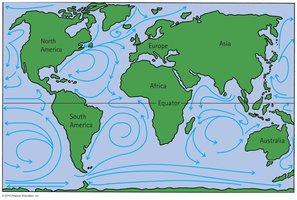
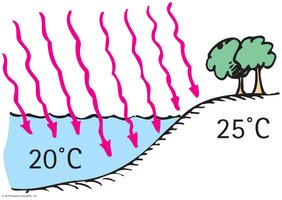
Oceans and large bodies of water moderate climate due to their high specific heat capacity.
Warm ocean currents transfer energy to the atmosphere, affecting weather patterns.
Thermal Expansion
General Principle
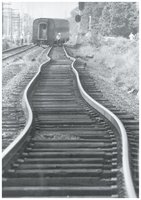
Thermal expansion is the increase in size of a substance when its temperature rises, due to faster molecular motion and increased spacing between molecules. Most substances expand when heated and contract when cooled.
Examples: Railroad tracks can buckle in summer due to expansion; metal lids loosen on jars when heated.
Engineering Applications
Expansion joints in bridges and gaps in sidewalks accommodate expansion and contraction.
Reinforcing steel in concrete is chosen to match the expansion rate of concrete.
Bimetallic Strips
Bimetallic strips, made of two metals with different expansion rates (e.g., brass and iron), bend when heated or cooled. This property is used in thermostats and temperature-regulating devices.

Expansion in Liquids and Gases
Liquids generally expand more than solids when heated.
Example: Gasoline may overflow from a car's tank on a hot day due to expansion.
Expansion of Water and Ice
Water exhibits unusual expansion behavior:
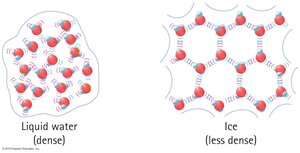
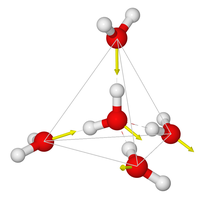
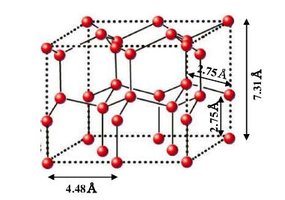
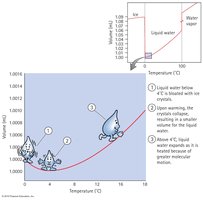
When water freezes, it expands due to the open structure of ice crystals, making ice less dense than liquid water.
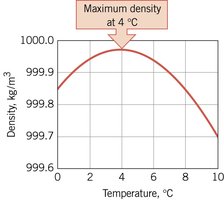
As water is heated from 0°C to 4°C, it contracts as ice crystals collapse, then expands above 4°C as molecular motion increases.
Thermal Expansion of Water: Density Anomaly
Water reaches maximum density at 4°C.
Below 4°C, water expands as it cools, which is why ice floats on water.
Summary Table: Key Properties
Property | Definition | Unit | Key Example |
|---|---|---|---|
Temperature | Average kinetic energy per particle | °C, K | Boiling water: 100°C |
Heat | Energy transferred due to temperature difference | Joule (J), calorie (cal) | Heating water on a stove |
Specific Heat Capacity | Heat needed to raise 1 g of substance by 1°C | J/(g·°C), cal/(g·°C) | Water: 1 cal/(g·°C) |
Thermal Expansion | Increase in size with temperature | Varies (length, area, volume) | Railroad tracks, bimetallic strips |
Conclusion
Understanding temperature, heat, specific heat capacity, and thermal expansion is crucial for analyzing thermal processes in physics. These concepts explain everyday phenomena, influence climate, and are essential in engineering design and material selection.
