Back
BackChapter 16: Heat Transfer – Conduction, Convection, Radiation, and the Greenhouse Effect
Study Guide - Smart Notes
 Tailored notes based on your materials, expanded with key definitions, examples, and context.
Heat Transfer
Introduction to Heat Transfer
Heat transfer is the process by which thermal energy moves from a region of higher temperature to a region of lower temperature. There are three primary mechanisms of heat transfer: conduction, convection, and radiation. Each mechanism operates under different physical principles and is relevant in various natural and engineered systems.
Conduction
Mechanism of Conduction
Conduction is the transfer of internal energy by electron and molecular collisions within a substance, especially solids. In this process, energy is transferred from the more energetic particles to the less energetic ones through direct contact.
Good Conductors: Materials with loosely held electrons, such as metals (e.g., silver, copper), transfer energy quickly.
Poor Conductors (Insulators): Materials with tightly held electrons, such as glass, wool, wood, paper, cork, plastic foam, and air, transfer energy slowly.
Insulation: Insulators do not prevent the flow of internal energy but slow the rate at which energy flows. Substances that trap air (e.g., wool, fur, feathers, snow) are effective insulators.
Example: If you hold one end of a metal bar against a piece of ice, the end in your hand becomes cold because heat flows from your hand to the ice, not the other way around.
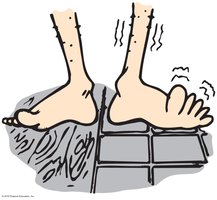
Dramatic Example of Poor Conduction
Walking barefoot on red-hot coals is possible because the coals are poor conductors of heat, so little energy is transferred to the feet quickly enough to cause burns.

Convection
Mechanism of Convection
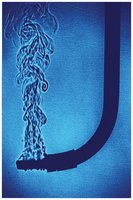
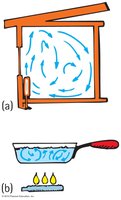
Convection is the transfer of heat by the bulk motion of fluids (liquids or gases). It occurs when a fluid is heated, expands, becomes less dense, and rises, while cooler, denser fluid sinks to take its place, creating a convection current.
Visible Effects: Shimmering air above a hot stove or asphalt, and visible shimmers in water due to temperature differences.
Reason Warm Air Rises: Warm air expands, becomes less dense, and is buoyed upward until its density matches the surrounding air.
Cooling by Expansion: When air expands, it cools. For example, the cloudy region above steam from a pressure cooker is cool due to expansion and mixing with cooler air.
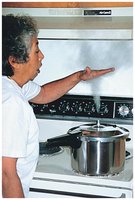
Convection in the Atmosphere
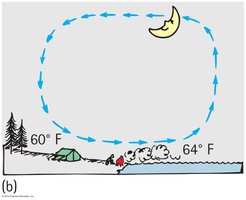
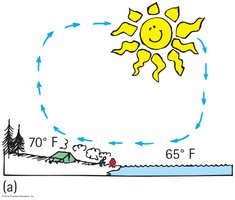
Winds are a result of uneven heating of the air near the ground. The ground warms more than water during the day, causing warm air to rise and be replaced by cooler air from above the water, creating a sea breeze.
Radiation
Mechanism of Radiation
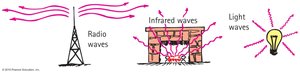
Radiation is the transfer of energy by electromagnetic waves and does not require a medium. The Sun's energy reaches Earth primarily through radiation.
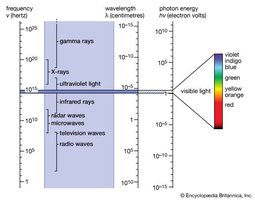
Electromagnetic Spectrum: Radiant energy exists as electromagnetic waves, ranging from long-wavelength radio waves to short-wavelength gamma rays. In the visible region, wavelengths range from red (long) to violet (short).
Emission: Every object above absolute zero emits radiant energy. The Sun emits visible light, while the Earth emits infrared radiation.
Absorption: Materials that absorb more energy than they emit are net absorbers; those that emit more than they absorb are net emitters. Good absorbers are also good emitters.
Reflection: Surfaces that reflect radiant energy poorly appear dark. Good reflectors are poor absorbers.
Wavelength and Frequency
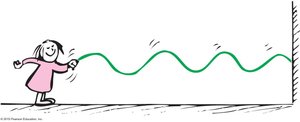
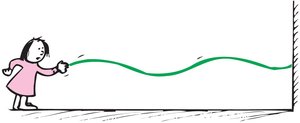
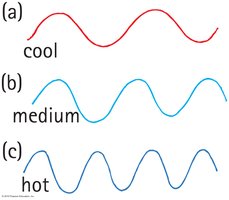
The wavelength of radiation is related to the frequency of vibration of the source. Low-frequency vibrations produce long-wavelength waves, while high-frequency vibrations produce short-wavelength waves.
Temperature and Radiation
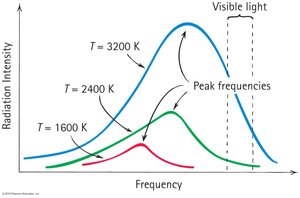
The temperature of an object determines the peak frequency and intensity of radiation it emits. Room-temperature objects emit infrared radiation, while objects above 500°C emit visible light (red, yellow, or white depending on temperature).
Reflection of Radiant Energy
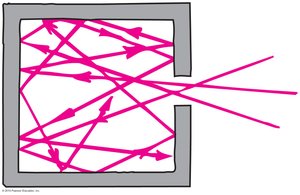
Darkness is often due to multiple reflections and partial absorption of light. Good reflectors are poor absorbers, and vice versa.
Newton's Law of Cooling
Statement of the Law
Newton's law of cooling states that the rate of cooling (or warming) of an object is approximately proportional to the temperature difference (∆T) between the object and its surroundings:
Example: A hot apple pie cools faster in a freezer than on a kitchen table due to a larger temperature difference.
Application: A beverage cools faster in the coldest part of a refrigerator because the temperature difference is greatest.
Global Warming and the Greenhouse Effect
The Greenhouse Effect
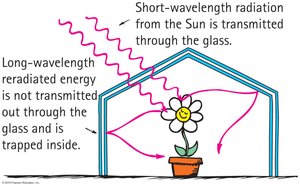
The greenhouse effect is a temperature-raising phenomenon similar to what occurs in greenhouses. It is based on two principles:
All objects radiate energy at a frequency (and wavelength) dependent on their temperature.
The transparency of materials depends on the wavelength of radiation.
Example: Sunlight (short-wavelength radiation) passes through glass windows and warms the interior of a car. The interior then emits longer-wavelength infrared radiation, which cannot escape through the glass, causing the temperature to rise.
Global Warming
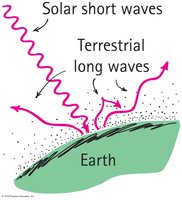
Earth absorbs energy from the Sun and reradiates it as longer-wavelength terrestrial radiation. Greenhouse gases in the atmosphere absorb this infrared radiation and re-emit it back to Earth, trapping heat and raising the planet's temperature. The long-term effects of this process are a major concern for climate change.
Solar Power
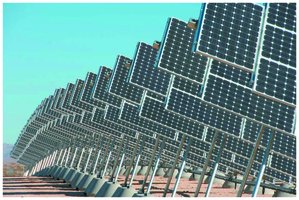
Solar power harnesses the vast amount of energy the Earth receives from the Sun. In just one hour, the Sun delivers more energy to Earth than all human energy consumption in a year.