 Back
BackChapter 16: Sound and Hearing – Study Notes
Study Guide - Smart Notes
 Tailored notes based on your materials, expanded with key definitions, examples, and context.
Sound and Hearing
Introduction to Sound Waves
Sound is a mechanical wave that propagates as a longitudinal wave through a medium such as air, water, or solids. It is characterized by oscillations of particles in the medium, which result in regions of compression and rarefaction. The human ear can detect sound frequencies in the range of approximately 20 Hz to 20,000 Hz.
Longitudinal Wave: The oscillations of particles are parallel to the direction of wave propagation.
Medium Requirement: Sound requires a material medium to travel; it cannot propagate in a vacuum.
Speed of Sound: The speed of sound varies with the medium and its properties (density, elasticity, temperature).
Example: The delay between seeing fireworks and hearing the explosion is due to the much slower speed of sound compared to light.

Describing Sound Waves
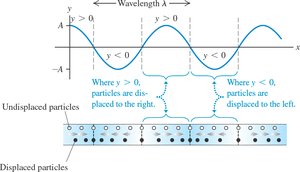
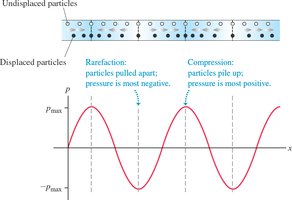
Sound waves can be described in terms of particle displacement or pressure fluctuations. Both descriptions are mathematically equivalent and provide insight into the nature of sound propagation.
Displacement Wave: Describes the movement of particles from their equilibrium positions.
Pressure Wave: Describes the variations in pressure caused by compressions and rarefactions in the medium.
Mathematical Representation of Sound Waves
A sinusoidal sound wave traveling in the x-direction can be represented as:
Displacement:
Pressure: , where is the pressure amplitude.
Here, is the amplitude, is the wave number, is the angular frequency, and is the bulk modulus of the medium.
Speed of Sound
Speed in Different Media
The speed of sound depends on the medium's properties. In general, sound travels faster in solids than in liquids, and faster in liquids than in gases.
In Fluids:
In Solids:
In Ideal Gases:



Where is the bulk modulus, is Young's modulus, is density, is the ratio of heat capacities, is the gas constant, is temperature, and is molar mass.
Perception and Analysis of Sound
Fourier Analysis and Harmonics
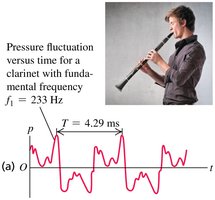
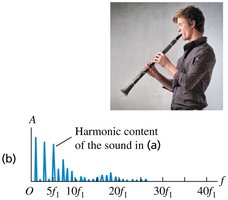
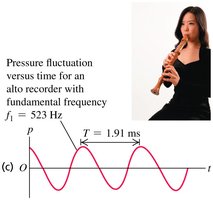
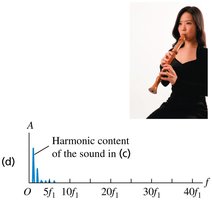
Complex sounds can be analyzed into their harmonic components using Fourier analysis. This process reveals the fundamental frequency and overtones that define the timbre of a sound.
Example: The pressure-time graph for a clarinet and its harmonic content.
Sound Intensity and the Decibel Scale
Sound Intensity
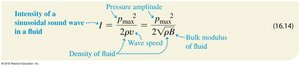
Sound intensity () is the average rate of energy transfer per unit area perpendicular to the direction of propagation. For a sinusoidal sound wave:
The Decibel Scale
Because the human ear can detect a wide range of intensities, sound intensity levels are measured on a logarithmic scale called the decibel (dB) scale:

Where is the reference intensity, approximately the threshold of human hearing at 1000 Hz.
Sound Interference and Beats
Interference of Sound Waves
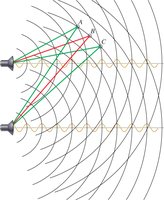
When two or more sound waves overlap, they interfere, producing regions of constructive and destructive interference. This is observed with coherent sources (same frequency and phase).
Beats
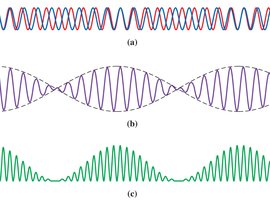
Beats occur when two sound waves of slightly different frequencies interfere, resulting in a periodic variation in amplitude (loudness) at the beat frequency:
Sound Diffraction and Localization
Diffraction
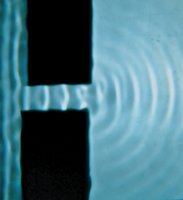
Sound waves can bend around obstacles and spread out after passing through narrow openings, a phenomenon known as diffraction. This explains why we can hear sounds even when the source is not in direct line of sight.
Sound Localization
Humans localize sound sources using differences in arrival time and intensity between the two ears. High-frequency sounds are more easily attenuated by the head, while low-frequency localization relies on timing differences.
The Doppler Effect
Frequency Shift Due to Relative Motion
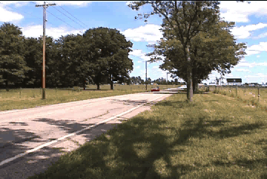
The Doppler effect describes the change in frequency (and wavelength) of a sound wave as perceived by an observer moving relative to the source of the sound.
Source moving toward observer: Observed frequency increases.
Source moving away from observer: Observed frequency decreases.
General formula: , where is the speed of sound, is the observer's speed (positive if moving toward the source), and is the source's speed (positive if moving away from the observer).

Standing Waves and Resonance in Pipes
Standing Waves in Pipes
Standing sound waves can form in pipes, with resonance frequencies determined by the pipe's length and whether its ends are open or closed.
Open Pipe: Both ends open; supports all harmonics.
Closed Pipe: One end closed; supports only odd harmonics.
Tables
Speed of Sound in Various Materials
Substance | Speed of Sound (m/s) |
|---|---|
Air (0°C) | 331 |
Air (20°C) | 343 |
Water (20°C) | 1482 |
Steel | 5960 |
Helium | 965 |
Carbon Dioxide | 259 |
Additional info: Table values inferred from standard physics references. |
Sound Levels in Common Situations
Situation | Sound Level (dB) |
|---|---|
Quiet home | 30 |
Street traffic | 70 |
Jackhammer | 120 |
Rock concert | 110-130 |
Threshold of pain | 130 |
Additional info: Table values inferred from standard physics references. |
Applications of Sound Waves
Ultrasonic Imaging
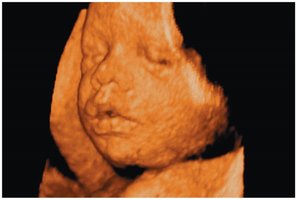
Ultrasound uses high-frequency sound waves to create images of internal body structures. It is widely used in medical diagnostics, such as fetal imaging and cardiac studies.
Active Noise Cancellation
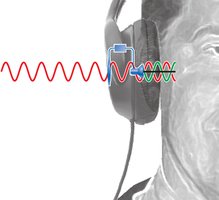
Active noise cancellation technology uses destructive interference to reduce unwanted ambient sounds. Headphones with this feature detect external noise and generate a sound wave with the opposite phase to cancel it out, especially effective for low-frequency sounds.
Summary
Sound is a longitudinal wave requiring a medium for propagation.
The speed of sound depends on the medium's properties.
Sound intensity and the decibel scale quantify the energy and perceived loudness of sound.
Interference, beats, diffraction, and the Doppler effect are key phenomena associated with sound waves.
Standing waves and resonance explain the operation of musical instruments and acoustic devices.
Applications include medical imaging and noise control technologies.
