 Back
BackChapter 17: Temperature and Heat – Structured Study Notes
Study Guide - Smart Notes
 Tailored notes based on your materials, expanded with key definitions, examples, and context.
Temperature and Heat
Introduction to Temperature and Heat
Temperature and heat are fundamental concepts in thermodynamics, often confused in everyday language but distinct in physics. Temperature is a measure of the average kinetic energy of the particles in a substance, while heat refers to the energy transferred between systems due to a temperature difference.
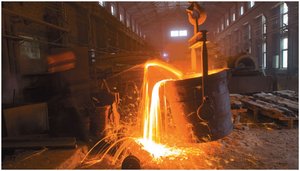
Key Point 1: Temperature is not the same as heat; temperature measures the state, while heat is energy in transit. Key Point 2: Heat flows from higher to lower temperature objects.
Temperature and Thermal Equilibrium
Thermal equilibrium occurs when two systems in contact no longer exchange heat, meaning they have the same temperature. Thermometers measure temperature by exploiting physical properties that change with temperature, such as the volume of a liquid.
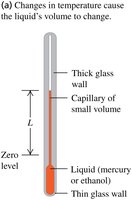
Key Point 1: Two systems are in thermal equilibrium if they have the same temperature. Key Point 2: Thermometers use materials whose properties (e.g., volume) change predictably with temperature.
Other Types of Thermometers
Modern thermometers include devices that measure infrared radiation, such as temporal artery thermometers, which detect the heat emitted from the skin.

Key Point: Infrared thermometers measure temperature without direct contact with the internal body.
The Zeroth Law of Thermodynamics
The Zeroth Law of Thermodynamics states: If system C is in thermal equilibrium with both systems A and B, then A and B are in thermal equilibrium with each other. This law underpins the concept of temperature as a measurable and transitive property.
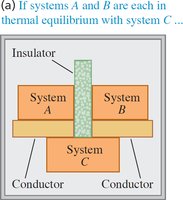
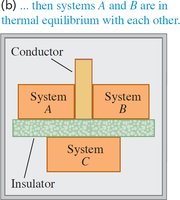
Key Point: The Zeroth Law allows the use of thermometers to compare temperatures of different systems.
Temperature Scales
Celsius and Kelvin Scales
The Celsius scale is based on the freezing (0°C) and boiling (100°C) points of water. The Kelvin scale is an absolute scale, starting at absolute zero (0 K), the theoretical point where all molecular motion ceases.
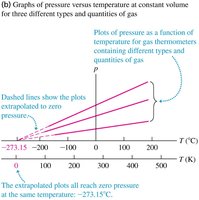
Key Point: Absolute zero is −273.15°C, where gas pressure extrapolates to zero.
Kelvin Scale and Temperature Conversions
Kelvin temperatures are measured in kelvins (K), not degrees. The conversion between Celsius and Kelvin is:
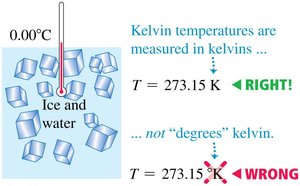
Key Point: Always use kelvins for absolute temperature in scientific calculations.
Temperature Conversions Table
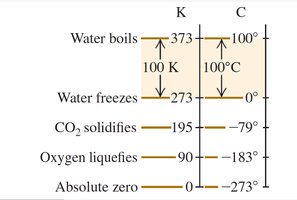
The following table compares key temperature points in Celsius and Kelvin:
Event | Kelvin (K) | Celsius (°C) |
|---|---|---|
Water boils | 373 | 100 |
Water freezes | 273 | 0 |
CO2 solidifies | 195 | -79 |
Oxygen liquefies | 90 | -183 |
Absolute zero | 0 | -273 |
Thermal Expansion
Linear Thermal Expansion
When the temperature of a solid changes, its dimensions change. For moderate temperature changes, the change in length is given by: where is the coefficient of linear expansion, is the original length, and is the temperature change.

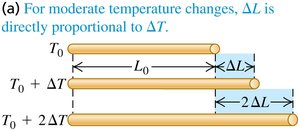
Key Point: Expansion is proportional to both the original length and the temperature change.
Molecular Basis for Thermal Expansion
Atoms in solids are held together by interatomic forces, often modeled as springs. As temperature increases, the average distance between atoms increases, causing the material to expand.
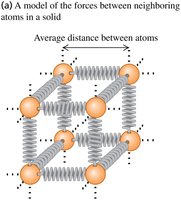
Key Point: Expansion occurs in all dimensions as atoms move farther apart.
Length Change Example
Example: A steel measuring tape calibrated at 20°C will be longer at higher temperatures due to thermal expansion. Calculations use the formula for linear expansion.
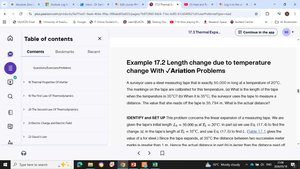

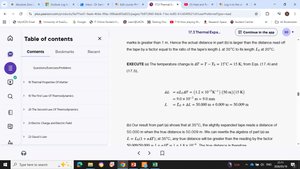
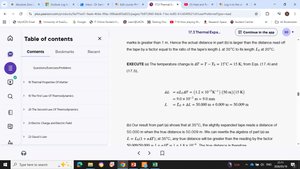
Example: If a tape is 50.000 m at 20°C, its length at 35°C is calculated using .
Expanding Holes and Volume Expansion
When an object with a hole is heated, the hole expands as well. The change in volume is given by: where is the coefficient of volume expansion.
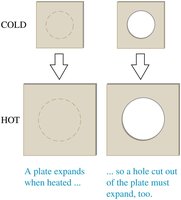
Key Point: Both the material and any holes within it expand with temperature.
Example of Thermal Expansion
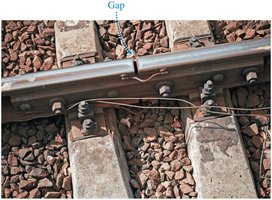
Railroad tracks have gaps between segments to accommodate thermal expansion. Without gaps, tracks can buckle in hot weather.
Thermal Expansion of Water
Water exhibits anomalous behavior between 0°C and 4°C, decreasing in volume as temperature increases. This property causes lakes to freeze from the top down.
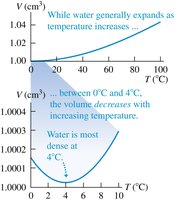
Key Point: Water is most dense at 4°C.
Thermal Stress
If a material is prevented from expanding or contracting as its temperature changes, thermal stress develops. The force per unit area required to keep the length constant is: where is Young's modulus.

Example: Expansion joints in bridges accommodate changes in length due to thermal expansion.

Quantity of Heat
Heat and Work
Heat can be transferred to a system by doing work (e.g., stirring water with a paddle) or by direct heating.
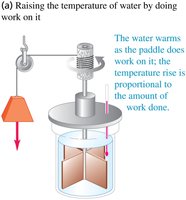
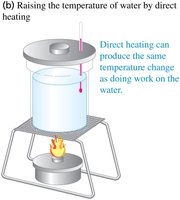
Key Point: The calorie is the amount of heat required to raise 1 g of water by 1°C.
Specific Heat
The specific heat is the amount of heat required to raise the temperature of 1 kg of a substance by 1 K. The heat required for a mass and temperature change is:

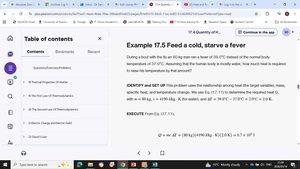
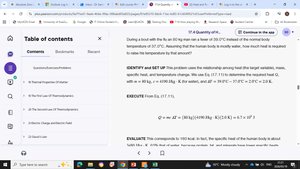
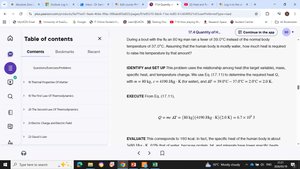
Example: Calculating heat required to raise body temperature during fever.

Molar Heat Capacity
The molar heat capacity is the heat required to raise the temperature of 1 mole of a substance by 1 K. The heat required for moles is:
Phase Changes
Phases of Matter and Latent Heat
Phase changes involve transitions between solid, liquid, and gas. During a phase change, temperature remains constant. The latent heat is the heat per unit mass required for the change:
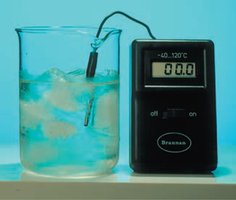

Key Point: Heat added during a phase change does not increase temperature.
Heat Added to Ice at a Constant Rate
When heat is added to ice, it first warms, then melts, then warms as water, then vaporizes, and finally warms as steam. The temperature remains constant during melting and vaporization.
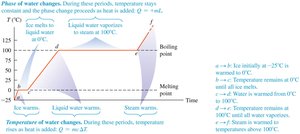
Heat of Fusion and Heat of Vaporization
The heat of fusion is the energy required to melt a solid, while the heat of vaporization is the energy required to vaporize a liquid. For example, gallium melts at room temperature, and water evaporates from skin, removing heat.


Mechanisms of Heat Transfer
Conduction
Conduction is the transfer of heat through a material without the movement of the material itself. The rate of heat transfer (heat current) is:

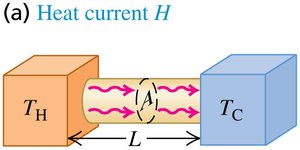
Key Point: Conductivity varies by material; metals are good conductors.
Convection
Convection is the transfer of heat by the movement of fluid (liquid or gas). Heated fluid rises, carrying energy with it.
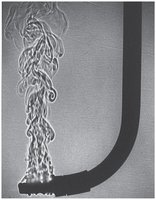
Key Point: Convection is important in atmospheric and oceanic heat transfer.
Radiation
Radiation is the transfer of heat by electromagnetic waves, such as infrared or visible light. The Stefan-Boltzmann law describes the heat current:

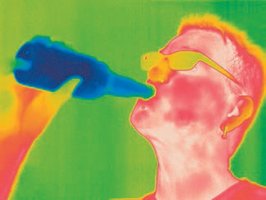
Key Point: All objects emit radiation; hotter objects emit more.
Radiation and Climate Change
Earth emits infrared radiation, which is absorbed and re-emitted by atmospheric CO2, contributing to global warming.
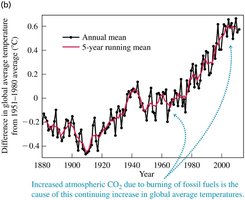
Key Point: Increased CO2 leads to higher global temperatures.
