 Back
BackChapter 17: Temperature and Heat – Study Notes
Study Guide - Smart Notes
 Tailored notes based on your materials, expanded with key definitions, examples, and context.
Temperature and Heat
Introduction to Temperature and Heat
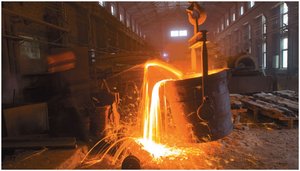
Temperature and heat are fundamental concepts in thermodynamics, but they are often confused. Temperature is a measure of the average kinetic energy of the particles in a substance, while heat refers to the energy transferred between objects due to a temperature difference. This chapter focuses on the macroscopic properties of matter related to temperature and heat.
Temperature and Thermal Equilibrium
Measuring Temperature
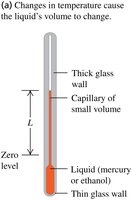
Thermometers are devices used to measure temperature. They operate based on physical properties that change with temperature, such as the volume of a liquid in a glass thermometer.
Thermal equilibrium occurs when two systems in contact no longer exchange energy as heat, indicating they are at the same temperature.
Other Types of Thermometers
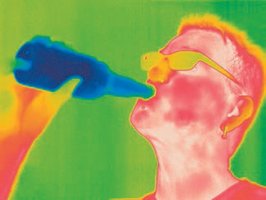
Modern thermometers, such as temporal artery thermometers, measure infrared radiation emitted by the body to determine temperature without direct contact with internal tissues.

The Zeroth Law of Thermodynamics
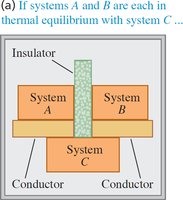
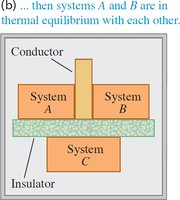
The Zeroth Law of Thermodynamics states: If system C is in thermal equilibrium with both system A and system B, then A and B are in thermal equilibrium with each other. This law underpins the concept of temperature as a measurable and transitive property.
Temperature Scales
Celsius and Kelvin Scales
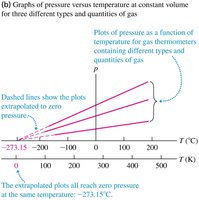
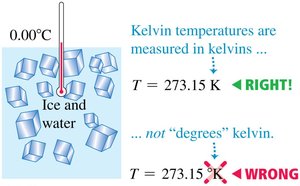
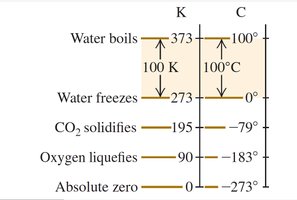
The Celsius scale sets 0°C as the freezing point and 100°C as the boiling point of water. The Kelvin scale is the SI unit for temperature, starting at absolute zero (0 K), the theoretical point where all molecular motion ceases. The conversion between Celsius and Kelvin is:
Thermal Expansion
Linear Thermal Expansion
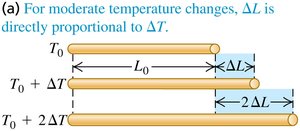
When the temperature of a solid changes, its length changes proportionally. The change in length is given by:
Where is the coefficient of linear expansion, is the original length, and is the temperature change.

Molecular Basis for Thermal Expansion
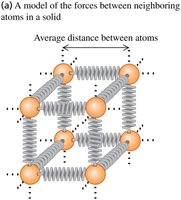
Thermal expansion can be explained by the increased average distance between atoms as temperature rises. Atoms in a solid vibrate more vigorously at higher temperatures, causing the material to expand.
Examples and Applications of Thermal Expansion
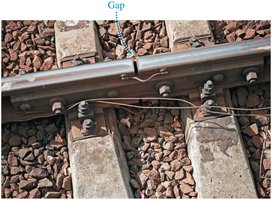
Thermal expansion must be considered in engineering applications, such as the design of railroad tracks and bridges, to prevent structural damage due to temperature changes.
Expanding Holes and Volume Expansion
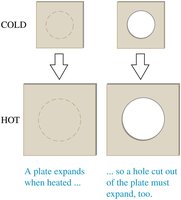
When an object with a hole is heated, both the object and the hole expand. The change in volume is given by:
Where is the coefficient of volume expansion.
Thermal Expansion of Water
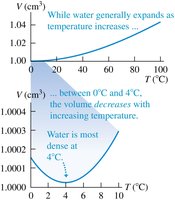
Water exhibits anomalous expansion: between 0°C and 4°C, it contracts as temperature increases, reaching maximum density at 4°C. This property is crucial for aquatic life in cold climates.
Thermal Stress
If a material is prevented from expanding or contracting as its temperature changes, thermal stress develops. The thermal stress is given by:
Where is Young's modulus, is the coefficient of linear expansion, and is the temperature change.


Quantity of Heat
Definition and Measurement
Heat is the energy transferred between objects due to a temperature difference. The calorie (cal) is the amount of heat required to raise the temperature of 1 gram of water by 1°C (from 14.5°C to 15.5°C).
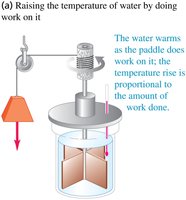
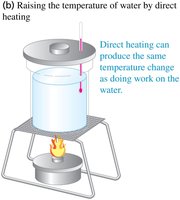
Specific Heat
The specific heat of a substance is the amount of heat required to raise the temperature of 1 kg of the substance by 1 K. The heat required to change the temperature of a mass by is:

Molar Heat Capacity
The molar heat capacity is the amount of heat required to raise the temperature of 1 mole of a substance by 1 K. The heat required for moles is:

Phase Changes
Latent Heat and Phase Transitions
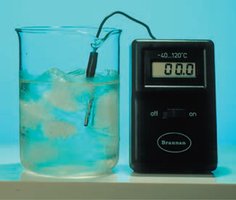
During a phase change (solid-liquid-gas), the temperature of a substance remains constant while heat is absorbed or released. The latent heat is the heat per unit mass required for a phase change:

Heat of Fusion and Vaporization
The heat of fusion is the energy required to change a substance from solid to liquid at constant temperature. The heat of vaporization is the energy required to change a substance from liquid to gas at constant temperature. These concepts explain phenomena such as melting ice and evaporation cooling.


Mechanisms of Heat Transfer
Conduction
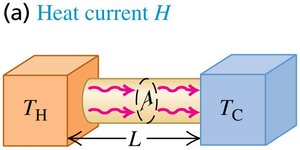
Conduction is the transfer of heat through a material without the movement of the material itself. The rate of heat transfer (heat current) is given by:
Where is the thermal conductivity, is the cross-sectional area, and are the temperatures at each end, and is the length.

Convection
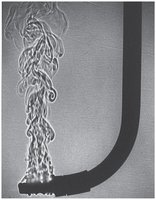
Convection is the transfer of heat by the bulk movement of fluids (liquids or gases). It is responsible for many natural phenomena, such as ocean currents and atmospheric circulation.
Radiation
Radiation is the transfer of energy by electromagnetic waves, such as infrared or visible light. All objects emit thermal radiation, and the rate of emission is given by the Stefan-Boltzmann law:
Where is the Stefan-Boltzmann constant, is the area, is the emissivity, and is the absolute temperature.

Radiation and Climate Change
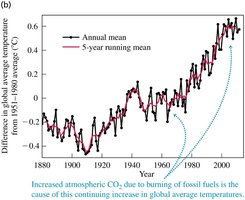
Earth emits infrared radiation, which is partially absorbed and re-emitted by greenhouse gases such as CO2. This process contributes to the greenhouse effect and global warming.
Additional info: Some equations and tables referenced in the text (such as coefficients of expansion and specific heats) are standard and can be found in most physics textbooks. The examples and images provided reinforce the physical principles discussed in each section.
