Back
BackChapter 20: Magnetism – Physics Study Notes
Study Guide - Smart Notes
 Tailored notes based on your materials, expanded with key definitions, examples, and context.
Magnetism
Magnets and Magnetic Fields
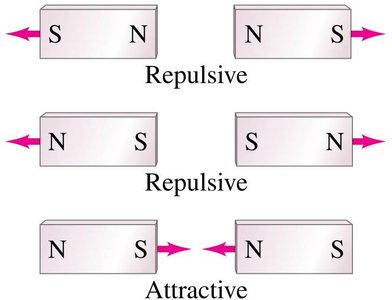
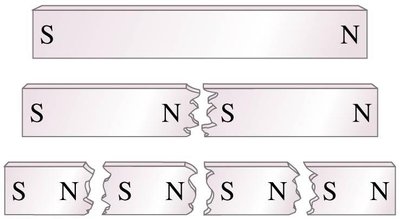
Magnetism is a fundamental force of nature, arising from the motion of electric charges. Magnets have two distinct poles: north and south. Like poles repel each other, while unlike poles attract. If a magnet is cut in half, each piece forms a new magnet with both a north and a south pole, demonstrating that magnetic poles always come in pairs.
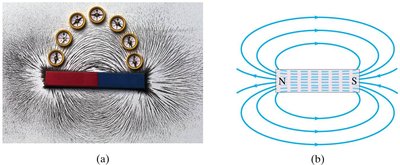
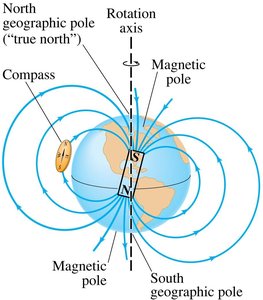
Magnetic field lines are used to visualize magnetic fields. These lines form closed loops from the north to the south pole outside the magnet and from south to north inside the magnet.
The Earth itself acts as a giant magnet, with its magnetic field resembling that of a bar magnet. The geographic North Pole is actually a magnetic south pole, as it attracts the north end of a compass needle.
A uniform magnetic field is one that is constant in both magnitude and direction, often produced between two wide, flat magnetic poles.
Electric Currents Produce Magnetic Fields
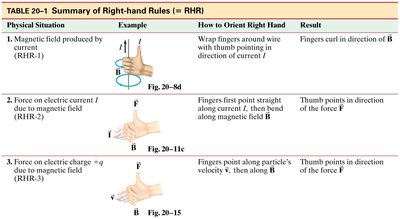
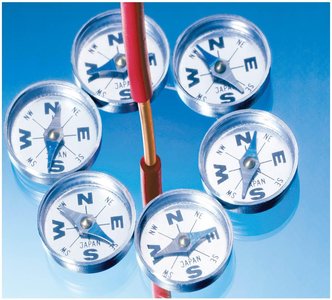
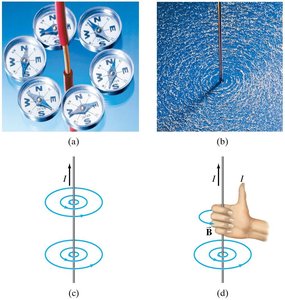
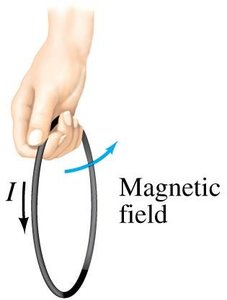
Experiments show that an electric current generates a magnetic field. The direction of the magnetic field around a current-carrying wire can be determined using the right-hand rule: if you wrap your right hand around the wire with your thumb pointing in the direction of the current, your fingers curl in the direction of the magnetic field lines.
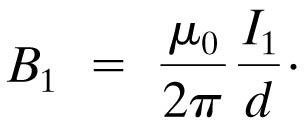
The strength of the magnetic field produced by a long, straight wire is inversely proportional to the distance from the wire.
The permeability of free space, μ0, is a constant:
Force on an Electric Current in a Magnetic Field; Definition of B
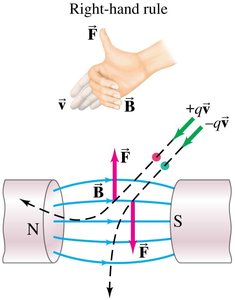
A current-carrying wire placed in a magnetic field experiences a force. The direction of this force is given by another right-hand rule: point your thumb in the direction of the current and your fingers in the direction of the magnetic field; your palm points in the direction of the force.
The magnitude of the force is given by:
The magnetic field strength (B) is measured in teslas (T):
Another unit:
Force on Electric Charge Moving in a Magnetic Field
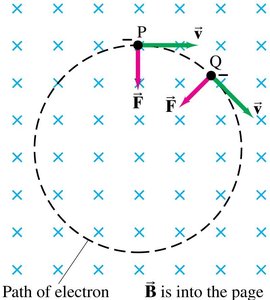
A charged particle moving through a magnetic field experiences a force perpendicular to both its velocity and the magnetic field. The direction is given by the right-hand rule for positive charges; for negative charges, the force is in the opposite direction.
The force is given by:
If the velocity is perpendicular to the field, the particle moves in a circular path.
Magnetic Field Due to a Long Straight Wire
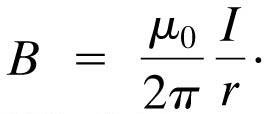
The magnetic field at a distance r from a long, straight current-carrying wire is given by:
The field forms concentric circles around the wire.
Force between Two Parallel Wires
Two parallel wires carrying currents exert a force on each other due to their magnetic fields. If the currents are in the same direction, the wires attract; if opposite, they repel.
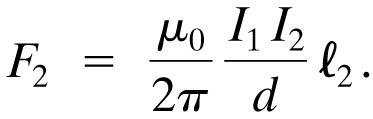
The force per unit length between two wires is:
This principle is used to define the ampere, the SI unit of current.
Solenoids and Electromagnets
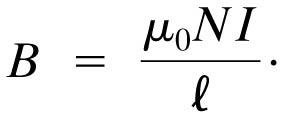
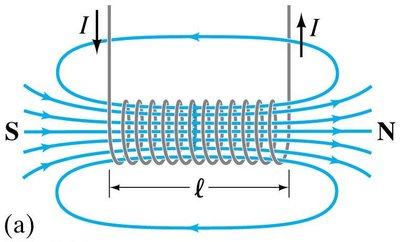
A solenoid is a long coil of wire. When current flows through it, a nearly uniform magnetic field is produced inside. Inserting an iron core increases the field strength, creating an electromagnet.
The field inside a solenoid:
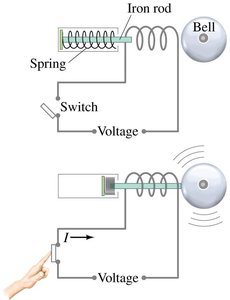
Electromagnets are widely used in devices such as electric bells and relays.
Ampère’s Law
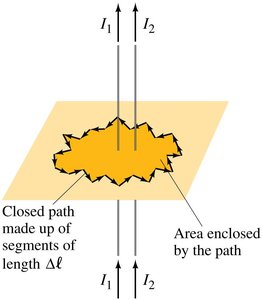
Ampère’s Law relates the integrated magnetic field around a closed loop to the total current passing through the loop. It is especially useful for calculating fields in systems with high symmetry.
Ampère’s Law:
Useful for solenoids, toroids, and long straight wires.
Torque on a Current Loop; Magnetic Moment
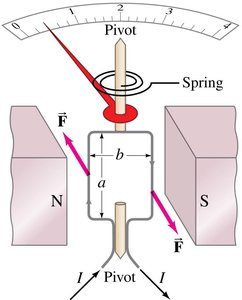
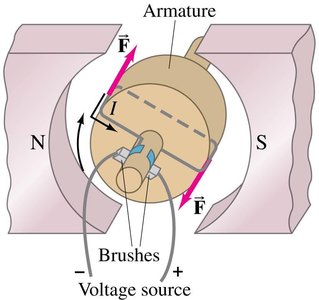
A current loop in a magnetic field experiences a torque, which tends to align the loop with the field. The torque is given by:
The magnetic dipole moment is
Applications: Galvanometers, Motors, Loudspeakers
Several devices utilize the principles of magnetism:
Galvanometer: Measures electric current by the torque on a current loop.
Electric motor: Converts electrical energy to mechanical energy using the torque on a current loop.
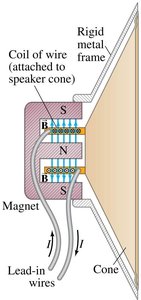
Loudspeaker: Uses the force on a current-carrying wire in a magnetic field to produce sound.
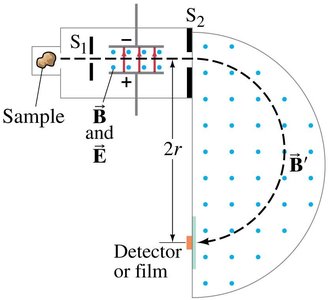
Mass Spectrometer
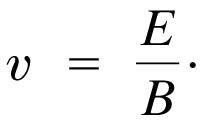
A mass spectrometer measures the masses of atoms by analyzing the motion of charged particles in perpendicular electric and magnetic fields. Only particles with a specific velocity pass through undeflected, and their radius of curvature in a magnetic field depends on their mass.
Velocity selector:
Ferromagnetism: Domains and Hysteresis
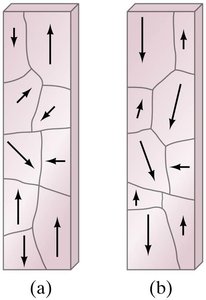
Ferromagnetic materials (e.g., iron, nickel) can be strongly magnetized. They consist of regions called domains, each with a uniform magnetic orientation. In an unmagnetized state, domains are randomly oriented; applying an external field aligns them, magnetizing the material.
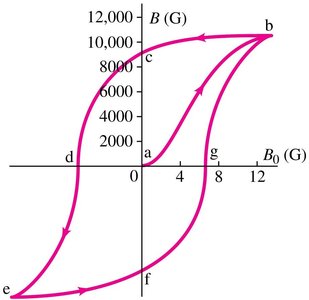
Ferromagnets can retain magnetization (hysteresis) or be demagnetized by heat or shock.
The relationship between the external and internal magnetic fields is nonlinear, shown by a hysteresis curve.
Summary Table: Right-Hand Rules
The right-hand rules are essential for determining the direction of magnetic fields, forces, and currents in various situations.
Physical Situation | How to Orient Right Hand | Result |
|---|---|---|
Magnetic field produced by current | Wrap fingers around wire with thumb in direction of current | Fingers curl in direction of B |
Force on electric current in magnetic field | Fingers point along current, bend along B | Thumb points in direction of force F |
Force on moving charge in magnetic field | Fingers point along velocity, then along B | Thumb points in direction of force F |