 Back
BackChapter 20: The First Law of Thermodynamics – Internal Energy, Heat, and Energy Transfer
Study Guide - Smart Notes
 Tailored notes based on your materials, expanded with key definitions, examples, and context.
Internal Energy and the First Law of Thermodynamics
Internal Energy
Internal energy is the total energy contained within a system, associated with its microscopic components such as atoms and molecules. It includes:
Random translational motion of particles
Rotational and vibrational motion of molecules
Potential energy due to interactions between molecules
Internal energy does not include the kinetic energy due to the system's overall motion through space.
Heat and Work
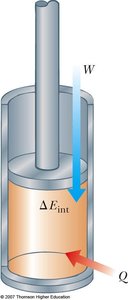
Heat is the transfer of energy across the boundary of a system due to a temperature difference. Work is energy transferred by mechanical means, such as compressing a gas with a piston. Both heat and work can change the internal energy of a system.
Mechanical Equivalent of Heat
Joule's experiments established the equivalence between mechanical energy and internal energy. The loss in potential energy of weights equals the work done by a paddle wheel on water, raising its temperature.
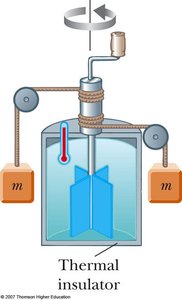
Joule found that:
1 calorie (cal) = 4.186 Joules (J)
Heat Capacity and Calorimetry
Heat Capacity
The heat capacity (C) of a sample is the amount of energy needed to raise its temperature by 1°C. The relationship is:
Specific Heat
Specific heat (c) is the heat capacity per unit mass. The equation for energy transfer is:
Sign conventions:
If temperature increases: Q and are positive (energy into system)
If temperature decreases: Q and are negative (energy out of system)
Calorimetry
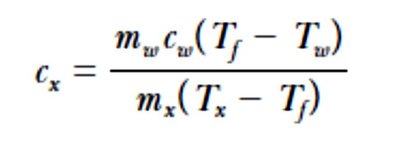
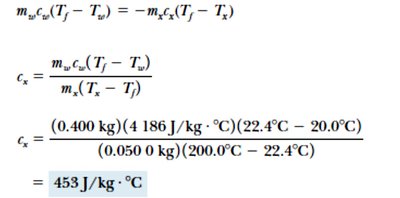
Calorimetry is a technique for measuring specific heat by mixing heated material with water and recording the final temperature. Conservation of energy requires:

Phase Changes and Latent Heat
Phase Changes
A phase change occurs when a substance transitions between solid, liquid, and gas. During a phase change, temperature remains constant while internal energy changes due to breaking or forming molecular bonds.
Latent Heat
The latent heat (L) is the energy required to change the phase of a mass m:
Types:
Latent heat of fusion: solid to liquid
Latent heat of vaporization: liquid to gas
Sign convention:
Positive: energy into system (melting, boiling)
Negative: energy out of system (freezing, condensation)
State and Transfer Variables
State Variables
State variables describe the system's state (e.g., pressure, temperature, volume, internal energy). They are defined only when the system is in thermal equilibrium.
Transfer Variables
Transfer variables (heat and work) are only defined during processes where energy crosses the system boundary.
Work in Thermodynamics
Work on a Gas
Work can be done on a deformable system, such as a gas in a cylinder with a movable piston. The process is quasi-static if the system remains in thermal equilibrium.
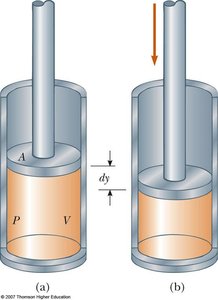
The work done is:
Interpretation:
If gas is compressed ( negative), work done on gas is positive
If gas expands ( positive), work done on gas is negative
If volume is constant, work done is zero
Total work:
PV Diagrams
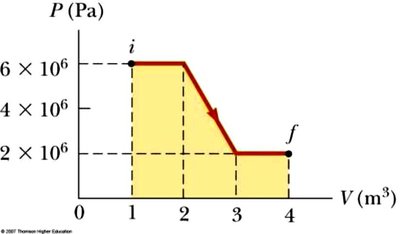
PV diagrams plot pressure vs. volume, showing the path of a thermodynamic process. The area under the curve represents the work done.
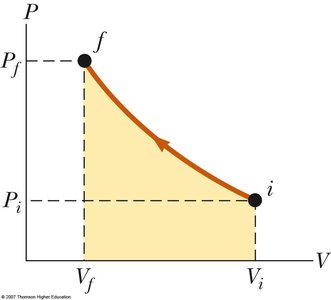
Work Done by Various Paths
Different paths between the same initial and final states yield different amounts of work.
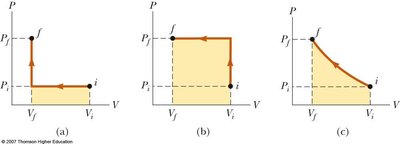
Heat Transfer Examples
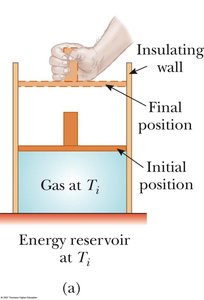
Energy Transfer by Heat
Energy transfer by heat depends on the process and the path taken. An energy reservoir is a source with a large capacity, so its temperature does not change during energy transfer.
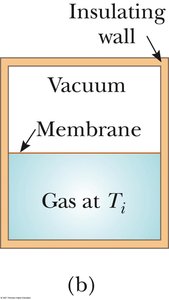
Adiabatic Free Expansion
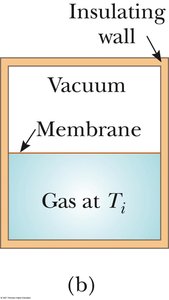
In adiabatic free expansion, gas expands into a vacuum in an insulated container. No work is done, and no heat is transferred, so internal energy remains constant.
The First Law of Thermodynamics
Statement and Equation
The First Law of Thermodynamics is a special case of the Law of Conservation of Energy, accounting for changes in internal energy and energy transfers by heat and work:
Isolated Systems
In an isolated system, no energy transfer occurs by heat or work, so internal energy remains constant (, ).
Cyclic Processes
A cyclic process starts and ends in the same state. On a PV diagram, it appears as a closed curve. The net work done per cycle equals the area enclosed by the path.
Special Thermodynamic Processes
Adiabatic Process
No energy enters or leaves the system by heat (). Achieved by thermal insulation or rapid process. .
Isobaric Process
Occurs at constant pressure. Work done is .
Isovolumetric Process
Occurs at constant volume. No work is done (), so .
Isothermal Process
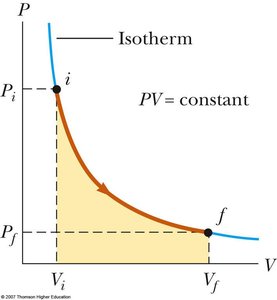
Occurs at constant temperature. , so . The PV diagram is a hyperbola (isotherm).
Isothermal Expansion Details
For an ideal gas undergoing isothermal expansion:
Work Done Example
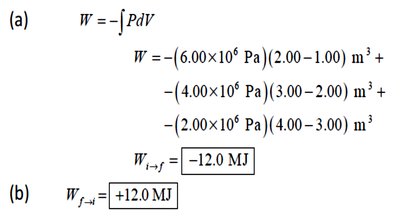
Work done on a gas during expansion or compression can be calculated from the area under the PV curve.
Energy Transfer Example
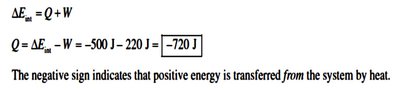
For a process where internal energy decreases and work is done on the system:
Mechanisms of Energy Transfer by Heat
Conduction
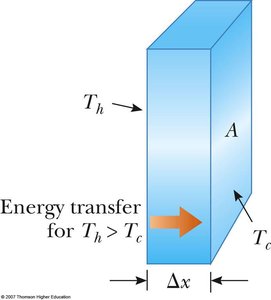
Conduction is the transfer of energy by collisions between microscopic particles. Metals are good conductors due to free electrons. The rate of conduction is:
Temperature Gradient
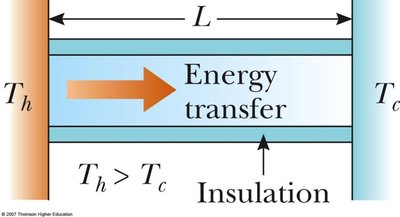
The temperature gradient measures how temperature changes with position:
Convection
Convection is energy transfer by the movement of a substance. It can be natural (due to density differences) or forced (by a fan or pump).
Radiation
Radiation is energy transfer by electromagnetic waves. All objects radiate energy due to thermal vibrations. The rate is given by Stefan's Law:
Where is the Stefan-Boltzmann constant, is surface area, is emissivity, and is temperature in Kelvins.
Net energy transfer when surroundings are at :
Ideal Absorber and Reflector
Ideal absorber (black body): ; absorbs all incident energy
Ideal reflector: ; absorbs none of the incident energy
