 Back
BackChapter 23: The Electric Field – Study Notes
Study Guide - Smart Notes
 Tailored notes based on your materials, expanded with key definitions, examples, and context.
The Electric Field
Definition and Properties
The electric field is a vector field that describes the force per unit charge exerted on a test charge at any point in space. It is produced by electric charges and can be represented by vectors or field lines.
Definition: The electric field \( \vec{E} \) at a point is defined as the force \( \vec{F} \) experienced by a small positive test charge \( q \) divided by the magnitude of the charge:
Units: Newtons per coulomb (N/C) or volts per meter (V/m).
Vector Nature: Electric fields have both magnitude and direction.
Superposition Principle: The net electric field due to multiple charges is the vector sum of the fields produced by each charge individually.
Electric Field of Point Charges
Single Point Charge
The electric field produced by a point charge \( q \) at a distance \( r \) is given by Coulomb's law:
\( \epsilon_0 \) is the permittivity of free space.
The direction of \( \vec{E} \) is radially outward from a positive charge and inward toward a negative charge.

Multiple Point Charges
For a system of point charges, the net electric field at a point is the vector sum of the fields due to each charge:
Each \( \vec{E}_i \) is calculated using the formula for a single point charge.
Electric Field Lines
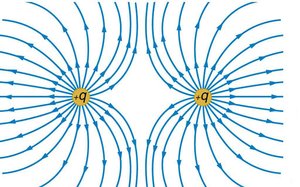
Electric field lines provide a visual representation of the field:
Lines start on positive charges and end on negative charges.
The density of lines indicates the field's strength.
Lines never cross.
Continuous Charge Distributions
Linear, Surface, and Volume Charge Densities
For macroscopic objects, charge is often distributed continuously:
Linear charge density (\( \lambda \)): Charge per unit length (C/m).
Surface charge density (\( \eta \) or \( \sigma \)): Charge per unit area (C/m2).
Volume charge density (\( \rho \)): Charge per unit volume (C/m3).
The total electric field is found by integrating the contributions from each infinitesimal charge element.
Electric Field of Symmetric Charge Distributions
Line of Charge
The electric field at a point near a uniformly charged rod can be calculated by integrating the contributions from each segment of the rod.
Ring of Charge
For a ring of radius \( R \) and total charge \( Q \), the electric field on the axis passing through the center is:
Disk and Plane of Charge
The electric field on the axis of a uniformly charged disk or an infinite plane can be derived by integrating over concentric rings. For an infinite plane, the field is constant and given by:
Parallel-Plate Capacitor
Structure and Field
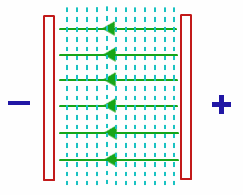
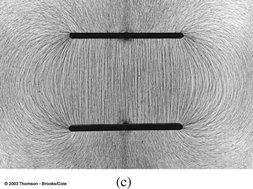
A parallel-plate capacitor consists of two large, flat, conducting plates separated by a small distance. The electric field between the plates is uniform and directed from the positive to the negative plate:
The field outside the plates is approximately zero.
This configuration is used to create a uniform electric field in experiments and devices.
Ideal vs. Real Capacitors
In an ideal capacitor, the field is perfectly uniform except at the edges. In real capacitors, edge effects (fringing) cause deviations from uniformity, but these are negligible if the plate separation is much smaller than the plate dimensions.
Motion of Charged Particles in Electric Fields
Force and Acceleration
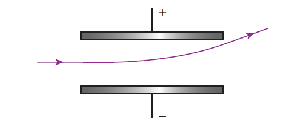
A charged particle in an electric field experiences a force:
This results in an acceleration:
The direction of acceleration depends on the sign of the charge.
Trajectory in a Uniform Field
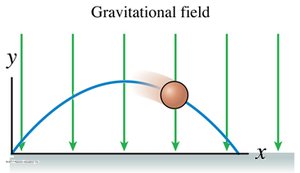
In a uniform electric field, a charged particle follows a parabolic path, analogous to projectile motion under gravity.
Applications: Cathode-Ray Tube and Millikan Oil-Drop Experiment
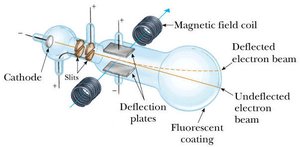
Cathode-Ray Tube (CRT)
The CRT uses electric and magnetic fields to deflect electron beams, allowing measurement of the charge-to-mass ratio of the electron.
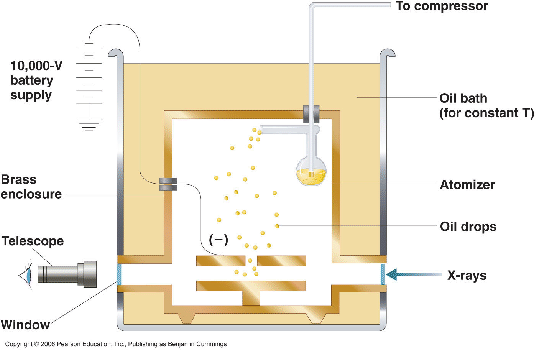
Millikan Oil-Drop Experiment
This experiment measured the elementary charge by balancing the gravitational and electric forces on tiny charged oil droplets.
Electric Dipoles
Definition and Properties
An electric dipole consists of two equal and opposite charges separated by a small distance. The dipole moment \( \vec{p} \) is defined as:
Direction: From negative to positive charge.
Dipoles in Electric Fields
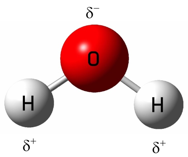
In a uniform electric field, a dipole experiences a torque that aligns it with the field but no net force. In a non-uniform field, it experiences both a torque and a net force toward regions of stronger field.
Water molecules are natural dipoles; their rotation in microwaves generates heat.
Summary Table: Electric Field Dependence on Geometry
Charge Distribution | Electric Field Dependence |
|---|---|
Point Charge | \( E \propto 1/r^2 \) |
Infinite Line | \( E \propto 1/r \) |
Infinite Plane | \( E = \text{constant} \) |
Additional info: This guide covers the main concepts, equations, and applications of electric fields as presented in Chapter 23, including both discrete and continuous charge distributions, field visualization, and the behavior of charges and dipoles in electric fields.
