 Back
BackChapter 36: Special Relativity – Concepts, Transformations, and Applications
Study Guide - Smart Notes
 Tailored notes based on your materials, expanded with key definitions, examples, and context.
Relativity: Foundations and Principles
Introduction to Relativity
Relativity is a fundamental theory in physics that revolutionizes our understanding of space, time, and motion. It is based on the principle that the laws of physics are the same in all inertial reference frames, leading to profound consequences for measurements of time, length, and simultaneity.
Inertial Reference Frame: A coordinate system in which Newton's first law (the law of inertia) holds true. All inertial frames move at constant velocity relative to each other.
Special Relativity: Developed by Albert Einstein in 1905, this theory applies to inertial frames and excludes gravity and acceleration.
General Relativity: Extends the theory to include gravity and accelerated frames (not covered in this chapter).
Reference Frames and Galilean Transformations
Reference Frames
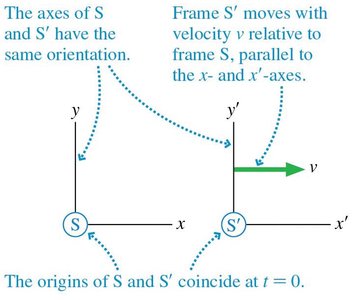
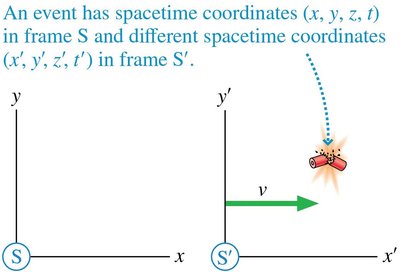
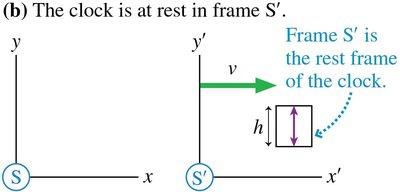
Reference frames are coordinate systems used to measure the position and time of events. Two commonly used frames are S and S', where S' moves at velocity v relative to S.
Axes: Both frames have axes (x, y, z) and (x', y', z').
Relative Motion: S' moves with velocity v relative to S, and vice versa.
Galilean Transformations
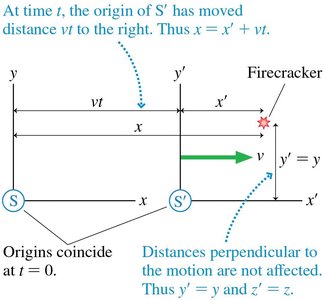
For low velocities (v << c), the Galilean transformations relate the coordinates and velocities of events in different inertial frames:
Position: , ,
Velocity: , ,
Galilean Principle of Relativity
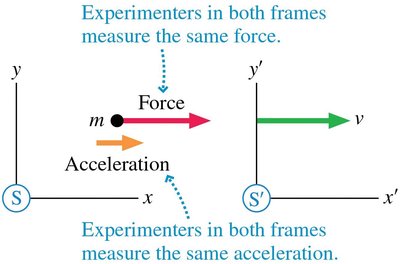
The laws of mechanics are the same in all inertial reference frames. Forces and accelerations are invariant under Galilean transformations.
Einstein’s Principle of Relativity and the Speed of Light
Einstein’s Principle of Relativity
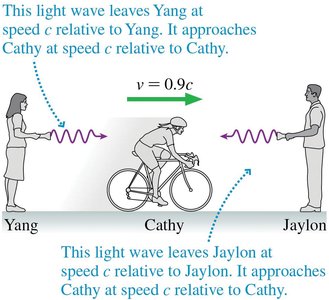
Einstein extended the principle of relativity to all the laws of physics, including electromagnetism. The speed of light in vacuum, m/s, is the same in all inertial reference frames, regardless of the motion of the source or observer.
Key Principle: No object or information can travel faster than the speed of light.
Events, Measurements, and Simultaneity
Events and Spacetime Coordinates
An event is a physical occurrence at a specific place and time, described by four spacetime coordinates (x, y, z, t) in a given reference frame.
Clock Synchronization
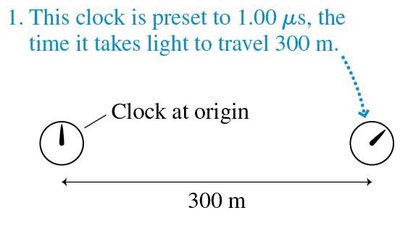
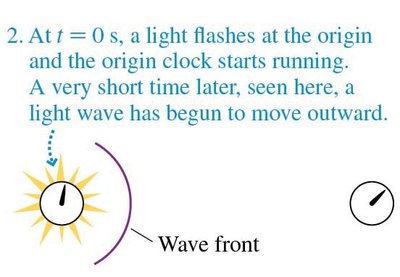
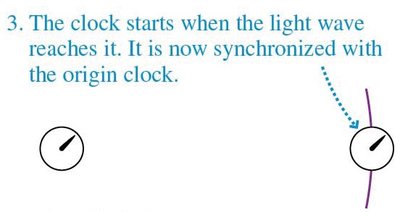
All clocks in a reference frame must be synchronized to ensure consistent time measurements. Synchronization is achieved using light signals, accounting for the travel time of light between clocks.
Simultaneity
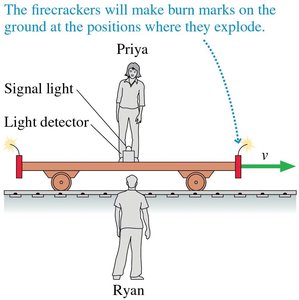
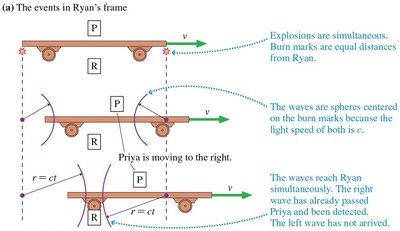
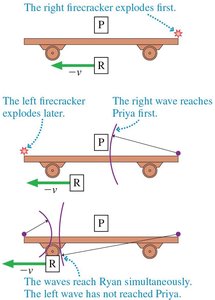
Two events are simultaneous in a reference frame if they occur at the same time according to synchronized clocks in that frame. Simultaneity is not absolute; it depends on the observer's frame of reference.
The Relativity of Simultaneity
Relativity of Simultaneity
Events that are simultaneous in one inertial frame may not be simultaneous in another moving frame. This is a direct consequence of the invariance of the speed of light and the relativity of time.
Time Dilation
Light Clock Thought Experiment
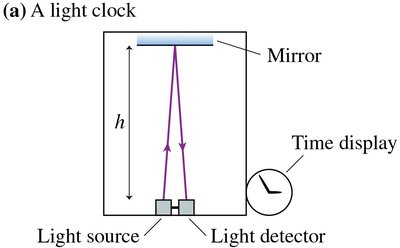
A light clock consists of a light pulse bouncing between two mirrors. In the clock's rest frame, the time for one tick is . In a frame where the clock moves at velocity v, the light travels a longer, diagonal path, leading to a longer tick interval.
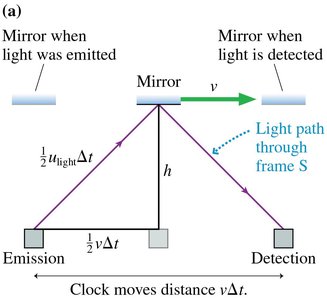
Time Dilation Formula:
Proper Time (Δτ): The time interval measured in the frame where both events occur at the same position.
Moving Clocks Run Slow: A moving clock ticks more slowly compared to a clock at rest in the observer's frame.
Applications of Time Dilation
Muons in the Atmosphere: Muons created by cosmic rays live longer (as measured on Earth) due to time dilation.
GPS Satellites: Atomic clocks on GPS satellites experience time dilation and require relativistic corrections for accurate positioning.
The Twin Paradox
Scenario and Resolution
The twin paradox involves one twin traveling at relativistic speeds while the other remains on Earth. The traveling twin ages less due to time dilation. The paradox is resolved by noting that only the Earth-bound twin remains in an inertial frame throughout; the traveling twin experiences acceleration and deceleration, breaking the symmetry.
Length Contraction
Concept and Formula
Objects moving at relativistic speeds appear contracted along the direction of motion when measured from a stationary frame. The contracted length L is given by:
Length Contraction Formula: , where is the proper length (measured in the object's rest frame).
Spacetime Interval and Lorentz Transformations
Spacetime Interval
The spacetime interval between two events is invariant under Lorentz transformations:
Spacetime Interval:
Lorentz Transformations
These equations relate the spacetime coordinates of events in different inertial frames moving at velocity v relative to each other:
Relativistic Velocity Transformation
Velocities transform differently at relativistic speeds. The Lorentz velocity transformation for motion along the x-axis is:
Relativistic Momentum and Energy
Relativistic Momentum
Relativistic Energy
Total Energy:
Rest Energy:
Kinetic Energy:
Mass-Energy Equivalence and Applications
Mass-Energy Equivalence
Mass and energy are interchangeable, as expressed by Einstein's famous equation:
Particle-Antiparticle Annihilation
When a particle meets its antiparticle, they annihilate, producing photons whose total energy equals the combined rest energy of the particles.
Nuclear Fission
Nuclear fission is a process where a heavy nucleus splits into smaller nuclei, releasing energy due to the conversion of mass into kinetic energy of the products.
Summary Table: Key Relativistic Equations
Concept | Equation | Description |
|---|---|---|
Time Dilation | Moving clocks run slow | |
Length Contraction | Moving objects contract in length | |
Lorentz Factor | Relativistic scaling factor | |
Spacetime Interval | Invariant between frames | |
Relativistic Momentum | Momentum at high speeds | |
Relativistic Energy | Total energy | |
Rest Energy | Energy at rest | |
Kinetic Energy | Relativistic kinetic energy | |
Velocity Transformation | Relativistic addition of velocities |
Applications and Modern Relevance
Relativity is essential for technologies such as GPS, particle accelerators, and nuclear energy.
It explains phenomena such as time dilation in fast-moving particles and the conversion of mass to energy in nuclear reactions.
