 Back
BackChapter 6: Circular Motion, Orbits, and Gravity – Study Notes
Study Guide - Smart Notes
 Tailored notes based on your materials, expanded with key definitions, examples, and context.
Circular Motion, Orbits, and Gravity
Introduction to Circular Motion
Circular motion is a fundamental concept in physics, describing the movement of objects along a circular path. This chapter explores the forces and accelerations involved in such motion, including orbital motion under the influence of gravity.
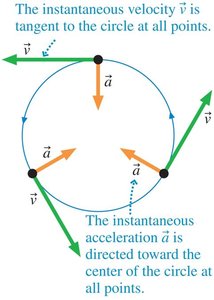
Uniform Circular Motion: An object moves at constant speed along a circular path, but its velocity changes direction continuously.
Centripetal Acceleration: The acceleration is always directed toward the center of the circle.
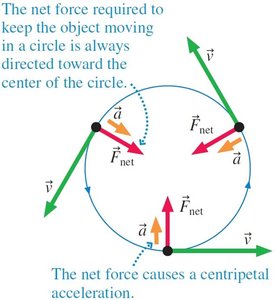
Net Force: A net force must act toward the center to maintain circular motion.

Velocity and Acceleration in Uniform Circular Motion
Although the speed is constant, the velocity vector changes direction, resulting in centripetal acceleration.
Instantaneous Velocity: Tangent to the circle at every point.
Instantaneous Acceleration: Directed toward the center of the circle.
Formula: The magnitude of centripetal acceleration is given by:
Period, Frequency, and Speed in Circular Motion
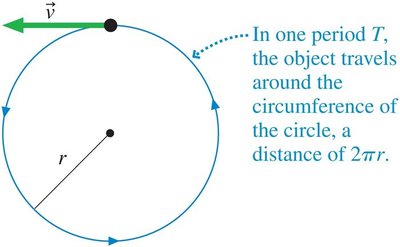
The period, frequency, and speed are key quantities describing circular motion.
Period (T): Time for one complete revolution.
Frequency (f): Number of revolutions per second, .
Speed (v): For a circle of radius r, or .
Dynamics of Uniform Circular Motion
Newton's second law applies to circular motion, relating the net force to the centripetal acceleration.
Net Force: The net force required is always directed toward the center.
Formula:
Source of Force: The net force may be provided by tension, friction, or the normal force, depending on the situation.
Forces in Circular Motion: Examples
Different forces can provide the necessary centripetal force in various scenarios.
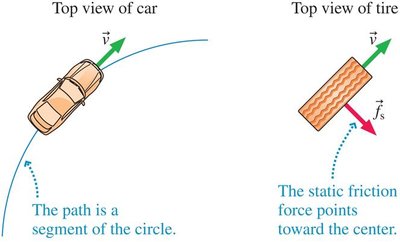
Car Rounding a Corner: Static friction between tires and road provides the centripetal force.
Ball on a String: Tension in the string provides the force.
Coin on a Turntable: Friction between the coin and the turntable provides the force.
Apparent Forces and Weight in Circular Motion
Apparent forces arise in rotating reference frames, and apparent weight can differ from true weight in circular motion.
Centrifugal Force: Not a real force; it is an apparent force felt in a rotating frame.
Apparent Weight: The normal force supporting you can be greater or less than your true weight, depending on your position in a loop.
Critical Speed: The minimum speed required to maintain contact at the top of a loop.
At the bottom of a loop: At the top of a loop:
Orbital Motion and Weightlessness
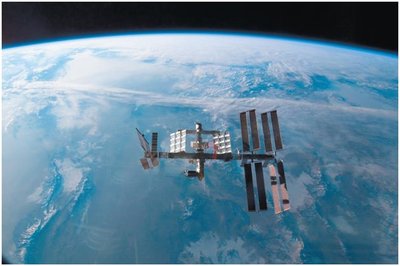
Objects in orbit are in continuous free fall, resulting in weightlessness for astronauts.
Orbital Speed: The speed required for a stable orbit is .
Weightlessness: Astronauts feel weightless because both they and their spacecraft are in free fall.
Newton’s Law of Universal Gravitation
Newton’s law describes the gravitational force between any two masses.
Inverse-Square Law: The force decreases with the square of the distance.
Formula: , where G is the gravitational constant.
Applications: Used to calculate gravitational forces between planets, satellites, and everyday objects.
Gravity and Orbits
Gravity provides the centripetal force for orbital motion. The speed and period of a satellite in orbit depend on the mass of the central body and the radius of the orbit.
Orbital Speed:
Orbital Period:
Geostationary Orbit: A satellite with a period of 24 hours remains stationary relative to the Earth's surface.
Summary Table: Key Equations in Circular Motion and Gravity
Concept | Equation | Description |
|---|---|---|
Centripetal Acceleration | Acceleration toward center | |
Net Force (Centripetal) | Force required for circular motion | |
Period | Time for one revolution | |
Frequency | Revolutions per second | |
Orbital Speed | Speed for stable orbit | |
Newton's Law of Gravity | Gravitational force | |
Orbital Speed (General) | Speed for orbit around mass M | |
Orbital Period | Period for orbit around mass M |
Applications and Examples
Car Turning a Corner: Maximum speed depends on static friction and radius of turn.
Banked Turns: Normal force provides centripetal acceleration when friction is absent.
Satellites and Space Stations: Orbital mechanics determine speed and period.
Centrifuges: Used to separate substances by applying high centripetal accelerations.
Summary of Key Concepts
Uniform circular motion requires a net force toward the center.
Apparent weight can differ from true weight in circular motion.
Gravity is a universal force obeying an inverse-square law.
Orbital motion and weightlessness are explained by free fall and gravity.
