 Back
BackChapter 6: Momentum – Study Notes for College Physics
Study Guide - Smart Notes
 Tailored notes based on your materials, expanded with key definitions, examples, and context.
Momentum
Definition and Properties
Momentum is a fundamental property of moving objects, representing "inertia in motion." It is defined as the product of an object's mass and its velocity. Momentum is a vector quantity, meaning it has both magnitude and direction.
Momentum formula: ()
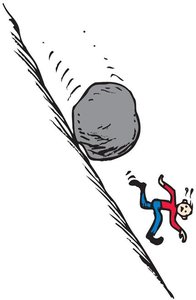
Example: A moving boulder has more momentum than a stone rolling at the same speed due to its greater mass. A fast boulder has more momentum than a slow boulder of the same mass. A boulder at rest has zero momentum.
Key Facts
Momentum is possessed only by moving objects.
Doubling the speed of an object doubles its momentum.
Momentum is related to energy and speed.
Impulse
Definition and Relationship to Momentum
Impulse is the product of force and the time interval over which the force acts. It quantifies the effect of a force acting over time and is directly related to the change in momentum of an object.
Impulse formula:
Impulse-momentum relationship:
Example: A brief force applied over a short time produces a smaller change in momentum than the same force applied over a longer time.
Impulse Changes Momentum
Increasing Momentum
Increasing the time of contact during the application of force results in a greater change in momentum. This principle is used in sports, such as golf and baseball, where following through with a swing increases the time the force acts on the ball, maximizing momentum transfer.
Example: A golfer swings a club and follows through, increasing the time of contact and thus the momentum imparted to the ball.

Decreasing Momentum Over a Long Time
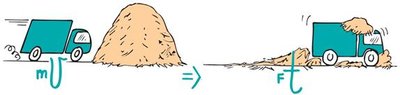
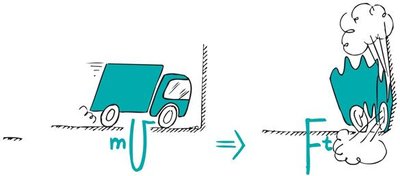
Extending the time over which momentum is reduced allows for a smaller average force to achieve the same change in momentum. This is important in safety applications, such as car crashes.
Example: A car hitting a haystack experiences the same change in momentum as hitting a wall, but the haystack increases the stopping time, reducing the force.
Decreasing Momentum Over a Short Time
When momentum is reduced over a short time interval, the force experienced is much greater. This is seen in activities such as karate, where a swift strike delivers a large force over a brief contact time.
Example: A karate expert splits bricks by striking them quickly, resulting in a large force due to the short contact time.

Additional Examples
Landing after a jump: Bending knees increases the time over which momentum decreases, reducing the force on the body.
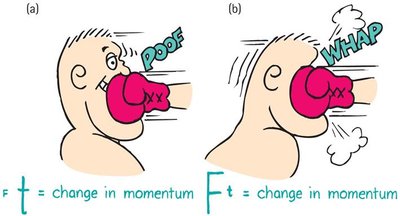
Boxing: "Riding with the punch" increases the time of impact, reducing the force experienced.
Bouncing
Impulses in Bouncing Objects
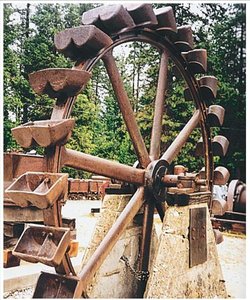
Impulses are generally greater when objects bounce, as the momentum change involves both stopping and reversing direction. This results in a "double impulse." Devices such as the Pelton wheel utilize bouncing to maximize energy transfer.
Example: Catching and throwing a flowerpot involves a greater impulse than simply catching it.
Pelton wheel: Designed to bounce water, increasing the impulse and energy transfer.
Conservation of Momentum
Law of Conservation of Momentum
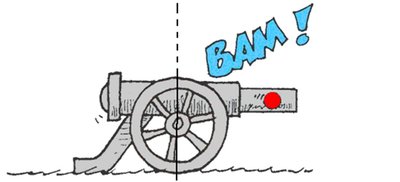
The law of conservation of momentum states that in the absence of external forces, the momentum of a system remains unchanged. This principle is fundamental in analyzing collisions and explosions.
Equation:
Example: When a cannon is fired, the momentum gained by the cannonball is equal and opposite to the momentum gained by the recoiling cannon.
Internal Forces and Momentum
Inter-molecular forces: Forces within an object cancel out, resulting in zero net impulse and no effect on the object's momentum.
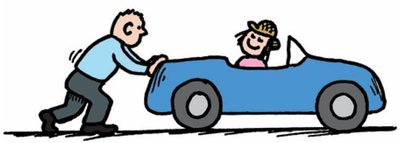
Pushing inside a car: Pushing against the dashboard does not change the car's momentum, as the force is internal to the system.
Collisions
Types of Collisions
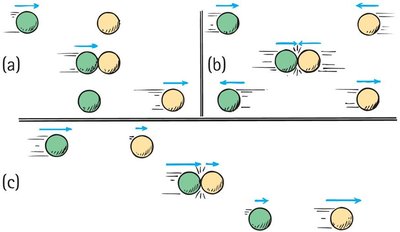
Collisions are classified as elastic or inelastic, depending on whether the objects rebound without lasting deformation or generate heat.
Elastic collision: Objects rebound without lasting deformation or heat generation.
Inelastic collision: Objects deform and/or generate heat during collision.

Conservation of Momentum in Collisions
For all collisions in the absence of external forces, the net momentum before the collision equals the net momentum after the collision.
Equation:
Example: A single car moving at 10 m/s collides with another car of the same mass at rest. After collision, both move at 5 m/s.
More Complicated Collisions
Collisions Not in a Straight Line
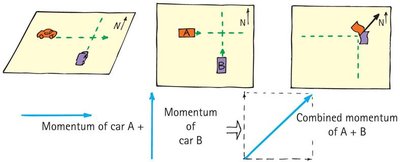
When colliding objects are not moving in the same straight line, their momenta are combined using vector addition, often represented as a parallelogram of vectors.
Example: Collision of two cars at a corner; the combined momentum is found by vector addition.
Explosions
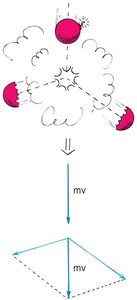
In an explosion, the vector sum of the momenta of the pieces after the explosion equals the initial momentum of the object before it exploded.
Example: A firecracker exploding; the sum of the momenta of the fragments equals the original momentum.
