 Back
BackChapter 7: Energy – Physics Study Notes
Study Guide - Smart Notes
 Tailored notes based on your materials, expanded with key definitions, examples, and context.
Energy
Introduction to Energy
Energy is a fundamental concept in physics, representing the capacity of a system to perform work. It is both a property and a process, observed when transferred or transformed. Energy is a conserved quantity, meaning it cannot be created or destroyed, only changed in form.
Definition: Energy is the property of a system that enables it to do work.
Conservation: The total energy in a closed system remains constant.
Observation: Energy is evident during transfer or transformation between systems.
Work
Definition and Characteristics
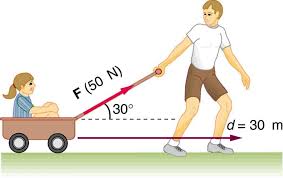
Work provides a link between force and energy. It is done when a force causes displacement of an object. The amount of work does not depend on the time taken or the velocity/acceleration of the object.
Formula: (Work equals force times distance)
Requirements: Application of force and movement by that force
Categories: Work against a force (e.g., lifting a box), work to change speed (e.g., hitting a golf ball)
Scalar Quantity: Work has magnitude but no direction.
Sign: Positive if force and displacement are in the same direction; negative if opposite.
Units: SI unit is the Joule (J), where

Examples and Applications
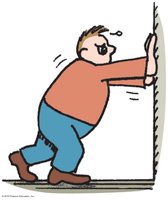
Pushing a stationary wall: No work is done on the wall, though muscles may do work internally.
Lifting a barbell: Work is done against gravity; doubling the weight doubles the work for the same distance.
Pushing a cart: Doubling the distance with constant force doubles the work done.
Mechanical Energy
Forms of Mechanical Energy
Mechanical energy is the energy due to the position or motion of an object. It is classified into two main types:
Kinetic Energy: Energy of motion
Potential Energy: Energy due to position
Work-Energy Theorem & Kinetic Energy
Work-Energy Theorem
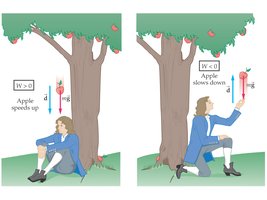
The work-energy theorem states that the total work done on an object is equal to its change in kinetic energy. Positive work increases speed; negative work decreases speed.
Formula:
Gain or reduction: Work results in a gain or reduction of energy.


Kinetic Energy
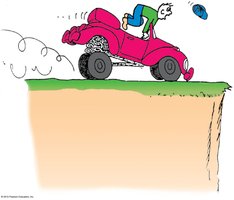
Kinetic energy is the energy possessed by a moving object. It depends on the mass and the square of the speed.
Formula:
Doubling speed: Quadruples kinetic energy.
Relation to momentum: Any moving object has both momentum and kinetic energy.

Potential Energy
Definition and Types
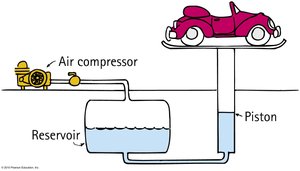
Potential energy is stored energy due to an object's position or configuration. It is held in readiness to do work.
Examples: Stretched bow, stretched rubber band
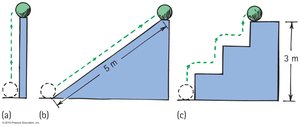
Gravitational Potential Energy: Energy due to elevated position
Formula: (mass × gravity × height)
Reference Level: Potential energy is relative to a chosen reference level, often Earth's surface.
Power
Definition and Characteristics
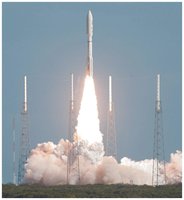
Power measures how quickly work is done or energy is transferred. It is the rate of doing work.
Formula:
Units: Watt (W), where
Conversions: ,
Examples and Applications
Running up stairs: Requires more power than walking up slowly.
Engines: Twice the power can do twice the work in the same time or the same work in half the time.
Conservation of Energy
Law of Conservation of Energy
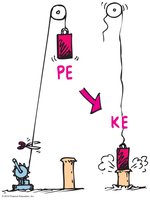
The law of conservation of energy states that energy cannot be created or destroyed, only transformed from one form to another. The total energy in a system remains constant.
Example: Energy transforms without net loss or gain in a pile driver.
Bow and Arrow: Work done in drawing the bow gives it potential energy, which is transferred to the arrow as kinetic energy and some as heat.


Kinetic Energy and Momentum Compared
Comparison Table
Both kinetic energy and momentum are properties of moving objects, but they differ in their mathematical and physical characteristics.
Property | Kinetic Energy | Momentum |
|---|---|---|
Type | Scalar | Vector |
Can be canceled? | No | Yes (directional) |
Formula | ||
Depends on | Mass and speed squared | Mass and velocity |
