 Back
BackCircular Dynamics and Orbits: Banked Curves, Force Analysis, and Satellite Motion
Study Guide - Smart Notes
 Tailored notes based on your materials, expanded with key definitions, examples, and context.
Circular Dynamics and Orbits
Overview of Circular Motion and Dynamics
Circular motion is a fundamental concept in physics, describing the movement of objects along a circular path. This topic covers the kinematics and dynamics of circular motion, including the forces involved, the role of friction, and applications such as banked curves and satellite orbits.
Position, Velocity, and Acceleration: In circular motion, position is described by angular position (θ), velocity by angular velocity (ω), and acceleration by angular acceleration (α).
Key Equations:
Linear velocity:
Linear acceleration (tangential):
Angular velocity:
Angular acceleration:
Newton's Second Law:
Torque:
Rotational analog:
Conservation Laws: Work, energy, and momentum principles apply to rotational systems as well.
Banked Curves
Banked curves are engineered to allow vehicles to safely navigate turns at higher speeds than would be possible on a flat surface. The banking angle helps provide the necessary centripetal force through the normal force, reducing reliance on friction.
Purpose: To increase the maximum safe speed and provide a safety margin against loss of traction.
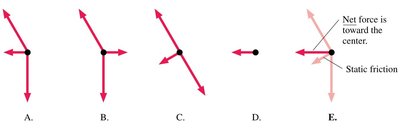
Force Analysis: The forces acting on a car in a banked curve include gravity, the normal force, and friction. The net force must point toward the center of the circle for uniform circular motion.
Coordinate Systems: The choice of coordinate system (e.g., r-z or x-y) depends on the problem and can simplify the analysis of forces.
Force Equations (r-z system):
Vertical (z):
Radial (r):
Comparison with Flat Road
On a flat road, the static friction provides the entire centripetal force required for circular motion, while the normal force balances gravity.
Flat Road Equations:
Radial:
Vertical:
Banked Curve Advantage: The normal force contributes to the centripetal force, reducing the need for friction.
Circular Orbits
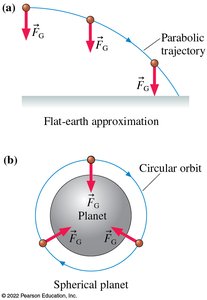
When an object moves at high speed near a planet, its trajectory can become a circular orbit. In this case, gravity provides the necessary centripetal force for uniform circular motion.
Flat-Earth vs. Spherical-Earth Approximation: For small distances, gravity is considered constant and downward. For orbits, gravity is always directed toward the planet's center.
Velocity for Circular Orbit: (near Earth's surface)
Example Calculation: For Earth, m, m/s², so m/s.
Period of Orbit:
Low-Earth Orbit: Period is about 90 minutes.

Geostationary and Geosynchronous Orbits
Satellites in geostationary orbits remain fixed above a point on the equator, matching Earth's rotation period (24 hours). Geosynchronous orbits have the same period but may be inclined relative to the equator.
Applications: Geostationary orbits are ideal for communications satellites, as they do not move relative to a point on Earth's surface.
Distance from Earth's Center: Geostationary satellites are approximately 36,000 km from Earth's center.
Dynamics of Non-Uniform Circular Motion
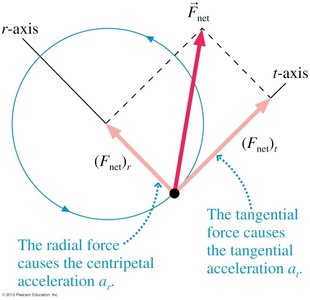
When the speed of an object in circular motion changes, there is a tangential acceleration in addition to the radial (centripetal) acceleration. The net force must have both radial and tangential components.
Radial Force: Causes centripetal acceleration, always points toward the center of the circle.
Tangential Force: Causes tangential acceleration, changes the speed of the object along the path.
Newton's Second Law (circular coordinates):
Radial:
Tangential:
Force and Acceleration in Circular Motion: Example Problems
Several discussion questions explore the direction of net force, the orientation of axes, and the calculation of angular acceleration for a ball rolling inside a horizontal pipe. These problems reinforce the concepts of force decomposition and the relationship between net force and acceleration in circular motion.
Key Concepts:
Net force always points toward the center for uniform circular motion.
For non-uniform motion, tangential components must be considered.
Angular acceleration can be related to forces using , where is torque and is moment of inertia.
Summary Table: Types of Circular Motion
Type | Forces Involved | Key Equations | Examples |
|---|---|---|---|
Uniform Circular Motion | Centripetal (radial) force | Satellite in low-Earth orbit | |
Non-Uniform Circular Motion | Centripetal + Tangential force | Car accelerating on a curved road | |
Banked Curve | Normal force, friction, gravity | Highway exit ramps | |
Geostationary Orbit | Gravity (centripetal) | hours, km | Communications satellites |
