 Back
BackCircular Dynamics and Uniform Circular Motion
Study Guide - Smart Notes
 Tailored notes based on your materials, expanded with key definitions, examples, and context.
Circular Dynamics and Uniform Circular Motion
Introduction to Circular Dynamics
Circular dynamics is the study of the motion of objects along circular paths and the forces that cause such motion. This topic is fundamental in physics, as it connects linear and rotational motion, and introduces key concepts such as centripetal acceleration and force.
Relating Linear and Angular Motion
Linear and Angular Velocity: The tangential (linear) velocity v of a point on a rotating object is related to its angular velocity ω by the equation: where r is the radius from the axis of rotation.
Distance Traveled: The arc length Δs traveled along the edge of a circle is given by: where Δθ is the angular displacement in radians.
Unit Consistency: Radians are dimensionless, so ensure angular velocity is in rad/s when using these formulas.
Example: If a wheel of radius 0.5 m rotates at 2 rad/s, the tangential velocity at the rim is m/s.
Rotational and Linear Analogues
Many concepts in linear motion have direct analogues in rotational motion:
Linear | Rotational |
|---|---|
Position (x) | Angular Position (θ) |
Velocity (v) | Angular Velocity (ω) |
Acceleration (a) | Angular Acceleration (α) |
Mass (m) | Moment of Inertia (I) |
Force (F) | Torque (τ) |
Newton's 2nd Law: | Rotational: |
Kinetic Energy: | Rotational: |
Components of Acceleration in Circular Motion
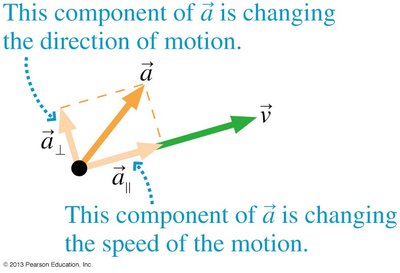
In circular motion, acceleration can be decomposed into two components:
Tangential Acceleration (a∥): Changes the speed of the object.
Radial (Centripetal) Acceleration (a⊥): Changes the direction of the velocity, always points toward the center of the circle.
Centripetal Acceleration
For an object moving at constant speed in a circle, the acceleration is always directed toward the center of the circle (centripetal). The magnitude of this acceleration is:
This acceleration is required to keep the object moving in a circle; without it, the object would move in a straight line.
Example: A car turning in a circle of radius 20 m at 10 m/s has a centripetal acceleration of m/s2.
Uniform Circular Motion
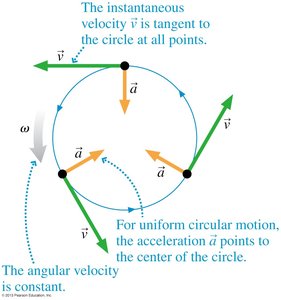
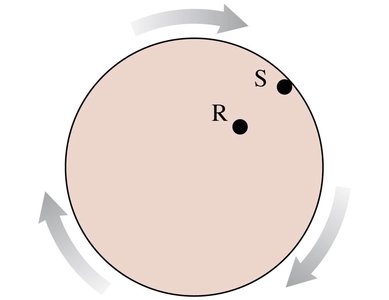
Uniform circular motion occurs when an object moves in a circle at constant speed. Key characteristics include:
Angular Frequency:
Tangential Velocity:
Radial Acceleration:
Acceleration in the tangential and z axes is zero; if not, the motion is non-uniform or helical.
Forces in Uniform Circular Motion
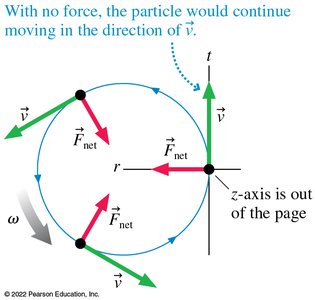
The net force required to keep an object in uniform circular motion is called the centripetal force. This is not a new type of force, but rather the name for the net force directed toward the center of the circle, provided by gravity, tension, friction, etc.:
There is no net force in the tangential or z directions for uniform circular motion.
Example: Car Turning a Corner
Consider a car of mass 1500 kg turning a corner of radius 50 m on a level road. The maximum speed before sliding is determined by the maximum static friction force:
Step 1: Model the Problem - The car is modeled as a particle in uniform circular motion, with static friction providing the centripetal force.
Step 2: Visualize - The direction of static friction is radial, preventing the car from sliding outward.
Step 3: Apply Newton's 2nd Law - In the radial direction: ; in the vertical direction: .
Step 4: Solve for Maximum Velocity - The maximum static friction is . Setting gives:
Step 5: Evaluate - For dry asphalt (): m/s (44.3 mph). For wet asphalt (): m/s (35.1 mph).

Summary Table: Key Equations for Circular Motion
Quantity | Linear | Rotational |
|---|---|---|
Displacement | ||
Velocity | ||
Acceleration | ||
Force |
Additional info: The notes also discuss the importance of static friction in real-world applications, such as car safety, and the distinction between centripetal (center-seeking) and centrifugal (apparent, outward) forces. Only the centripetal force is real in the inertial frame.
