 Back
BackCircular Motion and Gravity: Study Notes
Study Guide - Smart Notes
 Tailored notes based on your materials, expanded with key definitions, examples, and context.
Circular Motion and Gravity
Uniform Circular Motion
Uniform circular motion describes the movement of an object at a constant speed along a circular path. The net force required for this motion always points toward the center of the circle, known as the centripetal force.
Centripetal Force: The net force that keeps an object moving in a circle, always directed toward the center.
Magnitude of Centripetal Force: , where m is mass, v is tangential speed, and r is the radius of the circle.
Period (T) and Frequency (f): , where T is the time for one complete revolution and f is the number of revolutions per second.
Universal Law of Gravitation
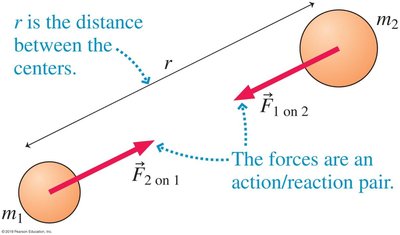
All objects with mass attract each other with a force that is proportional to the product of their masses and inversely proportional to the square of the distance between their centers. This is described by Newton's Law of Universal Gravitation.
Gravitational Force Equation:
Gravitational Constant:
Action-Reaction Pair: The force that m1 exerts on m2 is equal in magnitude and opposite in direction to the force that m2 exerts on m1 (Newton's Third Law).
Gravitational Acceleration on Earth
The acceleration due to gravity at Earth's surface, denoted as g, is derived from the universal law of gravitation. It depends on Earth's mass and radius.
Earth's Mass:
Earth's Radius:
Gravitational Acceleration:
Weight: The force Earth exerts on a mass is
Variation of Gravitational Acceleration with Altitude
Gravitational acceleration decreases with altitude above Earth's surface. The change is small for elevations like Mt. Everest but becomes significant at greater heights.
At Altitude h:
Example: At the top of Mt. Everest ( m), decreases by about 0.3% compared to sea level.
10% Decrease: To decrease by 10%, you must be much farther from Earth's surface.
Gravity on the Moon
The Moon's gravity is much weaker than Earth's due to its smaller mass and radius. This affects how high and far you can jump on the Moon compared to Earth.
Moon's Mass:
Moon's Radius:
Moon's Surface Gravity:
Jump Height and Distance: You can jump about 6 times higher and farther on the Moon than on Earth, assuming the same initial speed and angle.
Orbits and Circular Motion
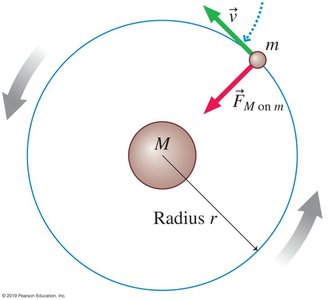
Orbital motion is a special case of uniform circular motion where the gravitational force provides the necessary centripetal force. The speed required for a stable circular orbit depends on the mass of the central body and the orbital radius.
Orbital Speed:
Relationship: The gravitational force equals the required centripetal force:
Note: is the distance from the center of the central mass (not just the surface).
Projectile Motion and Orbits
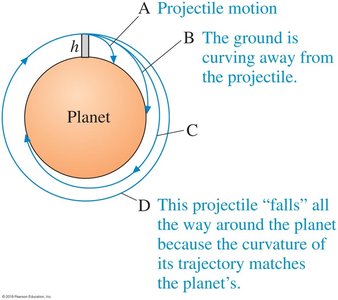
If a projectile is launched horizontally with sufficient speed, the curvature of its trajectory can match the curvature of the planet, resulting in continuous free fall—an orbit.
Concept: The ground curves away beneath the projectile at the same rate it falls, so it never lands.
Application: This is the principle behind satellites in low Earth orbit.
Apparent Weightlessness in Orbit
In orbit, astronauts experience weightlessness not because gravity is absent, but because they are in continuous free fall around Earth. The normal force (apparent weight) becomes zero.
Apparent Weight:
In Orbit: Since ,
Misconception: Gravity is still present in orbit; objects are just in free fall.
Orbital Periods and Kepler's Third Law
Kepler's Third Law relates the period of an orbit to its radius. For a planet or satellite orbiting a mass M at radius r:
Orbital Period:
Kepler's Law: (constant for a given central mass)
Application: Used to determine the mass of the Sun or planets by observing orbital periods and radii.
Geostationary Orbits
A geostationary satellite orbits Earth with a period equal to Earth's rotation (24 hours), remaining above the same point on the equator. The required orbital radius can be calculated using the period and Earth's mass.
Geostationary Orbit Radius:
Typical Value: km from Earth's center
Altitude Above Surface: Subtract Earth's radius from the orbital radius to find the satellite's altitude.
