 Back
BackCircular Motion and Gravity: Uniform and Non-Uniform Circular Motion
Study Guide - Smart Notes
 Tailored notes based on your materials, expanded with key definitions, examples, and context.
Circular Motion and Gravity
Review of Newton’s Laws and Apparent Weight
Before delving into circular motion, it is important to recall key aspects of Newton’s Laws as they relate to forces in various systems:
Apparent weight is the normal force you feel, which can differ from your actual weight depending on acceleration.
Tension in an ideal rope is constant throughout, and pulleys only change its direction.
Springs exert a restoring force proportional to displacement, described by Hooke’s Law:
Uniform Circular Motion (UCM)
Definition and Characteristics
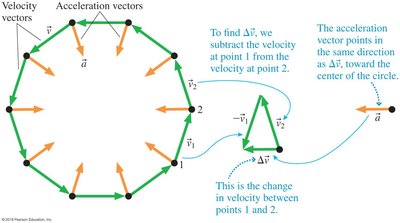
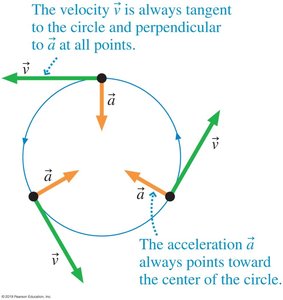
Uniform circular motion describes the motion of an object traveling at constant speed along a circular path. Although the speed is constant, the velocity is not, because the direction changes continuously. This means the object is always accelerating, even if its speed does not change.
Speed is constant, but velocity (a vector) changes direction.
The acceleration is always directed toward the center of the circle (centripetal acceleration).
The motion is periodic, repeating after a fixed interval called the period.
Period and Frequency
The period (T) is the time for one complete revolution, and the frequency (f) is the number of revolutions per unit time. They are related by:
SI unit of period: seconds (s); SI unit of frequency: Hertz (Hz)
Speed in Uniform Circular Motion
The speed of an object in uniform circular motion can be expressed as:
Alternatively,
Centripetal (Radial) Acceleration
The acceleration responsible for changing the direction of velocity (not its magnitude) is called centripetal acceleration:
Always points toward the center of the circle
Centripetal Force
The net force required to keep an object moving in a circle (centripetal force) is:
Example: Centrifuge
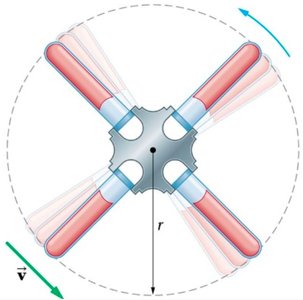
A centrifuge spins test tubes in a circle to separate substances by density. If the linear speed at the bottom of the tube is 100 m/s and the radius is 0.1 m, the centripetal acceleration is:
Expressed in terms of (acceleration due to gravity):
Example: Centripetal Acceleration of the Moon
Given the Moon’s orbital radius m and period s, the centripetal acceleration is:
Plugging in values:
Relative to : (very small)
Applications of Uniform Circular Motion
Air Hockey Example (Horizontal Circular Motion)
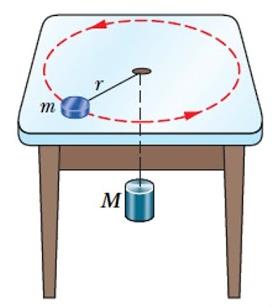
A puck of mass moves in a circle on a frictionless table, attached by a string to a hanging mass . The speed required to keep the block at rest is found by equating the tension (from the block’s weight) to the required centripetal force:
Combining:
Tetherball Example (Circular Motion in 3D)
When a ball moves in a horizontal circle at the end of a rope (tetherball), the horizontal component of the rope’s tension provides the centripetal force:
The vertical component balances weight:
Solving for : , where is the rope length
Non-Uniform Circular Motion (NUCM)
Vertical Circular Motion
When an object moves in a vertical circle (e.g., a ball on a string), the tension and weight both contribute to the net force, but their contributions vary with position:
At the top: (tension is smallest)
At the bottom: (tension is largest)
Friction and Circular Motion: Cars on Curves
Flat Curves
For a car of mass on a flat curve of radius , the maximum speed before sliding is determined by the maximum static friction force :
Maximum speed:
Banked Curves
Banking a curve allows higher speeds without relying solely on friction. The normal force provides a horizontal component for centripetal acceleration:
Horizontal force:
Vertical force:

Summary Table: Key Equations in Circular Motion
Quantity | Symbol | Equation | Notes |
|---|---|---|---|
Period | T | Time for one revolution | |
Frequency | f | Revolutions per second | |
Centripetal Acceleration | Points to center | ||
Centripetal Force | Net inward force |
