 Back
BackCosmology and the Evolution of the Universe: A Physics Study Guide
Study Guide - Smart Notes
 Tailored notes based on your materials, expanded with key definitions, examples, and context.
The Universe and Cosmology
Introduction to Cosmology
Cosmology is the scientific study of the large scale properties, origin, evolution, and eventual fate of the universe. It seeks to answer fundamental questions about the universe's structure, composition, and history.
Cosmology investigates the universe as a whole, including its beginning, expansion, and large-scale structure.
Modern cosmology is grounded in physics, particularly in the theories of relativity and quantum mechanics.
Key questions include: "Where did it all come from?" and "How does the universe evolve?"
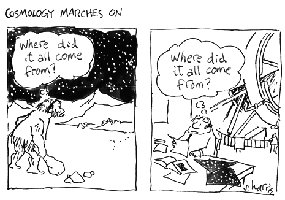
The Standard Models: Particle Physics and Cosmology
Two Standard Models
Physics uses two major frameworks to describe the universe: the Standard Model of Particle Physics (describing the smallest scales) and the Standard Model of Cosmology (describing the largest scales).
Particle Physics: Describes the fundamental particles and forces at scales of ~10-17 cm.
Cosmology: Describes the universe at scales up to ~1028 cm.
Observational Cosmology: Hubble's Discoveries
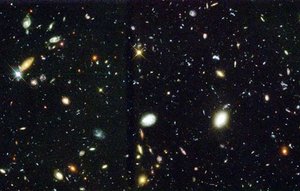
The Hubble Deep Field
The Hubble Space Telescope provided deep images of the universe, revealing thousands of galaxies at various stages of evolution. This allowed astronomers to study the universe's structure and history.
Hubble's Law and the Expanding Universe
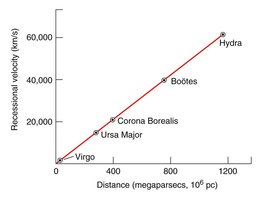
Edwin Hubble discovered that distant galaxies are moving away from us, and the farther a galaxy is, the faster it recedes. This relationship is known as Hubble's Law and is evidence for the expansion of the universe.
Hubble's Law:
Where is the recessional velocity, is the Hubble constant, and is the distance to the galaxy.
This discovery overturned the idea of a static universe and led to the concept of the Big Bang.
The age of the universe is estimated to be billion years.

Expansion of the Universe and Redshift
Redshift and the Stretching of Light
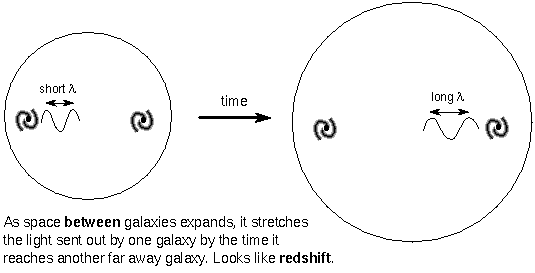
As the universe expands, the light from distant galaxies is stretched to longer wavelengths, a phenomenon known as redshift. This effect provides direct evidence for the expansion of space itself.
Redshift (): The fractional increase in wavelength due to the expansion of the universe.
As space expands, photons traveling through it are stretched, increasing their wavelength and shifting their color toward the red end of the spectrum.
This is observed as a cosmological redshift in the spectra of distant galaxies.
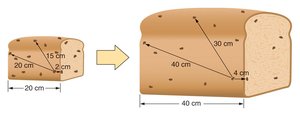
Expansion Analogy: Raisin Bread Model
The expansion of the universe can be visualized using the analogy of a loaf of raisin bread rising. As the dough (space) expands, the raisins (galaxies) move apart, not because they are moving through the dough, but because the dough itself is expanding.
Galaxies are not moving through space, but with space as it expands.
This analogy helps explain why all galaxies appear to be moving away from each other.
The Big Bang Theory
Origin and Evolution of the Universe
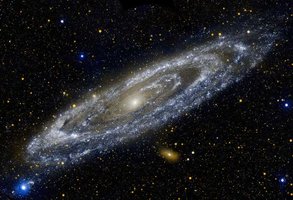
The Big Bang theory posits that the universe began as a hot, dense state and has been expanding and cooling ever since. Looking farther into space is equivalent to looking back in time, allowing astronomers to study the early universe.
The universe began approximately 13.8 billion years ago from a singular, extremely hot and dense state.
As the universe expanded, it cooled, allowing matter to form and structures to develop.
The Big Bang did not occur at a single point, but everywhere in space simultaneously.
Observational Evidence for the Big Bang
There are three main lines of evidence supporting the Big Bang model:
Cosmological Redshift: The observed redshift of galaxies' spectral lines.
Cosmic Microwave Background (CMB): The residual thermal radiation from the early universe, now observed as microwave radiation at about 3 K.
Primordial Element Abundances: The observed hydrogen to helium mass ratio (about 3:1) matches predictions from Big Bang nucleosynthesis.
Timeline of the Universe
Major Eras in Cosmic Evolution
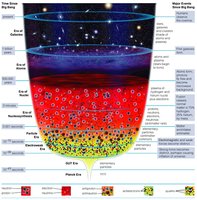
The history of the universe is divided into several key eras, each characterized by different physical processes and structures.
Electroweak Era: Only photons and energy, no ordinary particles.
Particle Era: Formation of matter and antimatter; slight excess of matter leads to the matter-dominated universe.
Era of Nucleosynthesis: Formation of light nuclei (hydrogen, helium, lithium) within the first few minutes.
Era of Nuclei: Nuclei capture electrons, universe becomes transparent, CMB is released.
Era of Atoms: Atoms form, cooling continues, protogalactic clouds develop.
Era of Galaxies: Galaxies and large-scale structures form.
Large-Scale Structure of the Universe
Superclusters, Voids, and the Cosmic Web
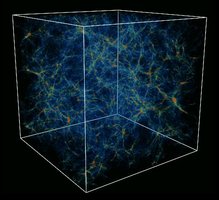
The universe is organized into a vast network of galaxies, clusters, and superclusters, separated by enormous voids. This structure resembles a "soap-bubble" or cosmic web, with galaxies concentrated along filaments and sheets.
Superclusters: Large groupings of galaxy clusters.
Voids: Vast, relatively empty regions between filaments of galaxies.
The distribution of matter is not random but follows a web-like pattern.
Stellar Evolution and Nucleosynthesis
Origin of Stars and Elements
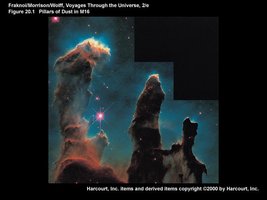
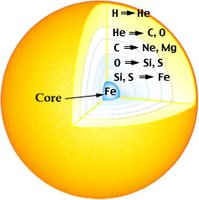
Stars form in nebulae—clouds of hydrogen gas—and undergo nuclear fusion, creating heavier elements. The process of nucleosynthesis in stars and supernovae is responsible for the chemical elements found in the universe.
Stellar Nucleosynthesis: Fusion of hydrogen into helium, and subsequently into heavier elements up to iron in massive stars.
Elements heavier than iron are formed during supernova explosions.
Fate of the Universe
Possible Scenarios for Cosmic Evolution
The ultimate fate of the universe depends on its density and the properties of dark energy. Three main scenarios are considered:
Closed Universe: High density leads to eventual collapse (Big Crunch).
Flat Universe: Critical density, expansion slows but never stops.
Open Universe: Low density, expansion continues forever.
Current evidence suggests the expansion is accelerating due to dark energy, with the universe composed of about 1/3 matter and 2/3 dark energy.
Summary Table: Key Evidence for the Big Bang
Evidence | Description |
|---|---|
Cosmological Redshift | Galaxies' spectral lines are shifted to longer wavelengths, indicating expansion. |
Cosmic Microwave Background | Uniform microwave radiation at 3 K, relic of the early hot universe. |
Primordial Element Abundances | Observed H/He/Li ratios match predictions from Big Bang nucleosynthesis. |
Key Equations
Hubble's Law:
Redshift:
Critical Density:
