 Back
BackDynamics and Forces: Newton's Laws, Friction, and Applications
Study Guide - Smart Notes
 Tailored notes based on your materials, expanded with key definitions, examples, and context.
Newton's Laws of Motion and Forces
Kinematics with Constant Acceleration
Kinematics describes the motion of objects without considering the forces that cause the motion. For constant acceleration, several key equations relate displacement, velocity, acceleration, and time:
Displacement:
Final velocity:
Velocity squared:
Average velocity: ,
In two dimensions, add appropriate subscripts for each axis, e.g., , .
Projectile Motion
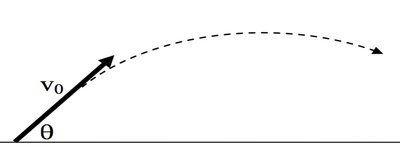
Projectile motion is a classic example of two-dimensional kinematics, where an object is launched with an initial velocity at an angle to the horizontal. The motion can be analyzed by breaking it into horizontal and vertical components:
Horizontal velocity:
Vertical velocity:
Acceleration: Only vertical acceleration due to gravity,
Forces and Newton's Laws
Definition of Force
A force is a quantitative measure of a push or pull, and is a vector quantity (having both magnitude and direction). Forces act ON one object BY another object, and are denoted as (force on A by B).
Newton's First Law (Law of Inertia)
Newton's First Law states that an object remains in its state of motion (at rest or moving at constant velocity) unless acted upon by a net force. In mathematical terms:
If , then is constant.
Newton's Second Law
Newton's Second Law relates the net force acting on an object to its acceleration:
Mass () is a measure of inertia, in units of kilograms (kg).
The direction of is the direction of .
Newton's Third Law
Newton's Third Law states that for every action, there is an equal and opposite reaction:
Action-reaction pairs are always of the same type and act on different objects.
Free Body Diagrams (FBD)
A Free Body Diagram is a graphical representation of all the forces acting on a single object. It helps in analyzing the net force and solving dynamics problems.
Applications of Newton's Laws
Elevator Problems
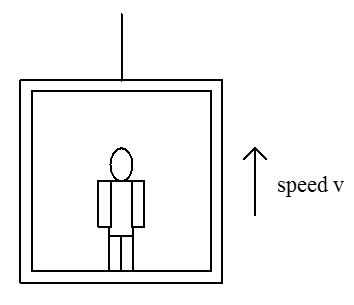
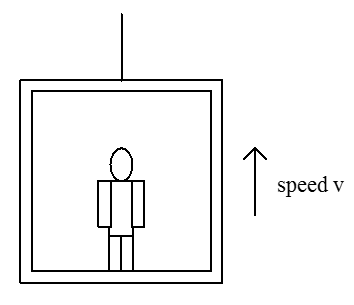
When analyzing forces in an elevator, consider the normal force () and weight ():
If the elevator moves at constant speed, .
If the elevator accelerates upward, .
If the elevator accelerates downward, .
Inclined Plane and Forces
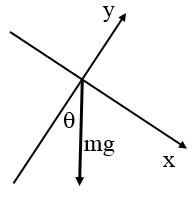
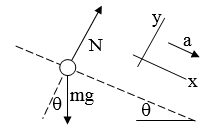
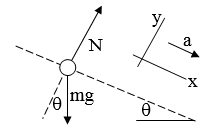
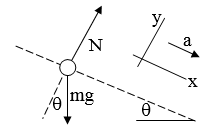
On an inclined plane, the weight vector can be decomposed into components parallel and perpendicular to the surface:
Parallel:
Perpendicular:
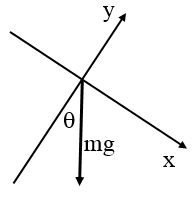
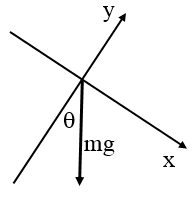
Block-on-a-Ramp
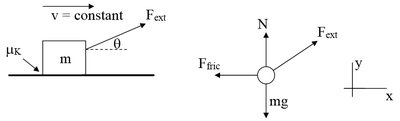
When a block rests or moves on a ramp, the normal force and friction must be considered. The normal force is , and the friction force (if present) is for kinetic friction.
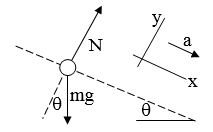
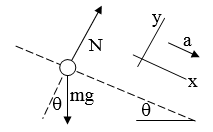
Friction
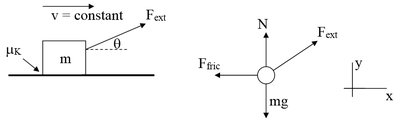
Friction opposes relative motion between surfaces. There are two main types:
Kinetic friction:
Static friction: (adjusts up to a maximum value)
Atwood's Machine
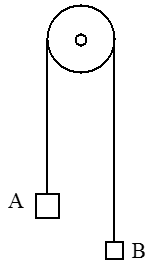
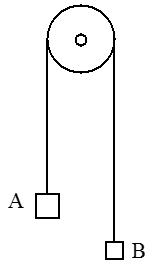
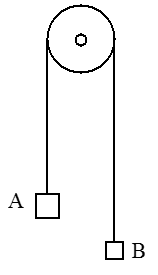
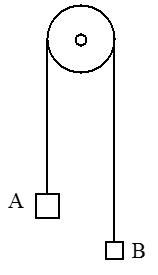
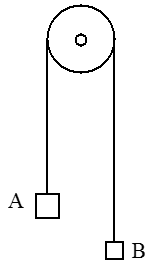
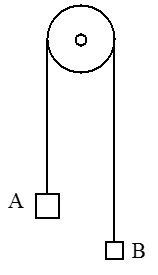
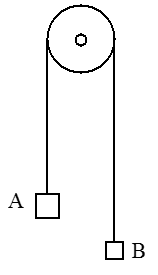
An Atwood's machine consists of two masses connected by a string over a pulley. The tension in the string and the acceleration of the masses can be found using Newton's Second Law:
For mass A:
For mass B:
Solving for :
Conical Pendulum
A conical pendulum is a mass moving in a horizontal circle, suspended by a string. The tension in the string has both vertical and horizontal components:
Vertical:
Horizontal: provides the centripetal force
Total tension:
Summary Table: Types of Forces
Force Type | Formula | Direction | Notes |
|---|---|---|---|
Weight | Downward | Local gravity | |
Normal | No general formula | Perpendicular to surface | Adjusts to balance other forces |
Tension | No general formula | Along string/rope | Only pulls |
Kinetic Friction | Opposes motion | Depends on surfaces | |
Static Friction | Opposes potential motion | Adjusts up to max |
Problem-Solving Strategy
Draw a Free Body Diagram (FBD) for the object.
Choose a coordinate system (often aligning axes with acceleration or incline).
Write out Newton's Second Law for each axis: , .
Solve for unknowns (forces, acceleration, etc.).
Additional info:
All images included are directly relevant to the explanation of the adjacent paragraphs, visually reinforcing concepts such as projectile motion, inclined planes, friction, Atwood's machine, and conical pendulum.
Some images are repeated for clarity and completeness in matching the explanation to the visual representation.
