 Back
BackElectric Charge and Coulomb’s Law: Study Notes
Study Guide - Smart Notes
 Tailored notes based on your materials, expanded with key definitions, examples, and context.
Electric Charge
Quantization and Conservation of Charge
Electric charge is a fundamental property of matter that determines the electromagnetic interaction between particles. The charge of free particles is quantized in units of the elementary charge C, so any charge can be written as where is an integer (including zero and negative values).
Quantization: Only certain discrete values of charge are possible for free particles.
Quarks: Have charges of or , but are never found as free particles.
Conservation: The net charge in any physical process is conserved; objects may exchange charge, but the total charge remains constant.
Insulators and Conductors
Properties and Examples
Materials are classified based on the mobility of their charge carriers.
Conductors: Materials where some charge carriers (typically electrons) are free to move. Examples include metals, ionized gases, electrolytes, and plasmas.
Insulators: Materials in which all electrons are bound to atoms and cannot move. Examples include glass, rubber, wood, plastic, and salt.
Electron Concentration: Metals have a high concentration of free electrons ( cm), while insulators have nearly zero.
Charge Distribution in Conductors and Insulators
When charged, conductors and insulators behave differently:
Conductors: Charge spreads uniformly over the surface.
Insulators: Charge remains localized at the point of charging.
Charging Methods: Insulators can be charged by friction; conductors can be charged by induction.
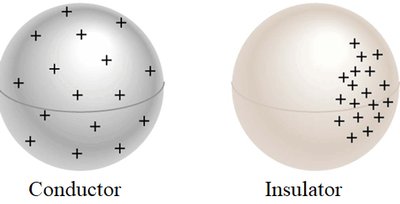
Charging by Induction
Charging by induction involves bringing a charged object near a conductor, causing redistribution of charges without direct contact. 
Coulomb’s Law
Force Between Point Charges
Coulomb’s law describes the force between two point charges:
The force is proportional to the product of the charges and inversely proportional to the square of the distance between them.
The force acts along the line connecting the charges.
It is attractive for opposite charges and repulsive for like charges.
Mathematical Expression: where , , and N·m/C$^2$. 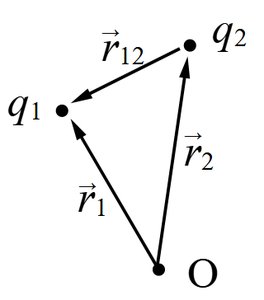
Coulomb’s Constant and Vacuum Permittivity
Coulomb’s constant:
Vacuum permittivity: C/(N·m$^2$)
Superposition Principle for Multiple Charges
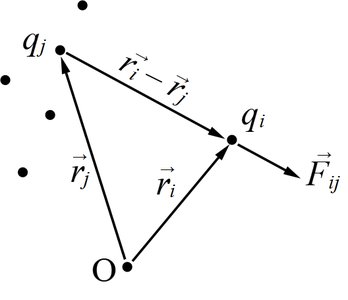
When multiple charges are present, the net force on any charge is the vector sum of the individual Coulomb forces from all other charges.
Net force on charge :
Vector notation: ,
Newton’s third law:
Net force on the system: (the sum of all internal forces is zero)
Exercises: Applications of Coulomb’s Law
Exercise 1: Four Point Charges at Square Corners
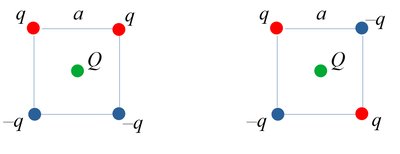
Four point charges (two and two ) are placed at the corners of a square of side . Find the force on a charge at the center for two arrangements.
Arrangement 1: Opposite corners have like charges.
Arrangement 2: Adjacent corners have like charges.
Given: C, C, cm.
Exercise 2: Force on Central Charge with Different Corner Charges
Find the magnitude of the force exerted on a charge nC located at the center of a square of side cm, with corner charges , , , and $q$. 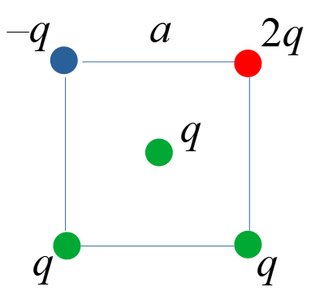
Exercise 3: Three Charges Along the x-axis
Three charges are placed along the x-axis at positions C), $6$ m ($q = -3 \mu m (C). Determine the force exerted on charge by and . 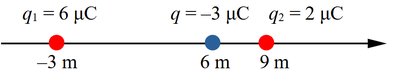
Exercise 4: Zero Net Force Position
Two charged particles lie along the x-axis: mC at the origin and mC at m. Where should a positive charge be placed so that the resultant force on it is zero? 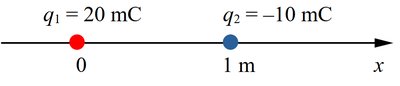
Exercise 5: Force on a Charge in 2D
Find the electric force exerted on a charge nC located at cm by two charges nC at cm and nC at cm. Example Solution Steps:
Calculate the distance between the central charge and each corner charge.
Apply Coulomb’s law for each pair.
Sum the vector forces to find the net force.
General Formula: Application: These exercises illustrate the use of Coulomb’s law and the superposition principle in practical scenarios involving multiple charges. Additional info: For all exercises, vector addition and careful attention to sign and direction are essential for correct results.
