 Back
BackElectric Charge and Electric Field: Foundations of Electrostatics
Study Guide - Smart Notes
 Tailored notes based on your materials, expanded with key definitions, examples, and context.
Electric Charge and Electric Field
Introduction to Electric Charge
Electric charge is a fundamental property of matter that gives rise to electric forces and fields. There are two types of electric charge: positive and negative. The study of how charges interact and the fields they produce is called electrostatics.
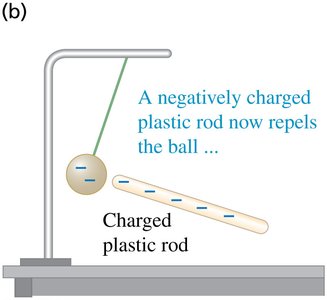
Two Types of Charge: Positive (e.g., glass rod rubbed with silk) and negative (e.g., plastic rod rubbed with fur).
Conservation of Charge: The total electric charge in a closed system remains constant.
Quantization of Charge: All observable charge is an integer multiple of the elementary charge, C.
Conductors and Insulators
Materials can be classified based on their ability to allow electric charges to move freely.
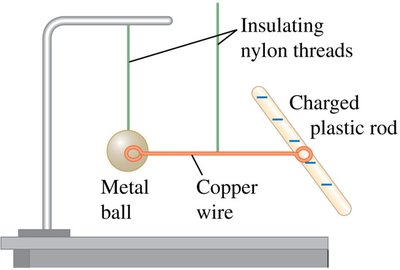
Conductors: Materials (e.g., copper) in which charges move freely.
Insulators: Materials (e.g., nylon) in which charges do not move freely.
Charging by Induction
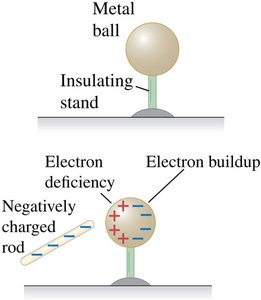
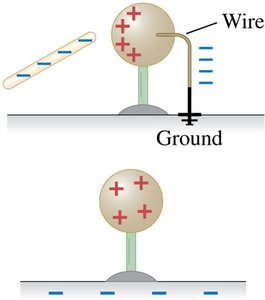
Charging by induction involves redistributing charges in a conductor without direct contact with a charged object. This process can be broken down into four steps:
Bringing a charged object near a conductor causes charge separation.
Connecting the conductor to ground allows charges to flow.
Removing the ground connection leaves the conductor with a net charge.
Removing the external charged object leaves the conductor charged.
Electric Forces on Uncharged Objects and Polarization
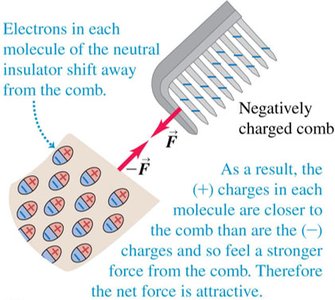
Charged objects can exert forces on neutral objects due to polarization, where the charges within molecules shift slightly, creating an induced dipole.
Polarization: Redistribution of charges within molecules of an insulator in the presence of an external electric field.
Attractive Force: The force between a charged object and a polarized neutral object is always attractive.

Coulomb's Law
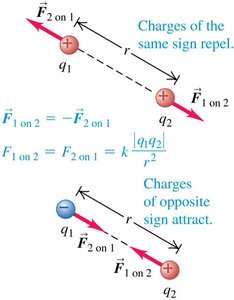
Coulomb's Law quantifies the electric force between two point charges. The force is proportional to the product of the charges and inversely proportional to the square of the distance between them.
Mathematical Form:
Vector Form:
Superposition Principle: The net force on a charge is the vector sum of the forces from all other charges.
Electric Field
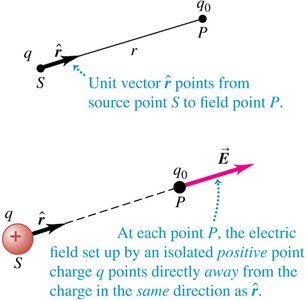
The electric field is a vector field that describes the force per unit charge at each point in space due to electric charges.
Definition:
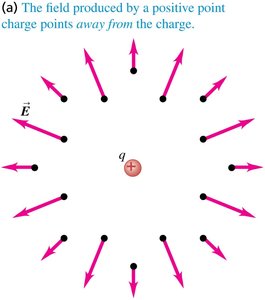
Field of a Point Charge:
Direction: Away from positive charges, toward negative charges.
Superposition of Electric Fields
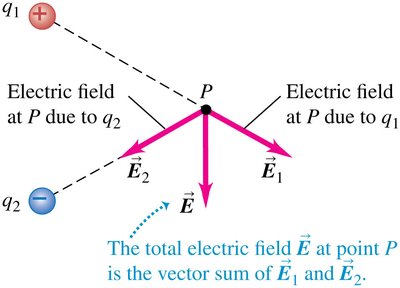
The total electric field at a point is the vector sum of the fields produced by all charges present.
Mathematical Form:
Electric Field of Charge Distributions
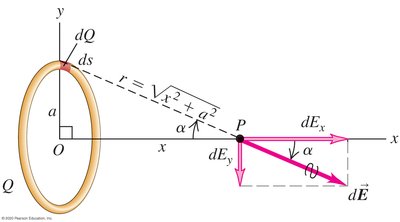
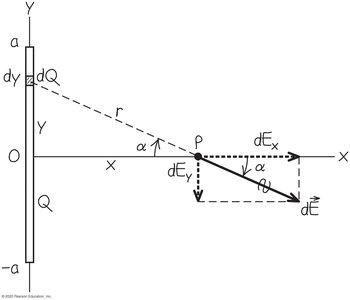
For continuous charge distributions, the electric field is found by integrating over the distribution:
Discrete Charges:
Continuous Distribution:
Electric Field Lines
Electric field lines are a visual tool to represent the direction and strength of the electric field. The tangent to a field line at any point gives the direction of the field at that point. Field lines never cross.
Field lines point away from positive charges and toward negative charges.
The density of lines indicates the field's strength.
Electric Dipoles
An electric dipole consists of two equal and opposite charges separated by a distance. The dipole moment is a vector pointing from the negative to the positive charge.
Dipole Moment:
Field of a Dipole (far from the dipole):
Force and Torque on a Dipole
When placed in a uniform electric field, a dipole experiences a torque that tends to align it with the field, but the net force is zero.
Torque:
Potential Energy:
Summary Table: Key Equations in Electrostatics
Concept | Equation |
|---|---|
Coulomb's Law | |
Electric Field (point charge) | |
Superposition Principle | |
Dipole Moment | |
Torque on Dipole | |
Potential Energy (Dipole) |
Additional info: This summary covers the foundational concepts of electric charge, electric field, Coulomb's law, and the behavior of conductors, insulators, and dipoles. It is suitable for exam preparation and provides a concise yet comprehensive overview of the main topics in introductory electrostatics.
