 Back
BackElectric Charge and Electric Field: Fundamental Concepts and Applications
Study Guide - Smart Notes
 Tailored notes based on your materials, expanded with key definitions, examples, and context.
Electric Charge and Electric Field
Introduction to Electric Charge
Electric charge is a fundamental property of matter that gives rise to electric forces and fields. The study of electric charge and its interactions forms the basis of electrostatics, a key area in electromagnetism.
Electrostatics deals with electric charges at rest and the forces between them.
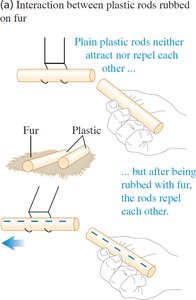
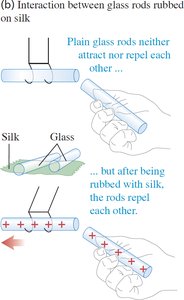
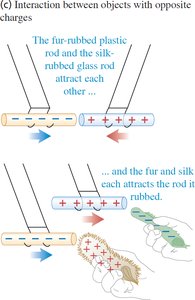
There are two types of electric charge: positive and negative.
Like charges repel; unlike charges attract.
Atomic Structure and Charge
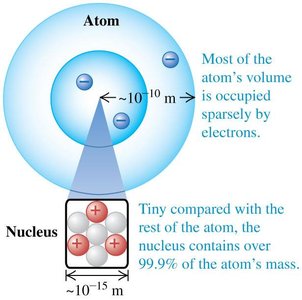
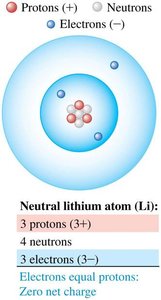
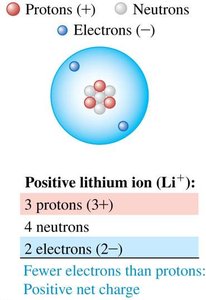
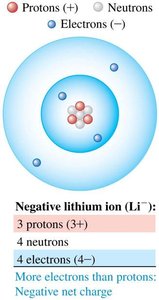
Atoms are composed of a nucleus containing protons and neutrons, surrounded by electrons. The distribution of these particles determines the atom's net charge.
Protons carry a positive charge, electrons carry a negative charge, and neutrons are neutral.
The nucleus is much smaller than the atom but contains most of its mass.
Atoms and Ions
A neutral atom has equal numbers of protons and electrons.
A positive ion (cation) forms when an atom loses one or more electrons.
A negative ion (anion) forms when an atom gains extra electrons.
Conservation and Quantization of Charge
Electric charge is conserved in all physical processes, and it is quantized in units of the elementary charge (e).
Conservation of charge: The total electric charge in a closed system remains constant.
Quantization: All observable charges are integer multiples of the elementary charge, C.
Conductors and Insulators
Materials are classified based on their ability to conduct electric charge.
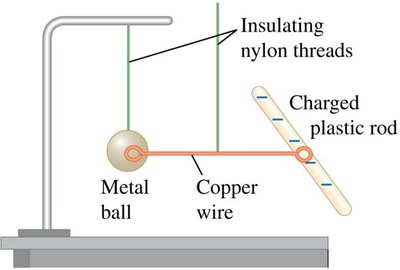
Conductors: Materials (e.g., metals like copper) in which electric charges move freely.
Insulators: Materials (e.g., nylon, glass) in which electric charges do not move freely.
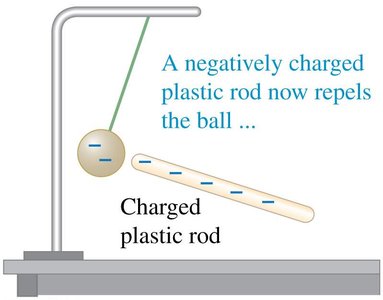
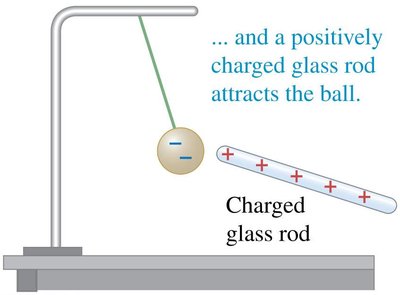
Charging by Induction
Charging by induction is a method to charge an object without direct contact. It involves the redistribution of charges due to the presence of a nearby charged object.
Bring a charged rod near a neutral conductor; charges in the conductor rearrange.
Connect the conductor to the ground to allow some charges to leave or enter.
Remove the ground connection, then the rod; the conductor is left with a net charge.
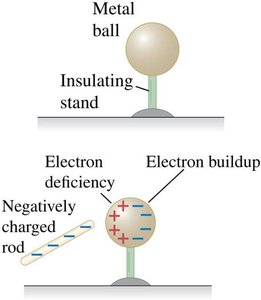
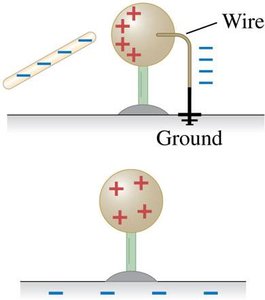
Electric Forces on Uncharged Objects and Polarization
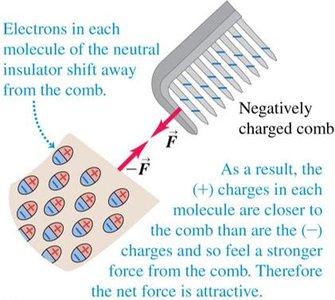
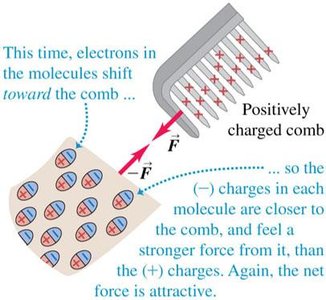
Charged objects can attract neutral objects due to polarization, where the charges within the molecules of the neutral object shift slightly, creating an induced dipole.
Polarization explains why a charged comb can pick up neutral bits of paper.
Both positively and negatively charged objects attract neutral insulators.

Applications: Electrostatic Painting
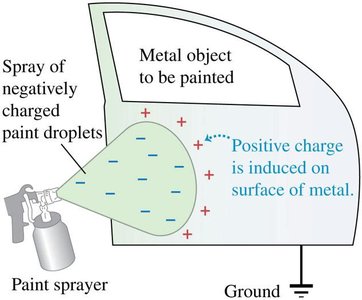
Electrostatic painting uses the principle of induced charge to attract paint droplets to a metal object, improving efficiency and reducing waste.
Coulomb's Law
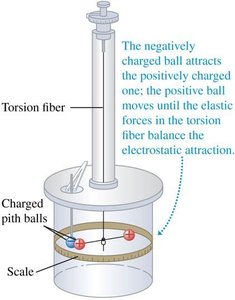
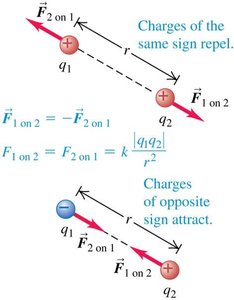
Coulomb's law quantifies the electric force between two point charges. The force is proportional to the product of the charges and inversely proportional to the square of the distance between them.
Mathematical form: where N·m2/C2.
The force acts along the line joining the charges.
Electric Field Concept
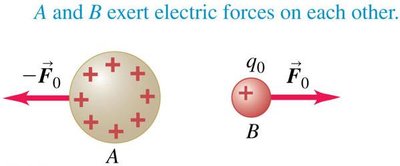
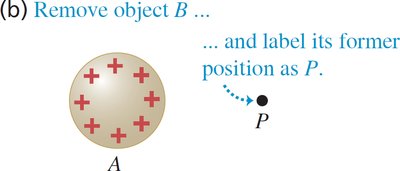
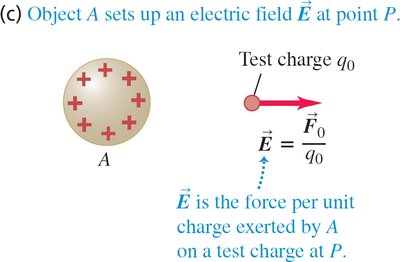
The electric field is a vector field that describes the force per unit charge exerted on a test charge at any point in space.
Defined as , where is the force on a test charge .
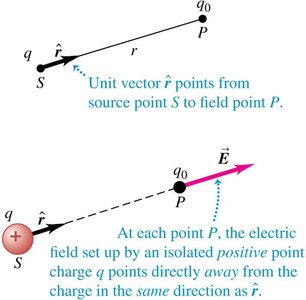
The direction of is the direction of the force on a positive test charge.
Electric Field of a Point Charge
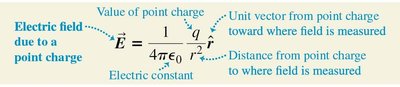
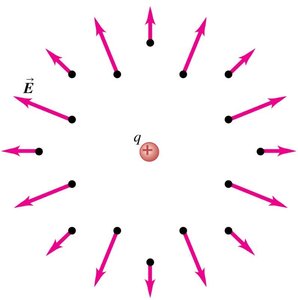
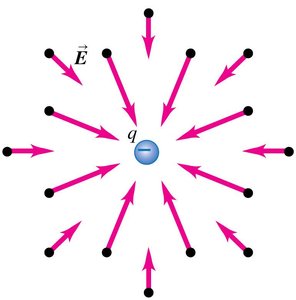
A point charge creates an electric field that radiates outward (for positive charge) or inward (for negative charge). The field's magnitude decreases with the square of the distance from the charge.
Mathematical form:
is the vacuum permittivity, C2/(N·m2).
Superposition Principle
The total electric field at a point due to multiple charges is the vector sum of the fields produced by each charge individually.
Mathematically:
Electric Field Lines
Electric field lines are a visual tool to represent the direction and strength of electric fields.
Field lines start on positive charges and end on negative charges.
The density of lines indicates the field's strength.
Field lines never cross.
Electric Dipoles and Water Molecule
An electric dipole consists of two equal and opposite charges separated by a distance. The water molecule is a natural example of an electric dipole, which explains its effectiveness as a solvent.
Dipoles experience torque in an electric field but no net force in a uniform field.
Example: The water molecule's dipole nature allows it to dissolve ionic compounds like salt by attracting positive and negative ions to opposite ends of the molecule.
Additional info: The concept of electric field lines and dipoles is foundational for understanding more advanced topics such as Gauss's law, electric potential, and the behavior of materials in electric fields.
