 Back
BackElectric Charge and Electric Field: Study Notes
Study Guide - Smart Notes
 Tailored notes based on your materials, expanded with key definitions, examples, and context.
Electric Charge and Electric Field
Introduction to Electric Charge
Electric charge is a fundamental property of matter that gives rise to electric forces and fields. The study of electric charge and its interactions forms the basis of electrostatics, a branch of electromagnetism—one of the four fundamental forces in nature.
Electrostatics: Charging and Interactions
Electrostatics deals with the interactions between electric charges at rest.
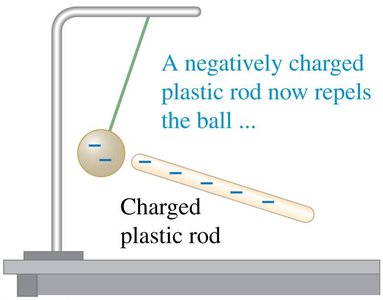
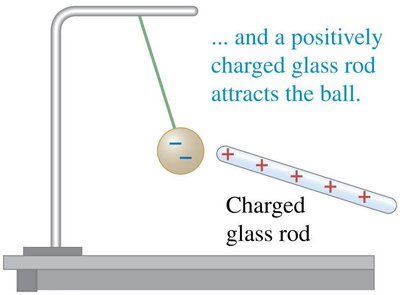
Objects can be charged by rubbing them with certain materials, such as plastic rods with fur or glass rods with silk.
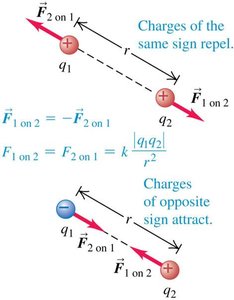
Like charges repel, and unlike charges attract.
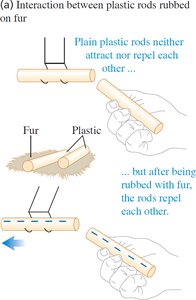
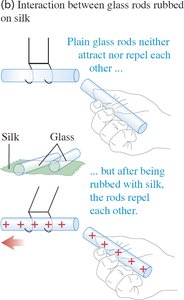
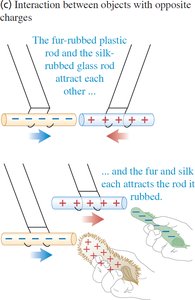
Structure of Matter and Electric Charge
Atoms are composed of protons (positive), neutrons (neutral), and electrons (negative). Protons and neutrons form the nucleus, while electrons occupy a much larger surrounding region.
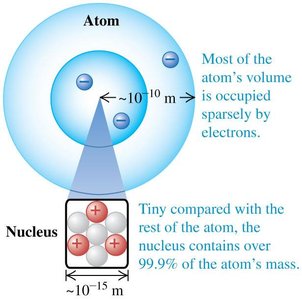
Atoms and Ions
A neutral atom has equal numbers of protons and electrons.
A positive ion (cation) forms when electrons are removed.
A negative ion (anion) forms when electrons are added.
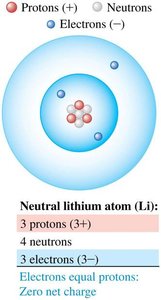
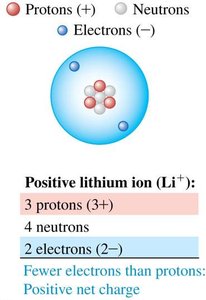
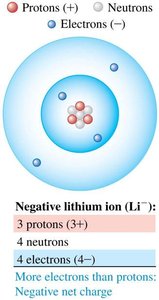
Conservation and Quantization of Charge
The proton and electron have equal and opposite charges in magnitude.
Charge is quantized: all observable charge is an integer multiple of the elementary charge .
Conservation of charge: The total electric charge in a closed system remains constant.
Conductors and Insulators
Materials can be classified based on their ability to conduct electric charge:
Conductors: Materials (e.g., metals like copper) in which electric charges move freely.
Insulators: Materials (e.g., nylon) in which electric charges do not move freely.
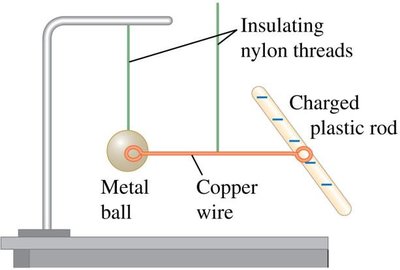
Charging by Induction
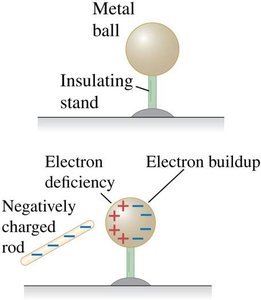
Charging by induction is a method to charge an object without direct contact. It involves the redistribution of charges due to the influence of a nearby charged object.
Bring a charged rod near a neutral conductor; charges in the conductor rearrange.
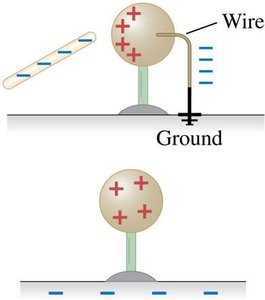
Connect the conductor to the ground, allowing some charges to leave or enter.
Remove the ground connection, then the rod; the conductor is left with a net charge.
Electric Forces on Uncharged Objects: Polarization
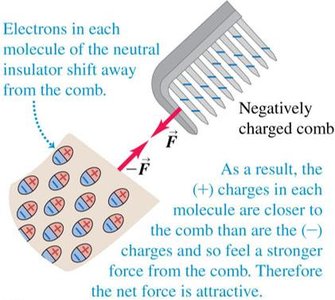
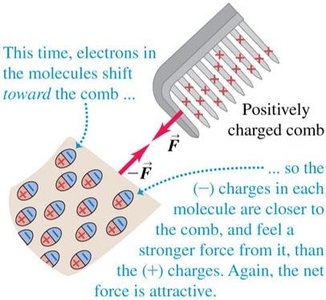
A charged object can attract neutral objects by inducing a separation of charges within the molecules of the neutral object, a process called polarization.
Polarization causes the centers of positive and negative charge to shift slightly, resulting in an attractive force.
This effect explains why a charged comb can pick up neutral bits of paper.

Applications: Electrostatic Painting
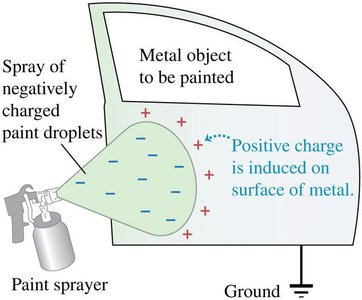
Electrostatic painting uses the attraction between charged paint droplets and an oppositely charged or neutral object to achieve efficient coating.
Coulomb's Law: Measuring Electric Force
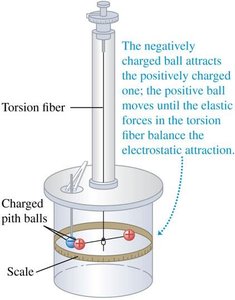
The force between two point charges is described by Coulomb's Law:
The force is proportional to the product of the charges and inversely proportional to the square of the distance between them.
Mathematically,
where is Coulomb's constant.
Electric Field: Concept and Definition
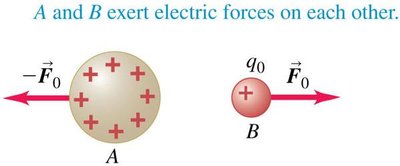
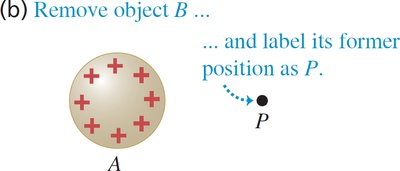
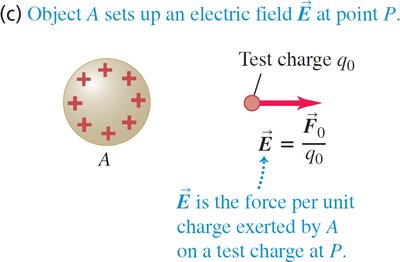
The electric field is a vector field that describes the force per unit charge exerted on a test charge at any point in space. It is defined as:
where is the force experienced by a test charge .
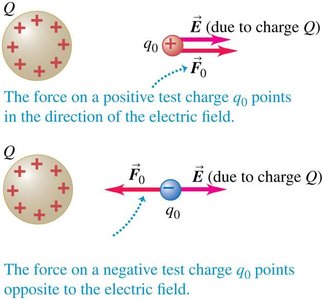
Electric Force Produced by an Electric Field
The force on a charge in an electric field is .
The direction of the force depends on the sign of the charge.
The Electric Field of a Point Charge
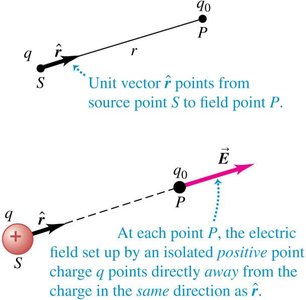
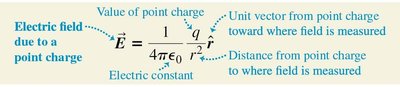
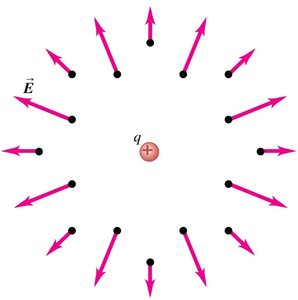
The electric field produced by a point charge at a distance is given by:
where is the vacuum permittivity, and is a unit vector pointing from the charge to the field point.
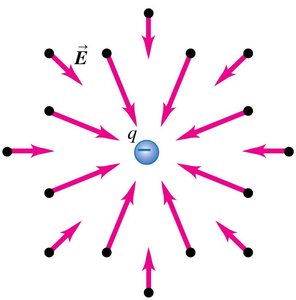
Superposition of Electric Fields
The total electric field at a point due to multiple charges is the vector sum of the fields produced by each charge individually.
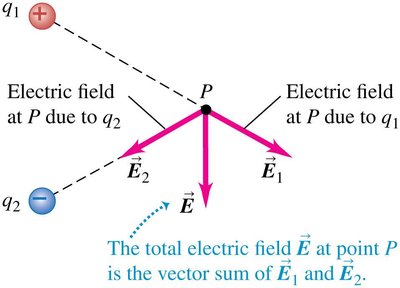
Electric Field Lines
Electric field lines are imaginary lines that represent the direction and strength of the electric field. The tangent to a field line at any point gives the direction of the field at that point. The density of lines indicates the field's magnitude.
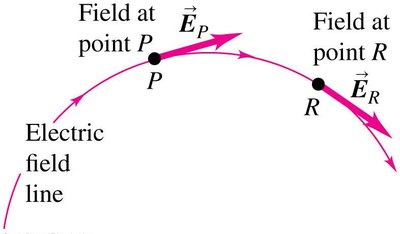
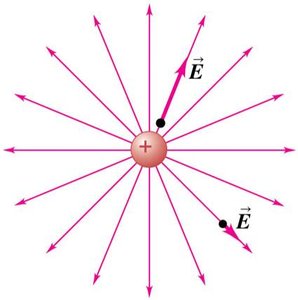
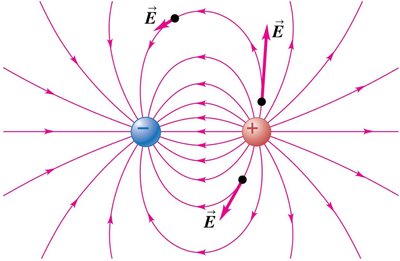
Electric Dipoles and Water Molecules
An electric dipole consists of two equal and opposite charges separated by a distance. The water molecule is a natural example of an electric dipole, with a partial negative charge near the oxygen and a partial positive charge near the hydrogens.
Dipoles interact strongly with electric fields and are crucial in many chemical and biological processes.
Force and Torque on a Dipole
When placed in a uniform electric field, a dipole experiences no net force but does experience a torque that tends to align the dipole with the field.
The torque on a dipole of moment in a field is .
