Back
BackElectric Charge and Electric Field: Study Notes (Chapter 21, Giancoli)
Study Guide - Smart Notes
 Tailored notes based on your materials, expanded with key definitions, examples, and context.
Electric Charge and Electric Field
Static Electricity; Electric Charge and Its Conservation
Static electricity arises from the accumulation of electric charge on objects, often through friction. Electric charge exists in two types: positive and negative. Like charges repel, while opposite charges attract. The principle of conservation of charge states that the total charge in an isolated system remains constant.
Electric charge is a fundamental property of matter.
Conservation of charge: The arithmetic sum of charges before and after any interaction is unchanged.
Charging by friction: Rubbing materials can transfer electrons, creating static electricity.

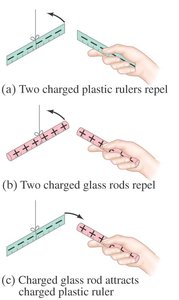
Example: Rubbing a comb with wool transfers electrons, allowing the comb to attract small paper pieces.
Electric Charge in the Atom
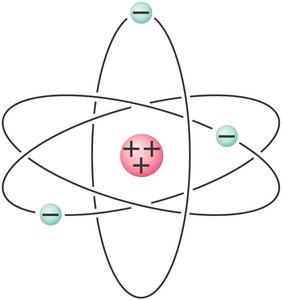
Atoms consist of a positively charged nucleus surrounded by negatively charged electrons. The nucleus contains protons (positive) and neutrons (neutral), while electrons (negative) orbit the nucleus. The overall charge of an atom is neutral unless electrons are added or removed.
Protons: Positive charge, located in the nucleus.
Electrons: Negative charge, found in the electron cloud.
Neutrons: No charge, also in the nucleus.
Polar molecules: Molecules like water have uneven charge distribution, resulting in a dipole moment.
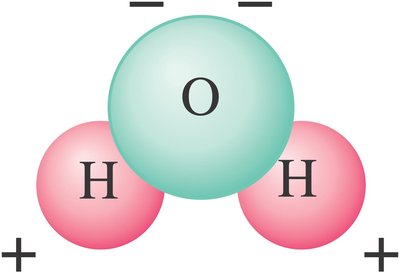
Example: Water is a polar molecule, with partial positive and negative charges at different ends.
Insulators and Conductors
Materials are classified based on their ability to conduct electric charge. Conductors allow charge to flow freely (e.g., metals), while insulators restrict charge movement (e.g., wood, glass). Semiconductors have intermediate properties.
Conductors: Electrons move freely; metals are typical conductors.
Insulators: Electrons are tightly bound; most non-metals are insulators.
Semiconductors: Conductivity between conductors and insulators.
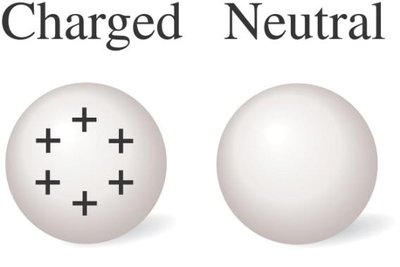
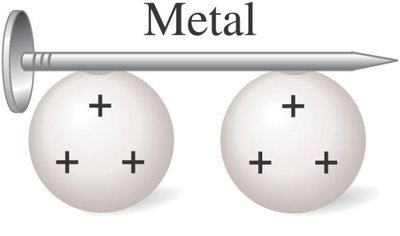
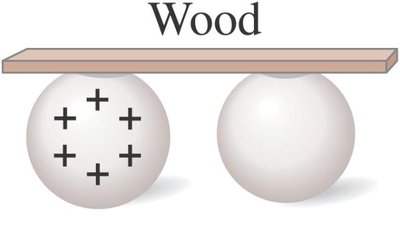
Example: Metal objects can be easily charged, while wood resists charge flow.
Induced Charge; the Electroscope
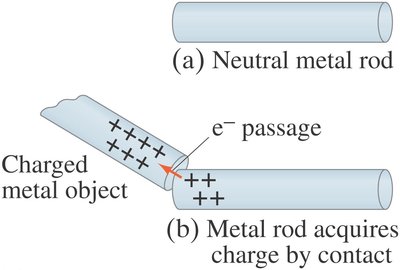
Objects can be charged by conduction (direct contact) or induction (without contact). Induction involves bringing a charged object near a conductor, causing charge separation. The electroscope is a device used to detect electric charge.
Charging by conduction: Transfer of charge by direct contact.
Charging by induction: Redistribution of charge without direct contact.
Electroscope: Detects presence and sign of charge.
Nonconductors: Experience charge separation but do not become charged by conduction or induction.
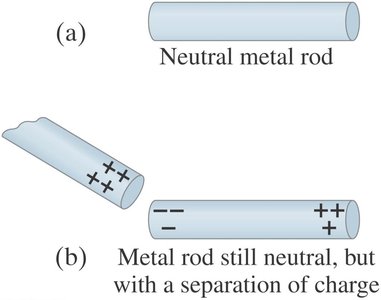
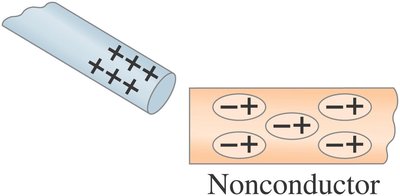
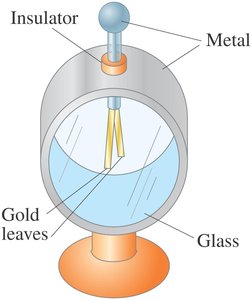
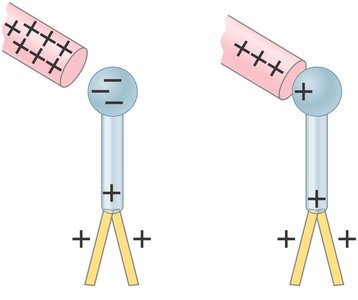
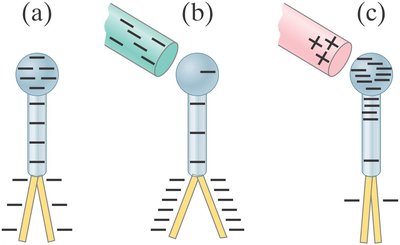
Example: The electroscope's gold leaves spread apart when charged, indicating the presence of electric charge.
Coulomb’s Law
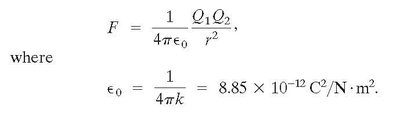
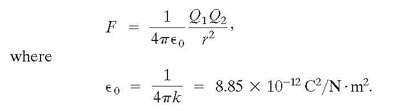
Coulomb’s law quantifies the force between two point charges. The force is proportional to the product of the charges and inversely proportional to the square of the distance between them. The direction of the force depends on the sign of the charges.
Formula: , where .
Unit of charge: Coulomb (C).
Charge quantization: Smallest charge is C.
Permittivity of free space: C/N·m.

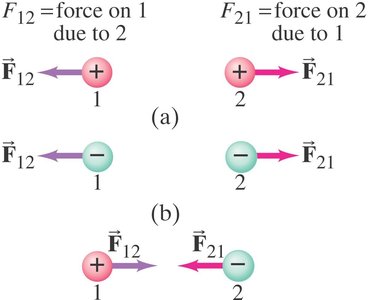
Example: Two positive charges repel each other, while a positive and a negative charge attract.
Conceptual Example: Which Charge Exerts the Greater Force?
For two charges and , the force each exerts on the other is equal in magnitude but opposite in direction, as per Newton's third law.

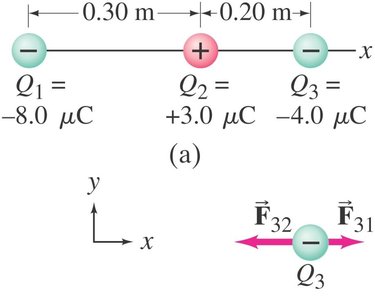
Example: Three Charges in a Line
Three charges arranged in a line experience net forces calculated by vector addition of individual Coulomb forces.
The Electric Field
The electric field is a region around a charged object where other charges experience a force. It is defined as the force per unit charge. The electric field is a vector quantity, with both magnitude and direction.
Definition:
Field of a point charge:
Force on a charge:
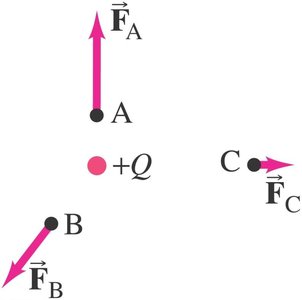

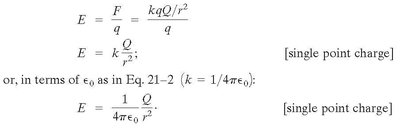
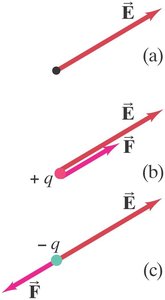
Example: The electric field at a point 30 cm from a charge C is directed toward the charge.
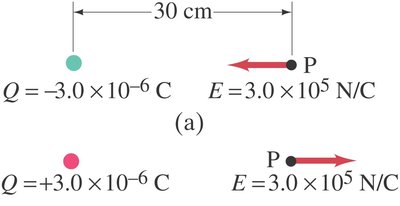
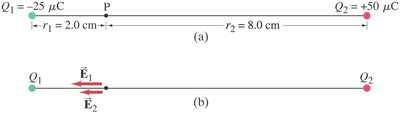
Example: Electric Field Between Two Charges
Calculate the electric field at a point between two charges by summing the fields due to each charge.
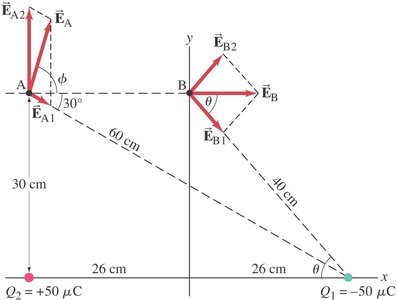
Example: Electric Field Above Two Point Charges
Find the total electric field at points above two charges by vector addition.
Electric Field Calculations for Continuous Charge Distributions
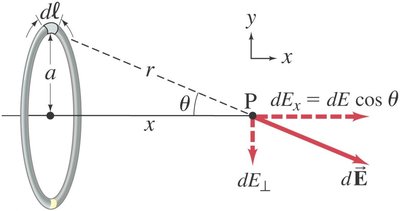
For objects with continuous charge distributions, the electric field is calculated by integrating the contributions from infinitesimal charge elements. Each component of the field is integrated separately.
Ring of charge: Field at a point on the axis is calculated using integration.
Disk of charge: Field at a point above the center is calculated similarly.
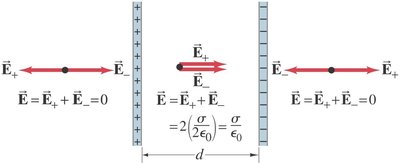
Infinite plane: Field is constant near the surface.
Parallel plates: Field between plates is uniform.
Field Lines
Electric field lines visually represent the direction and strength of the electric field. They start on positive charges and end on negative charges. The density of lines indicates field strength.
Direction: Field is tangent to the line at any point.
Magnitude: Proportional to line density.
Origin and termination: Start on positive, end on negative charges.
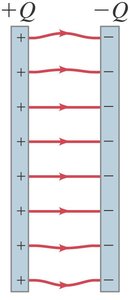
Electric Fields and Conductors
Inside a conductor, the static electric field is zero. Any excess charge resides on the surface. The electric field at the surface is perpendicular to the surface.
Field inside conductor: Zero in electrostatic equilibrium.
Surface charge: Resides on outer surface.
Field direction: Perpendicular to surface.
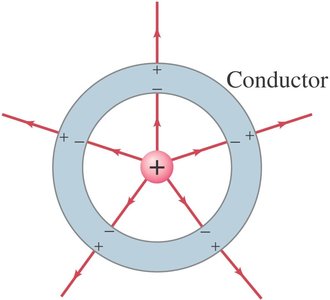
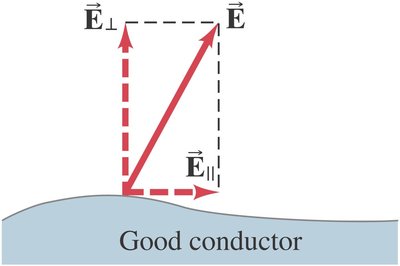
Conceptual Example: Shielding and Safety in a Storm
A hollow metal box placed between charged plates has zero electric field inside, demonstrating electrostatic shielding. This principle explains why a car is a safe place during a lightning storm.
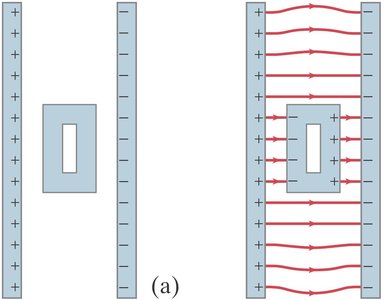

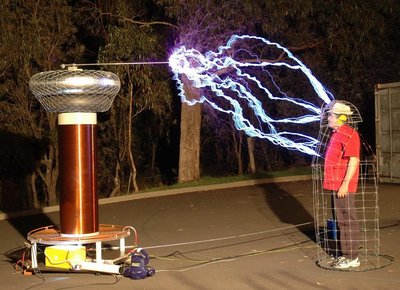
Motion of a Charged Particle in an Electric Field
The force on a charged particle in an electric field is given by . Knowing the mass and charge allows prediction of the particle's motion.
Acceleration:
Uniform field: Particle experiences constant acceleration.
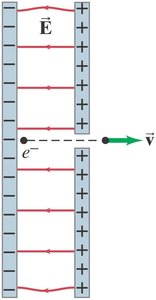
Example: An electron accelerated between parallel plates leaves with a speed determined by the electric field and plate separation.
Summary Table: Key Concepts of Electric Charge and Electric Field
Concept | Definition/Formula | Example/Application |
|---|---|---|
Electric Charge | Quantized in units of | Charge on electron: C |
Conservation of Charge | Total charge remains constant | Charge transfer by friction |
Coulomb’s Law | Force between two point charges | |
Electric Field | ; | Field around a point charge |
Conductors | Electrons move freely | Metals |
Insulators | Electrons tightly bound | Wood, glass |
Field Lines | Visual representation of field | Lines from + to - charge |
Electrostatic Shielding | Field inside conductor is zero | Faraday cage, car during lightning |