 Back
BackElectric Charge and Electric Field: Study Notes
Study Guide - Smart Notes
 Tailored notes based on your materials, expanded with key definitions, examples, and context.
Electric Charge & Electric Field
Electric Charges
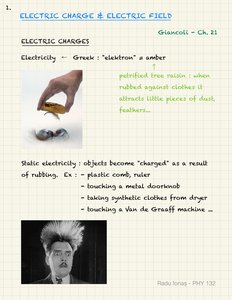
Electricity originates from the Greek word 'elektron', meaning amber. The concept of electric charge was first observed when amber was rubbed against cloth, attracting small pieces of dust or feathers. This phenomenon is known as static electricity, where objects become 'charged' as a result of rubbing.
Examples: plastic comb, ruler, metal doorknob, synthetic clothes from dryer, Van de Graaff machine.
Atomic-Scale Understanding of Charge
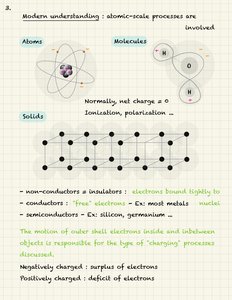
Modern physics explains electric charge through atomic-scale processes. Atoms, molecules, and solids are normally electrically neutral, but ionization and polarization can occur.
Non-conductors (Insulators): Electrons are bound tightly to atoms.
Conductors: Free electrons are present (e.g., most metals).
Semiconductors: Intermediate behavior (e.g., silicon, germanium).
The motion of outer shell electrons inside and between objects is responsible for charging processes.
Negatively charged: Surplus of electrons.
Positively charged: Deficit of electrons.
Induced Charge and Electroscope
Induced Charge
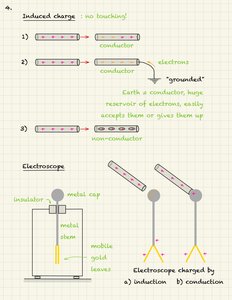
Induced charge occurs without direct contact. When a charged object is brought near a conductor, electrons move due to the influence of the external charge. The Earth acts as a reservoir for electrons, accepting or giving them up easily.
Conductors allow electrons to move freely.
Non-conductors do not allow free movement of electrons.
Electroscope
An electroscope is a device used to detect electric charge. It consists of a metal cap, metal stem, and mobile gold leaves. It can be charged by induction or conduction.
Electric Force and Superposition Principle
Vector Form of Electric Force
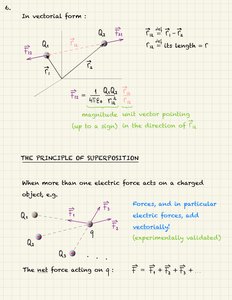
The electric force between two charges can be represented in vector form:
Magnitude and direction are determined by the positions and values of the charges.
Formula:
Principle of Superposition
When more than one electric force acts on a charged object, the net force is the vector sum of all individual forces:
Electric Field
Concept of Electric Field
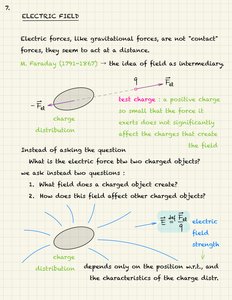
Electric forces act at a distance, similar to gravitational forces. Michael Faraday introduced the idea of the electric field as an intermediary. The electric field is created by a charge and affects other charges in its vicinity.
The field depends on the position and characteristics of the charge distribution.
Field strength is denoted as .
Examples of Electric Field Calculations
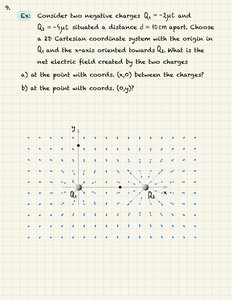
Example: Two Negative Charges
Consider two negative charges and separated by 10 cm. The net electric field at various points can be calculated using vector addition.
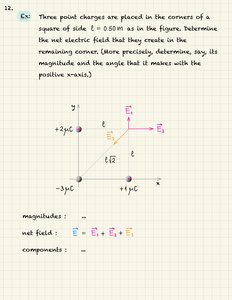
Example: Three Point Charges in a Square
Three point charges are placed at the corners of a square. The net electric field at the remaining corner is determined by summing the fields from each charge, considering both magnitude and direction.
Continuous Charge Distributions
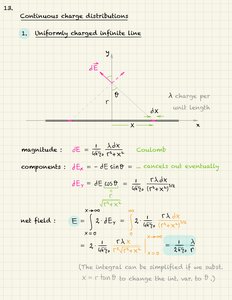
Uniformly Charged Infinite Line
For a uniformly charged infinite line, the electric field at a point is calculated by integrating over the length of the line:
Charge per unit length:
Magnitude:
Net field:
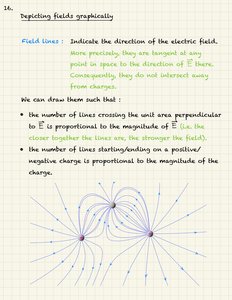
Depicting Fields Graphically
Field Lines
Field lines indicate the direction of the electric field. They are tangent to the field at any point and never cross. The density of field lines represents the strength of the field.
The number of lines crossing a unit area perpendicular to is proportional to the magnitude of $ \vec{E} $.
Lines start/end on charges proportional to their magnitude.
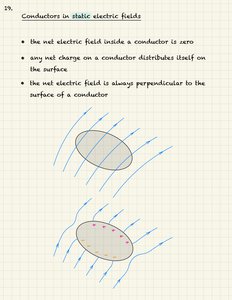
Conductors in Static Electric Fields
Properties of Conductors
The net electric field inside a conductor is zero.
Any net charge on a conductor distributes itself on the surface.
The net electric field is always perpendicular to the surface of a conductor.
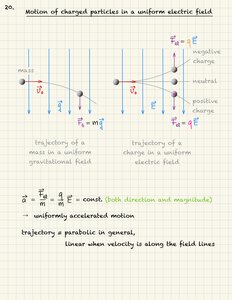
Motion of Charged Particles in Uniform Electric Fields
Trajectories and Equations
Charged particles in a uniform electric field experience a constant force, resulting in uniformly accelerated motion. The trajectory is generally parabolic, but linear if velocity is along the field lines.
Equation of motion:
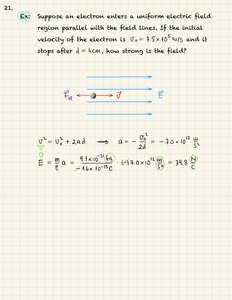
Example: Electron in Uniform Electric Field
An electron enters a uniform electric field region parallel to the field lines. If its initial velocity is m/s and it stops after cm, the field strength can be calculated using kinematic equations and the relationship between force and electric field.
Relevant equations: ,
