 Back
BackElectric Charge, Coulomb’s Law, and Electric Fields
Study Guide - Smart Notes
 Tailored notes based on your materials, expanded with key definitions, examples, and context.
Electric Charge and the Structure of Matter
Definition and Properties of Electric Charge
Electric charge is a fundamental property of matter that determines the electromagnetic interactions between particles. It is a scalar quantity and can be positive, negative, or zero. The symbol for charge is q or Q, and its unit is the coulomb (C).
Elementary charge: The smallest unit of charge, denoted as e, is .
Conservation: Charge is conserved in all physical processes.
Only particles with mass can have charge.
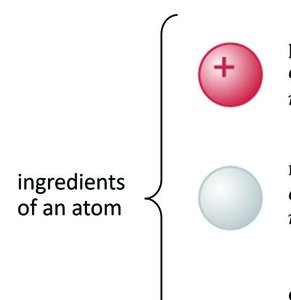
Ingredients of an Atom
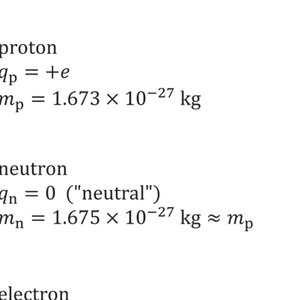
Atoms are composed of three main types of particles: protons, neutrons, and electrons. Each has distinct charge and mass properties.
Proton: ,
Neutron: (neutral),
Electron: ,

Conductors and Insulators
Classification of Materials
Materials are classified based on their ability to allow electric charge to move:
Conductors: Charge can move freely. Examples: metals, electrolytes, human body, planet Earth.
Insulators: Charge cannot move freely. Examples: glass, ceramics, teflon, quartz, styrofoam, acrylic, PVC.

Charging by Induction
Charging by induction involves redistributing charges in a conductor without direct contact. A charged object brought near a conductor causes electrons to move, creating regions of positive and negative charge.
Electric Forces on Uncharged Objects
Polarization and Attraction
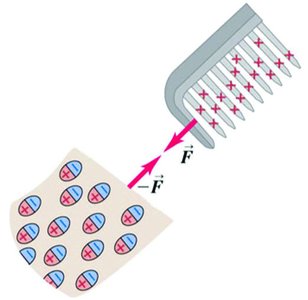
When a charged object is brought near a neutral object, the charges within the neutral object rearrange (polarize), resulting in an attractive force.
Example: A charged comb attracts neutral paper by polarizing the molecules in the paper.
Coulomb’s Law
Fundamental Law of Electric Force
Coulomb’s law describes the force between two point charges. Like charges repel, unlike charges attract.
Mathematical form:
Coulomb constant:
Electric permittivity:
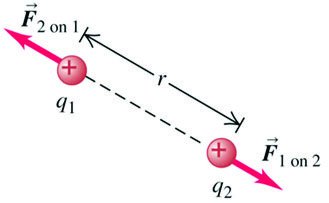
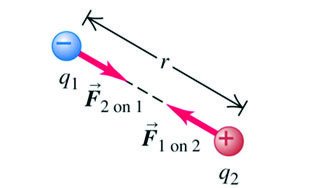
Direction of Forces
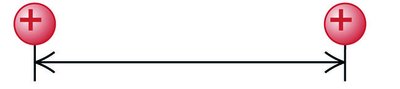
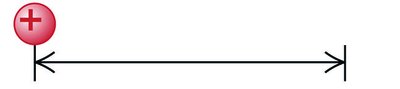
The force acts along the line joining the two charges. For like charges, the force is repulsive; for unlike charges, it is attractive.
Electric Field
Definition and Properties
The electric field is a vector field that describes the force per unit charge exerted on a test charge at any point in space. The symbol for electric field is E, and its unit is newton per coulomb (N/C).
Mathematical form (point charge):
Superposition principle: The total electric field is the vector sum of fields from all charges:
Electric Field Lines
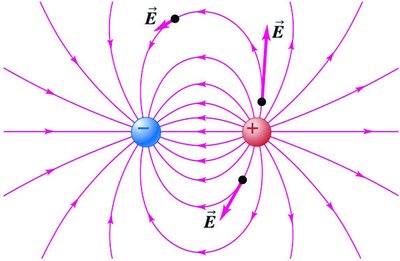
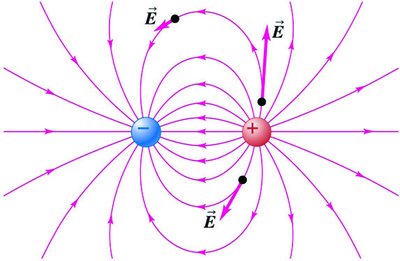
Electric field lines visually represent the direction and strength of the electric field. Lines point away from positive charges and toward negative charges.
Electric Dipoles
Definition and Properties
An electric dipole consists of two equal and opposite charges separated by a distance. The dipole moment is a vector quantity pointing from negative to positive charge.
Dipole moment:
Unit: coulomb-meter (C·m)
Force and Torque on a Dipole in a Uniform Field
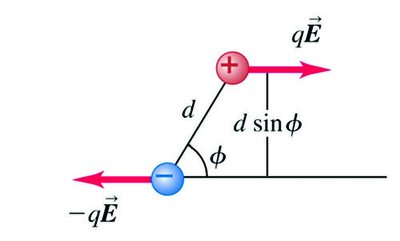
A dipole in a uniform electric field experiences a torque that tends to align the dipole with the field. The torque is given by:
Torque:
Potential Energy of a Dipole
The potential energy of a dipole in a uniform electric field depends on its orientation:
Potential energy:
Potential energy decreases as the dipole aligns with the field.
Summary Table: Properties of Charge and Electric Field
Quantity | Symbol | Type | Unit |
|---|---|---|---|
Charge | q, Q | Scalar | Coulomb (C) |
Electric Field | E | Vector | Newton/Coulomb (N/C) |
Dipole Moment | p | Vector | Coulomb-meter (C·m) |
