 Back
BackElectric Charge, Electric Field, and Electric Potential: Study Notes for Physics Majors
Study Guide - Smart Notes
 Tailored notes based on your materials, expanded with key definitions, examples, and context.
Electric Charge and Electric Field
Static Electricity; Electric Charge and Its Conservation
Electric charge is a fundamental property of matter, responsible for electric phenomena. Charges can be transferred between objects, often by rubbing, resulting in static electricity. There are two types of charge: positive and negative. Like charges repel, and opposite charges attract. The total charge in any closed system is conserved.
Charge Conservation: The arithmetic sum of all charges in a system remains constant during any interaction.
Example: Rubbing a glass rod with silk transfers electrons, leaving the rod positively charged and the silk negatively charged.
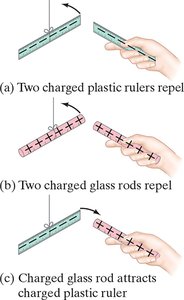
Additional info: Conservation of charge is a cornerstone of all electromagnetic phenomena.
Electric Charge in the Atom
Atoms consist of a positively charged nucleus surrounded by negatively charged electrons. The nucleus is small and massive, while the electron cloud is large and diffuse. Most atoms are electrically neutral, but ions can form by gaining or losing electrons.
Polar Molecules: Molecules like water are neutral overall but have uneven charge distribution, resulting in a dipole moment.
Example: Water (H2O) is a polar molecule, with oxygen slightly negative and hydrogen slightly positive.


Insulators and Conductors
Materials are classified based on their ability to conduct electric charge. Conductors (e.g., metals) allow charge to flow freely, while insulators (e.g., wood, glass) do not. Semiconductors have intermediate properties.
Conductors: Electrons are free to move.
Insulators: Electrons are bound and cannot move freely.
Example: Metal nail conducts charge, wood does not.

Induced Charge; the Electroscope
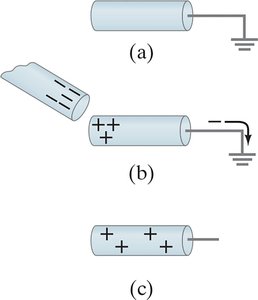
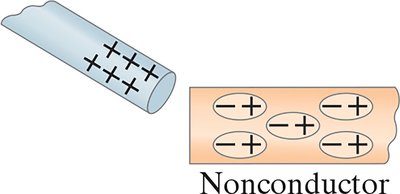
Metal objects can be charged by conduction (direct contact) or induction (without contact). Nonconductors experience charge separation but do not become charged by conduction or induction. The electroscope is a device used to detect electric charge.
Charging by Conduction: Transfer of charge by direct contact.
Charging by Induction: Redistribution of charge without direct contact, often involving grounding.
Electroscope: Used to detect and determine the sign of an unknown charge.


Coulomb’s Law
Coulomb’s Law: Force Between Charges
Coulomb’s law quantifies the force between two point charges. The force is proportional to the product of the charges and inversely proportional to the square of the distance between them.
Formula:
Direction: Force acts along the line joining the charges; attractive for opposite charges, repulsive for like charges.
Unit of Charge: Coulomb (C)
Proportionality Constant:
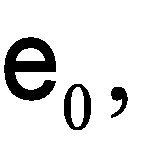
Permittivity of Free Space:








The Electric Field
Definition and Properties
An electric field surrounds every charge and exerts a force on other charges. The field is defined as the force per unit charge.
Formula:
For a Point Charge:
Force on a Charge:
Electric Field Calculations for Continuous Charge Distributions
For continuous distributions, the electric field is calculated by integrating over the charge distribution.
Formula:
Examples: Ring of charge, long line of charge, uniformly charged disk, two parallel plates.
Field Lines
Representation and Properties
Electric field lines visually represent the direction and strength of the electric field. They start on positive charges and end on negative charges. The density of lines indicates field strength.
Field lines never cross.
Field is tangent to the line at any point.
Number of lines is proportional to charge magnitude.
Electric Fields and Conductors
Properties of Conductors in Electrostatics
In electrostatic equilibrium, the electric field inside a conductor is zero. Any excess charge resides on the surface, and the field at the surface is perpendicular.
Shielding: Hollow conductors shield their interiors from external fields.
Motion of a Charged Particle in an Electric Field
Force and Trajectory
The force on a charged particle in an electric field is . Knowing the mass and charge allows prediction of its motion.
Example: Electron accelerated between parallel plates.
Electric Dipoles
Definition and Behavior
An electric dipole consists of two equal and opposite charges separated by a distance. The dipole moment points from negative to positive charge. In a uniform field, a dipole experiences a torque but no net force.
Torque:
Potential Energy:
Electric Forces in Molecular Biology: DNA Structure and Replication
Electrostatic Forces in DNA
Electrostatic forces play a crucial role in molecular biology, particularly in the structure and replication of DNA. The nucleotide bases (A-T and G-C) attract each other through electrostatic interactions.
Replication: During DNA replication, complementary bases are attracted by electrostatic forces.
Gauss’s Law
Electric Flux
Electric flux measures the number of electric field lines passing through a surface. For a uniform field, .
Gauss’s Law
Gauss’s law relates the net electric flux through a closed surface to the charge enclosed:
Formula:
Applications: Useful for calculating fields in symmetric situations (spheres, cylinders, planes).
Applications of Gauss’s Law
Gauss’s law can be applied to various charge distributions:
Spherical Shell: Field outside is as if all charge were at the center; inside is zero.
Solid Sphere: Field inside increases linearly with radius.
Infinite Plane: Field is constant near the surface.
Conductors: Field just outside is proportional to surface charge density.
Electric Potential
Electric Potential Energy and Potential Difference
The electrostatic force is conservative, allowing definition of potential energy. The change in electric potential energy is the negative of the work done by the electric force.
Electric Potential:
Unit: Volt (V)
Potential Difference:
Relation between Electric Potential and Electric Field
The electric field is related to the spatial rate of change of electric potential:
Formula:
Uniform Field:
Electric Potential Due to Point Charges
The potential at a distance r from a point charge Q is:
Formula:
Superposition: For multiple charges, sum the potentials.
Potential Due to Any Charge Distribution
The potential due to a continuous charge distribution is found by integrating:
Formula:
Equipotential Lines and Surfaces
Equipotential lines or surfaces are regions where the electric potential is constant. Electric field lines are always perpendicular to equipotentials.
Surface of a conductor: Always an equipotential.
Potential Due to Electric Dipole; Dipole Moment
The potential due to an electric dipole at a point far from the dipole is:
Formula:
Dipole Moment:
Electrostatic Potential Energy; the Electron Volt
The potential energy of two point charges is:
Formula:
Electron Volt (eV): Energy gained by an electron moving through a potential difference of 1 V;
Digital Electronics and Signal Voltage
Digital signals use binary numbers to represent values, and are less sensitive to noise than analog signals. Signal voltages are used in electronics to encode information.
TV and Computer Monitors
Cathode ray tubes (CRTs) use electric fields to steer electrons onto a screen, creating images. Modern flat screens use pixels whose brightness can be controlled.
Electrocardiogram (ECG or EKG)
The ECG measures changes in electric potential on the surface of the heart to detect defects.
Summary Tables
Comparison of Conductors and Insulators
Property | Conductor | Insulator |
|---|---|---|
Charge Mobility | Free electrons | Bound electrons |
Charge Distribution | Surface | Throughout |
Examples | Metals | Wood, glass |
Summary of Key Equations
Concept | Equation |
|---|---|
Coulomb's Law | |
Electric Field (point charge) | |
Gauss's Law | |
Electric Potential (point charge) | |
Potential Energy (two charges) |
