 Back
BackElectric Charge: Properties, Quantization, and Interactions
Study Guide - Smart Notes
 Tailored notes based on your materials, expanded with key definitions, examples, and context.
Electric Charge
The Law of Charges
Electric charge is a fundamental property of matter that governs electromagnetic interactions. The law of charges states:
Like charges repel: Two objects with the same type of charge (both positive or both negative) will push away from each other.
Unlike charges attract: Objects with opposite charges (one positive, one negative) will pull toward each other.
These principles are demonstrated in experiments with rubber rods, balloons, fur, silk, and glass rods, where electrons transfer between materials, resulting in net positive or negative charges.
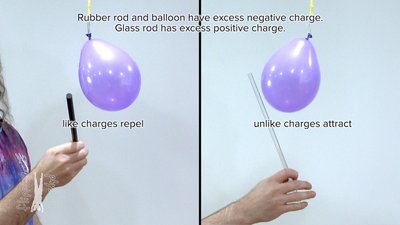
Charge Transfer and Material Interactions
When materials are rubbed together, electrons can transfer from one to another, creating charged objects:
Rubbing fur against a rubber rod or balloon transfers electrons from the fur to the rubber, leaving the rubber negatively charged and the fur positively charged.
Rubbing silk against a glass rod transfers electrons from the glass to the silk, leaving the glass positively charged and the silk negatively charged.
These processes illustrate how charge is transferred and how the law of charges governs the resulting interactions.
Elementary Particles and Charge
Electric charge is carried by elementary particles:
Electron: An elementary particle with charge .
Proton: Not an elementary particle (composed of quarks), with charge .
Elementary charge (): The smallest unit of charge measured on an isolated particle, coulombs (C).
Coulomb (C): SI unit for electric charge.
Protons are much more massive than electrons: .
Quarks are elementary particles that make up protons and neutrons:
Up quark: Charge
Down quark: Charge
Proton: $2 down quark ( total charge)
Neutron: $1 down quarks ($0$ total charge)
Examples of Charge Transfer
Three outcomes can occur when a rubber balloon is rubbed against hair:
The balloon stays in your hair: Electrons transfer from hair to balloon, balloon becomes negatively charged, hair positively charged. Unlike charges attract, pulling hair and balloon together.
Hairs stick out when balloon is pulled away: Hair is left with a net positive charge. Like charges repel, causing hairs to push apart.
The balloon sticks to a wall: This is due to polarization, a topic covered in future lessons.
Quantization of Charge
Electric charge is quantized, meaning it exists in discrete units:
Charge comes in multiples of the elementary charge ().
The net charge () on an object is given by:
= net charge
= excess number of charge carriers (must be an integer)
= elementary charge
Because protons and electrons cannot be divided, must be an integer.
Example Calculations
How many excess protons are needed for 1 coulomb?
protons
This is 6.25 quintillion protons.
Can an object have a net negative charge of C?
electrons
Since must be an integer, it is not possible to have a net charge of C.
Charge is always an integer multiple of the elementary charge.
Summary Table: Properties of Electric Charge
Property | Description |
|---|---|
Elementary Charge () | C |
Electron Charge | |
Proton Charge | |
Quantization | Charge comes in integer multiples of |
Law of Charges | Like charges repel, unlike charges attract |
SI Unit | Coulomb (C) |
Mass Ratio |
Additional info: Polarization is mentioned as a future topic and is not covered in detail here. The quantization of charge is a fundamental concept in physics, ensuring that all observable charges are whole-number multiples of the elementary charge.
