 Back
BackElectric Charges and Fields: Core Concepts and Laws
Study Guide - Smart Notes
 Tailored notes based on your materials, expanded with key definitions, examples, and context.
Electric Charges & Field
Electric Charge
Electric charge is a fundamental property of matter responsible for electric phenomena. There are two types of charges: positive (on protons) and negative (on electrons). Like charges repel each other, while unlike charges attract. The SI unit of charge is the coulomb (C).
Types: Protons (\(+\)), Electrons (\(-\))
Unit: Coulomb (C)
Basic Law: Like charges repel, unlike charges attract.
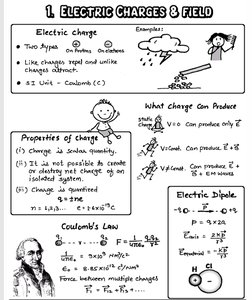
Properties of Charge
Charge is Scalar: It has magnitude but no direction.
Quantization: Charge exists in discrete packets, multiples of elementary charge (\(e\)).
Conservation: Total charge in an isolated system remains constant.
What Charge Can Produce
Static Charge (\(q\)): Produces an electric field (\(\vec{E}\)).
Moving Charge (\(q, v\)): Produces both electric and magnetic fields (\(\vec{E}, \vec{B}\)).
Accelerating Charge: Produces electromagnetic waves (\(\vec{E}, \vec{B}\), and EM waves).
Coulomb's Law
Coulomb's Law quantifies the force between two point charges. The force is directly proportional to the product of the charges and inversely proportional to the square of the distance between them.
Formula:
Where:
\(F\): Force between charges
\(q_1, q_2\): Magnitudes of charges
\(r\): Distance between charges
\(k = \frac{1}{4\pi\varepsilon_0}\): Coulomb's constant
Electric Dipole
An electric dipole consists of two equal and opposite charges separated by a distance. The dipole moment (\(\vec{p}\)) is a vector quantity pointing from negative to positive charge.
Dipole Moment:
Field on Axis:
Field on Equator:
Torque on Dipole in External Field
When placed in a uniform electric field, a dipole experiences a torque that tends to align it with the field.
Torque:
Stable Equilibrium: When dipole is aligned with the field (\(\theta = 0\))
Unstable Equilibrium: When dipole is anti-aligned (\(\theta = 180^\circ\))
Electric Flux (\(\Phi\))
Electric flux measures the number of electric field lines passing through a surface. It is a scalar quantity.
Formula:
For Closed Surface:
Dielectric Constant (\(K\))
The dielectric constant is the ratio of the permittivity of a material to the permittivity of free space. It quantifies a material's ability to reduce the effective electric field within it.
Formula:
For Vacuum:
For Air:
Charge Distribution
Charge can be distributed in different ways on objects:
Linear Charge Density (\(\lambda\)): Charge per unit length
Surface Charge Density (\(\sigma\)): Charge per unit area
Volume Charge Density (\(\rho\)): Charge per unit volume
Gauss's Law
Gauss's Law relates the electric flux through a closed surface to the total charge enclosed by that surface.
Formula:
Key Point: Only the charge enclosed by the surface contributes to the net flux.
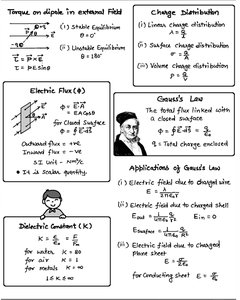
Applications of Gauss's Law
Electric Field Outside a Charged Shell:
Electric Field Inside a Shell:
Electric Field due to Charged Sheet:
For Conducting Sheet:
