 Back
BackElectric Charges and Forces: Study Notes Ch 22
Study Guide - Smart Notes
 Tailored notes based on your materials, expanded with key definitions, examples, and context.
Electric Charges and Properties
Types and Quantization of Charge
Electric charge is a fundamental property of matter, existing in two types: positive and negative. The charge of a proton is defined as positive, while that of an electron is negative. Charge is quantized, meaning it occurs in discrete units, with the elementary charge denoted as C. The total charge on an object is given by , where and are the numbers of protons and electrons, respectively.
Conductors and Insulators
Materials are classified based on their ability to allow charge movement:
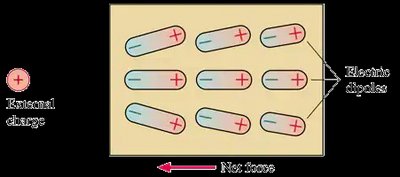
Insulators: Charge cannot move long distances; they do not conduct electricity but can be polarized.
Conductors: Charge can move freely and conduct electricity; they can also be polarized.
Charging and Discharging Conductors
Charging by Contact and Induction
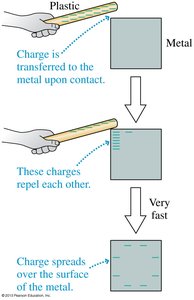
Conductors can be charged by direct contact or by induction. When a charged object touches a conductor, charge is transferred and spreads rapidly over the surface due to repulsion between like charges.
Polarization of Conductors
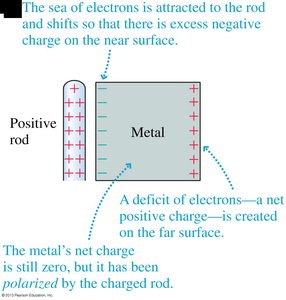
When a charged rod is brought near a conductor without touching, the conductor becomes polarized. Electrons shift within the metal, creating regions of excess negative and positive charge, but the net charge remains zero.
Electroscope and Charge Polarization
Electroscope Behavior
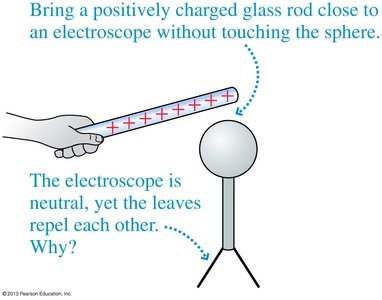
An electroscope is a device used to detect electric charge. When a positively charged rod is brought near a neutral electroscope, the leaves move apart due to polarization: positive charges are repelled to the leaves, causing them to repel each other.
Charge Polarization
Charge polarization refers to the slight separation of positive and negative charges within a neutral object when exposed to an external electric field. This effect is crucial in understanding the behavior of insulators and conductors in electric fields.
Coulomb's Law and Electrical Forces
Coulomb's Law
The force between two point charges is described by Coulomb's Law:
: Charges (Coulombs)
: Distance between charges (meters)
: Permittivity of free space
: Unit vector from one charge to the other
The constant is often denoted as N·m2/C2.
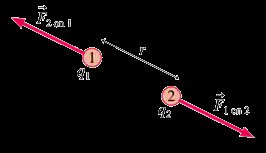
Force Direction and Superposition Principle
The direction of the force depends on the sign of the charges: like charges repel, unlike charges attract. The superposition principle states that the net force on a charge is the vector sum of all individual forces acting on it.
Force Diagrams and Examples
For multiple charges, force vectors must be added component-wise. Consider three charges arranged in a square; the net force on one charge is found by summing the forces from the other two.
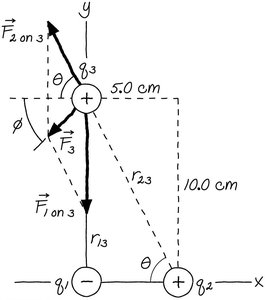
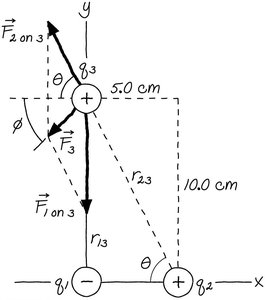
Electric Field Concept
Definition and Properties
The electric field is a vector field that exists everywhere in space and describes the force per unit charge at each point. It is defined as:
The force on a charge in an electric field is:
Field Representation and Examples
Electric fields can be visualized as arrows indicating magnitude and direction at each point, similar to wind velocity maps in meteorology.
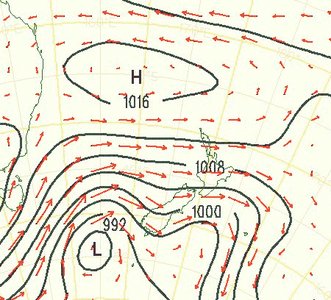
Calculating Forces from Electric Fields
Given an electric field and a charge, the force is calculated by multiplying the charge by the field vector. For example, if and nC, the force is .
Summary Table: Properties of Conductors and Insulators
Property | Conductors | Insulators |
|---|---|---|
Charge Mobility | High (free movement) | Low (localized) |
Electrical Conductivity | Conduct electricity | Do not conduct |
Polarization | Can be polarized | Can be polarized |
Charge Distribution | Spreads over surface | Remains localized |
Key Equations
Charge Quantization:
Coulomb's Law:
Electric Field:
Force from Electric Field:
Example: If a charge nC is placed in an electric field , the force is N.
Additional info: The notes expand on brief points by providing definitions, examples, and equations for clarity and completeness. All images included directly reinforce the explanation of the adjacent paragraph, as required.
