 Back
BackElectric Current: Definition, Direction, and Calculations
Study Guide - Smart Notes
 Tailored notes based on your materials, expanded with key definitions, examples, and context.
Electric Current
Definition and Basic Concepts
Electric current is defined as the continuous flow of electric charges through a material. In metallic conductors, these charges are primarily electrons. The unit of electric current is the ampere (A), which is equivalent to one coulomb of charge passing through a point in a circuit per second.
Electric current (I): The rate at which charge flows through a surface.
Unit: Ampere (A), where 1 A = 1 C/s.
Charge (Q): Measured in coulombs (C).
Time (t): Measured in seconds (s).
Formula:
Where:
I = current (A)
Q = charge (C)
t = time (s)
Rearranged:
Example: If a current of 2 A flows for 3 seconds, the total charge transferred is C.
Direction of Electric Current
There are two conventions for the direction of current:
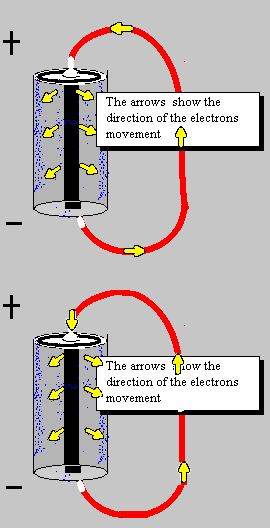
Conventional current direction: The direction in which positive charges would flow, from the positive terminal to the negative terminal of a power source.
Electron flow: The actual movement of electrons, which is from the negative terminal to the positive terminal.
Key Point: In metallic conductors, current is carried by electrons, which move opposite to the direction of conventional current.
Types of Electric Current
Direct Current (DC): Flows in one direction only (e.g., from a battery).
Alternating Current (AC): Changes direction periodically (not covered in detail here).
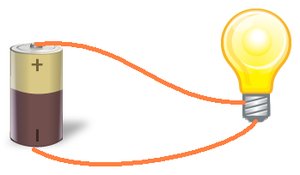
Example: In a simple circuit with a battery and a bulb, the current flows from the positive terminal, through the bulb, and returns to the negative terminal.
Charge, Current, and Time Calculations
Relationship Between Charge, Current, and Time
The total charge transferred by a current over a period of time can be calculated using:
Q = total charge (C)
I = current (A)
t = time (s)
Example: If a wire carries a current of 3 A for 2 minutes (120 s), the total charge is C.
Worked Examples
Example 1: If 30 C of charge passes through a conductor in 5 s, the current is A.
Example 2: A device draws 500 mA (0.5 A) for 10 minutes (600 s). The charge is C.
Example 3: If a smartphone battery requires 9000 C to fully charge at 1.5 A, the time required is s = 1.67 hours.
Number of Electrons Calculation
Each electron carries a charge of C. The number of electrons (n) corresponding to a total charge Q is:
Where e is the elementary charge ( C).
Example: If 300 C of charge passes through a device, the number of electrons is electrons.
Applications and Importance of Electric Current
Real-Life Examples
Household wiring: Electric current powers lights, appliances, and devices.
Electroplating: Current is used to deposit metal layers in manufacturing.
Medical devices: Pacemakers and diagnostic equipment rely on controlled electric currents.
Importance: Understanding electric current is essential for designing safe electrical systems, developing new technologies, and solving practical problems in engineering and science.
Practice Problems
1. Which particles primarily carry current in a metal wire? Answer: Electrons
2. Direct current (DC) flows: Answer: In one direction only
3. A wire carries a current of 3 A. How much charge passes through it in 2 minutes? Answer: 360 C
4. A smartphone battery delivers 2000 mA for 1.5 hours. Total charge supplied is: Answer: 10,800 C
5. In a particle accelerator, a beam of protons carries protons per second. What is the current? Answer: A
Additional info: The above notes expand on the lesson objectives, providing definitions, formulas, and worked examples for a comprehensive understanding of electric current, its calculation, and its significance in real-world applications.
