 Back
BackElectric Field and Its Effects on Point Charges and Dipoles
Study Guide - Smart Notes
 Tailored notes based on your materials, expanded with key definitions, examples, and context.
Electric Field: Definition and Properties
Physical Meaning of a Field
A field is a physical quantity defined at every point in space and time. Examples include temperature, gravitational field, velocity field in a liquid, and stress tensor. In physics, fields describe how objects interact with their environment and with each other.
Electric Field as a Vector Field
The electric field \( \vec{E}(\vec{r}) \) is a vector field that mediates the interaction between electric charges. It is generated by charges and continuously accompanies them, influencing other charges in its vicinity.
Electric charge quantifies how strongly an object generates its own electric field and interacts with fields from other charges.
The electric field is measured in units of Newtons per Coulomb (N/C).
Electric Field Produced by Point Charges
Force and Field Calculation
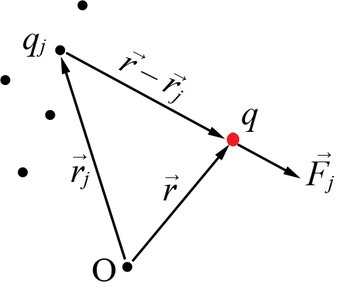
The force on a test charge q at point \( \vec{r} \) due to a set of point charges q_j is given by:
Force from each charge:
Total force:
Electric field:
Superposition principle: The total electric field is the vector sum of fields from all charges:
Field from a single charge:
The electric field points away from positive charges and toward negative charges.
Electric Field Lines
Visualization and Properties
Electric field lines (EFLs) are a graphical tool for visualizing electric fields. They provide insight into the direction and strength of the field at various points.
EFLs start at positive charges or at infinity and end at negative charges or at infinity.
EFLs may be curved, but in static (time-independent) fields, they never form closed loops.
The electric field at a point is tangential to the local EFL.
The density of EFLs at a point is proportional to the magnitude of the electric field.
EFLs do not cross, ensuring the uniqueness of the field direction at each point.
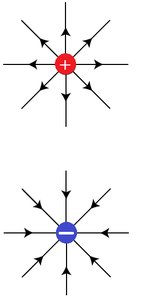
Examples of Electric Field Lines
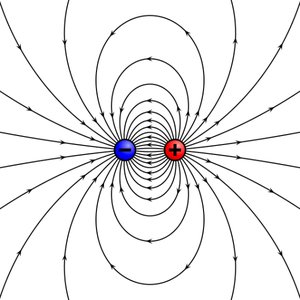
Dipole: Field lines between a positive and negative charge.
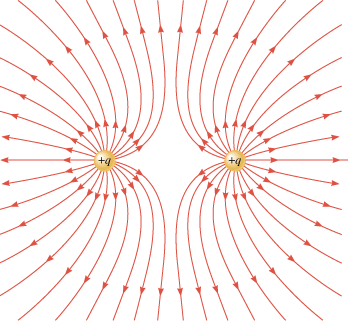
Two positive charges: Field lines repel from both charges.
Asymmetric dipole: Field lines for charges of unequal magnitude.
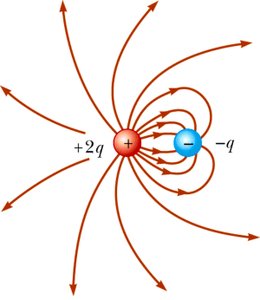
Two negative charges: Field lines converge toward both charges.
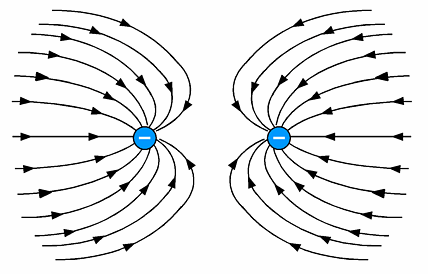
Electric Dipoles
Definition and Examples
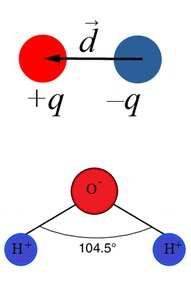
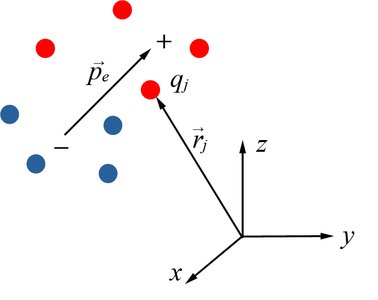
An electric dipole is an electrically neutral object in which positive and negative charges are displaced relative to each other. Dipoles are fundamental in understanding molecular interactions and material properties.
Permanent dipoles: Polar molecules such as water (H2O), sulfur dioxide (SO2), hydrogen sulfide (SH2), and hydrochloric acid (HCl) possess permanent dipole moments.
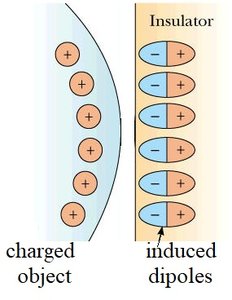
Induced dipoles: Non-polar atoms and molecules become dipoles when placed in an electric field.
Electrostatic interactions in media are weaker than in vacuum due to dipole effects.
Dipole Moment
Mathematical Definition
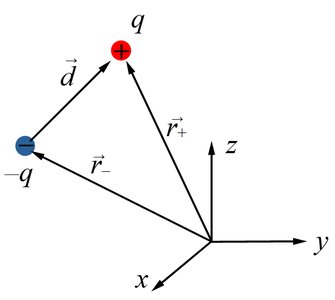
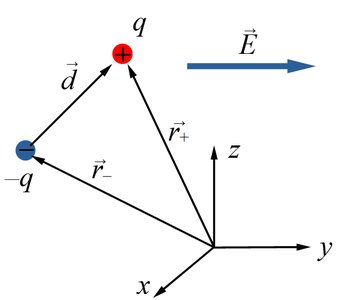
The electric dipole moment \( \vec{p}_e \) quantifies the separation of positive and negative charges:
For many point charges: with (neutrality condition).
For two opposite charges:
Measured in units of Coulomb-meters (C·m).
The dipole moment is independent of the choice of origin. Additional info: This is because the sum of charges is zero, so shifting the origin does not affect the value.
Permanent Dipole in a Uniform Electric Field
Force and Torque on a Dipole
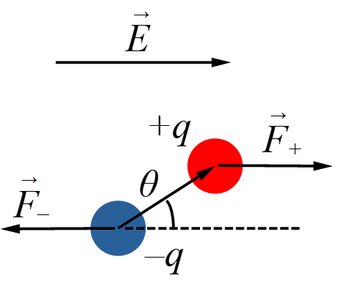
When a dipole is placed in a uniform electric field, it experiences forces and torques:
Force on a charge:
Net force on a dipole: (no net force in a uniform field)
Torque on the dipole:
Magnitude of torque:
Torque direction is perpendicular to both \( \vec{E} \) and \( \vec{p}_e \) (right-hand rule).
Torque is independent of the choice of pivot point. Additional info: This follows from the vector nature of torque and the neutrality of the dipole.
Potential Energy in a Uniform Electric Field
Work and Potential Energy
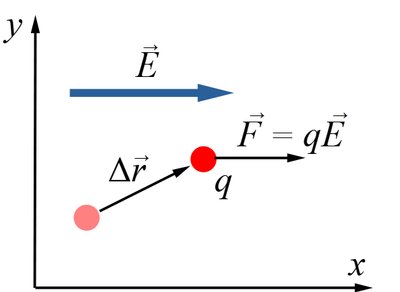
The work done by an electric field as a charge or dipole is displaced relates to potential energy:
Work done by the field:
Potential energy of a point charge: (up to an additive constant)
Potential energy of a dipole:
Exercises and Applications
Exercise 1: Field Line Density
Is it possible to have an electric field represented by parallel field lines that are dense in one region and sparse in another region?
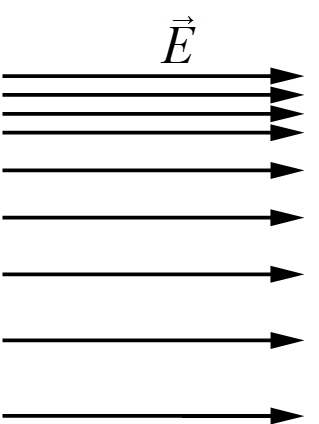
Key Point: In a uniform electric field, field lines are equally spaced. Varying density implies a non-uniform field.
Exercise 2: Net Electric Field at a Point
A charge q1 of magnitude 3 µC and another unknown charge q2 are placed as shown. The net electric field \( \vec{E} \) at point P points in the negative y-direction. Find q1 and q2 and the magnitude of \( \vec{E} \).
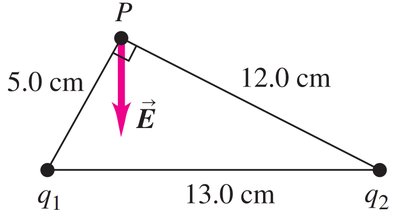
Key Point: Use vector addition of fields from both charges and geometry to solve for unknowns.
Exercise 3: Dipole Moment of Water Molecule
In a water molecule, the two hydrogens carry partial charges of +0.3e, and the oxygen carries a partial charge of −0.6e. The HO bond length is 0.96 Å, and the angle between these bonds is 105°. Find the magnitude of the dipole moment and sketch its electric field lines.
Key Point: Calculate dipole moment using geometry and charge values. Sketch field lines similar to a dipole.
Exercise 4: Attraction of Neutral Objects
A permanent dipole in a uniform electric field experiences no net force. Yet a charged plastic pen can pick up small neutral insulating objects like tiny bits of paper. How is this possible?
Key Point: Induced dipoles in the paper experience a non-uniform field, resulting in a net force.
Exercise 5: Origin Independence
(a) Dipole moment independence: The value of the dipole moment is independent of the choice of origin because the total charge is zero.
(b) Torque independence: The torque on a permanent dipole by a uniform electric field is independent of the choice of pivot point due to the vector nature of torque and neutrality.
Exercise 6: Electric Field of a Dipole
Find the electric field produced by an electric dipole with moment \( \vec{p}_e = qd \hat{z} \) at a point \( \vec{r} \) such that \( r \gg d \):
(a) On the x-axis (perpendicular to the dipole):
(b) On the dipole’s z-axis:
Field is given in vector form as a function of pe and r.
Additional info: These results are derived from the general expression for the field of a dipole at large distances.
