 Back
BackElectric Field Calculation: Point Charges and Continuous Distributions
Study Guide - Smart Notes
 Tailored notes based on your materials, expanded with key definitions, examples, and context.
Electric Field Calculation
Electric Field Produced by Point Charges
The electric field ⃗E at a point in space is a vector quantity that describes the force per unit charge exerted by a source charge. For a point charge, the field is determined by Coulomb's law.
Force on a test charge: The force ⃗F on a small charge q placed in an electric field ⃗E(⃗r) is given by .
Field from a point charge at the origin: , where is Coulomb's constant, is the charge, and is the position vector.
Field from a point charge at position :
Direction: The electric field points away from positive charges and toward negative charges.
Example: Calculating the field at a point along the axis of a point charge.
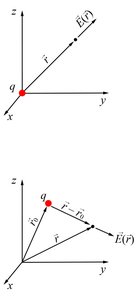
Electric Field Produced by a Continuous Charge Distribution
When charges are distributed over a region (not just at points), the electric field is calculated by summing contributions from each infinitesimal charge element.
Charge element: Divide the region into small elements with charge at position .
Field from each element:
Total field:
Infinitesimal limit:
Example: Calculating the field from a charged rod or disk.
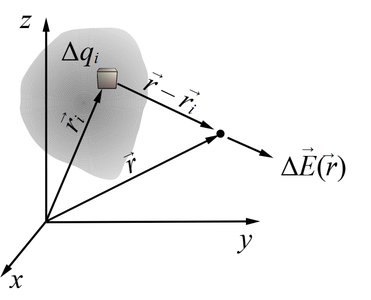
Types of Charge Distributions
Continuous charge distributions can be classified by their geometry:
Volume charge density: (C/m3),
Surface charge density: (C/m2),
Linear charge density: (C/m),
General field formula:
Integration strategies: Use symmetry, factorization, change of variables, or parametric differentiation to simplify the integral.
Common Indefinite Integrals and Integration Tricks
Solving electric field integrals often requires knowledge of standard integrals:
Exercises: Applications of Electric Field Calculations
Exercise 1: Electric Dipole Field (Far Field Approximation)
An electric dipole ⃗pe = q ⃗d is centered at the origin and oriented along the y-axis. Find the electric field at any point ⃗r = (x, y) in the (xy)-plane for .
Dipole field (far field):
Application: Used in molecular physics and electromagnetism for fields far from dipoles.
Exercise 2: Electric Field of a Charged Ring
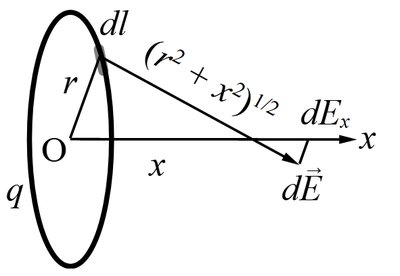
A ring of radius r carries charge q. Find the electric field ⃗E(x) at an arbitrary point on its axis of symmetry x.
Setup: Use symmetry; all field components perpendicular to the axis cancel.
Field on axis:
Example: Field at the center () is zero; field far from ring () approaches that of a point charge.
Exercise 3: Electric Field of a Disk with a Central Hole
A thin disk with a circular hole in the center has uniform surface charge density σ. Find the magnitude and direction of the electric field ⃗E(x) at an arbitrary point on its axis of symmetry x.
Setup: The disk has inner radius and outer radius .
Field calculation: Integrate over the annular region; use superposition (subtract field of inner disk from outer disk).
Formula:
Direction: Along the x-axis.
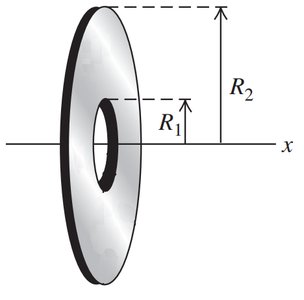
Exercise 4: Electric Field of a Uniformly Charged Rod
A rod of length L has positive charge Q uniformly distributed along its length. Calculate the electric field on the y-axis at y > L/2 and on the x-axis. What is the electric field on the x-axis if L becomes infinite?
Linear charge density:
Field at point (y > L/2): Integrate contributions from each segment using , where is the distance from segment to point.
Field on x-axis: Use symmetry; integrate along rod.
Infinite rod: (for points perpendicular to rod).
Application: Models fields near wires and rods in electrostatics.
