 Back
BackElectric Field, Electric Force, and Coulomb’s Law: Study Notes
Study Guide - Smart Notes
 Tailored notes based on your materials, expanded with key definitions, examples, and context.
Electric Field and Electric Force
Introduction to Electric Field and Force
The concepts of electric field and electric force are fundamental to understanding interactions between charged particles. An electric field is a region of space around a charged object where other charges experience a force. The electric force is the interaction between two charges, described quantitatively by Coulomb’s Law.
Electric Field (E): The force per unit charge experienced by a small positive test charge placed in the field.
Electric Force (Fe): The force exerted by one charge on another due to their electric fields.
SI Units: Electric field is measured in Newtons per Coulomb (N/C) or Volts per meter (V/m).

Definition of Electric Field
The electric field vector E at a point in space is defined as the electric force Fe acting on a positive test charge q0 placed at that point, divided by the magnitude of the test charge:
The direction of E is the direction of the force on a positive test charge.
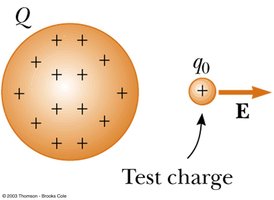
Direction of Electric Field
Positive Source Charge: The electric field points away from the charge.
Negative Source Charge: The electric field points toward the charge.
A positive test charge is repelled by positive charges and attracted to negative charges.
Coulomb’s Law
Statement and Mathematical Formulation
Coulomb’s Law quantifies the electric force between two point charges. The force is proportional to the product of the charges and inversely proportional to the square of the distance between them:
ke: Coulomb constant, N·m2/C2
q1, q2: Magnitudes of the two point charges (in Coulombs)
r12: Distance between the charges (in meters)
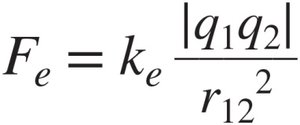
Nature of Electric Forces
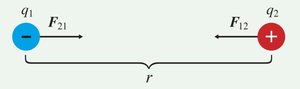
Attractive Force: Between charges of opposite sign.
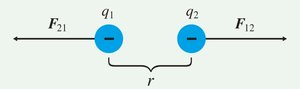
Repulsive Force: Between charges of the same sign.
The force acts along the line joining the two charges.
Vector Nature of Electric Forces
Electric force is a vector quantity. For two charges, the forces are equal in magnitude and opposite in direction (Newton’s Third Law):
Like charges: Repel each other.
Unlike charges: Attract each other.
Superposition Principle
When more than two charges are present, the net force on any charge is the vector sum of the forces exerted by all other charges:
Calculate the force from each charge separately using Coulomb’s Law.
Add the forces vectorially to find the net force.

Electric Field Lines
Properties and Interpretation
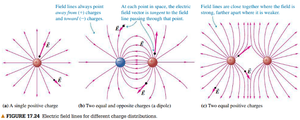
Electric field lines provide a visual representation of the electric field in a region:
Lines begin on positive charges and end on negative charges.
The density of lines indicates the strength of the field (closer lines = stronger field).
Field lines never intersect.
The direction of the field at any point is tangent to the field line at that point.
Electric Field Patterns
Single Point Charge: Lines radiate outward (positive) or inward (negative).
Electric Dipole: Two equal and opposite charges; field lines emerge from the positive and terminate on the negative charge, with high density between them indicating a strong field.
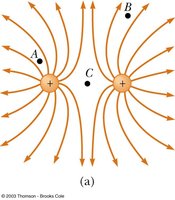
Ranking Electric Field Strength
The magnitude of the electric field is greatest where field lines are closest together. If no lines are present at a point, the field is zero.
Problem Solving Strategies
Units and Conversions
Charges must be in Coulombs (C).
Distances must be in meters (m).
Forces are in Newtons (N).
Convert units as necessary before applying formulas.
Applying Coulomb’s Law
Identify all charges and their positions.
Calculate the force between each pair using Coulomb’s Law.
Determine the direction of each force (attraction or repulsion).
Use vector addition to find the net force on each charge.
Calculating Electric Fields
Use for a test charge.
For multiple charges, use the superposition principle to sum the fields vectorially.
Sample Problems and Applications
Example 1: Balancing Electric Force and Weight
A Styrofoam ball of mass kg and charge C is suspended in an electric field. What field strength is needed to balance its weight?
Set
Solve for :
Plug in values: N/C
Example 2: Force Between Two Charges
Two charges, +3 μC and −5 μC, are 2 meters apart. Calculate the electrostatic force between them:
Convert μC to C: C = C, C = C
Use Coulomb’s Law:
Calculate the result (attractive force).
Example 3: Two Identical Charges (Worksheet)
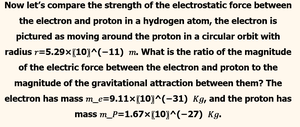
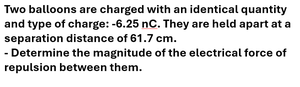
Electric Field in Real Life
Photocopiers: Use electric fields to move toner particles onto paper.
Lightning: Caused by the buildup of electric fields in clouds.
Electrostatic Precipitators: Use electric fields to remove particles from exhaust gases.
Understanding electric fields is crucial for technology, safety, and environmental applications.
Summary Table: Key Concepts
Concept | Definition | Formula | SI Unit |
|---|---|---|---|
Electric Field (E) | Force per unit charge | N/C or V/m | |
Electric Force (Fe) | Force between two charges | N | |
Coulomb Constant (ke) | Proportionality constant in Coulomb’s Law | N·m2/C2 |
Additional info: These notes include expanded academic context and examples for clarity and exam preparation.
