 Back
BackElectric Fields from Point Charges and Charged Arcs – Step-by-Step Guidance
Study Guide - Smart Notes
 Tailored notes based on your materials, expanded with key definitions, examples, and context.
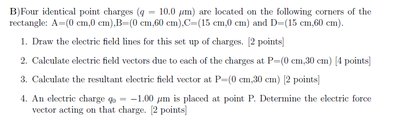
Q1. Four identical point charges (q = 10.0 μm) are located at the corners of a rectangle: A = (0 cm, 0 cm), B = (0 cm, 60 cm), C = (15 cm, 0 cm), and D = (15 cm, 60 cm).
Draw the electric field lines for this set up of charges. [2 points]
Calculate electric field vectors due to each of the charges at P = (0 cm, 30 cm). [4 points]
Calculate the resultant electric field vector at P = (0 cm, 30 cm). [2 points]
An electric charge q0 = -1.00 μm is placed at point P. Determine the electric force vector acting on that charge. [2 points]
Background
Topic: Electric Fields from Point Charges
This problem tests your understanding of how to calculate and represent electric fields created by multiple point charges, and how to determine the force on a test charge placed in that field.
Key Terms and Formulas
Electric field due to a point charge:
Electric field vector:
Superposition principle: The net electric field is the vector sum of the fields from all charges.
Electric force:
Step-by-Step Guidance
Sketch the rectangle and label the positions of the four charges. Indicate the location of point P at (0 cm, 30 cm).
For each charge, determine the vector from the charge to point P. Calculate the distance and the direction for each.
Use the electric field formula to write the expression for at P due to each charge. Remember to include the direction (toward or away from the charge, depending on the sign of ).
Set up the vector sum of the four electric field contributions at P. Break each field into and components as needed.
For the force on at P, use with your net field vector (do not compute the final value yet).
Try solving on your own before revealing the answer!
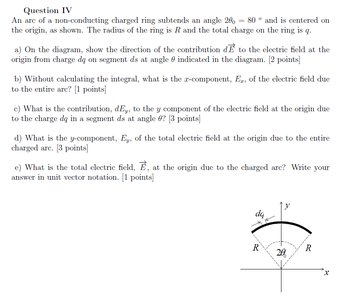
Q2. An arc of a non-conducting charged ring subtends an angle 2θ0 = 80° and is centered on the origin. The radius of the ring is R and the total charge on the ring is q.
On the diagram, show the direction of the contribution of to the electric field at the origin from charge on segment ds at angle θ. [2 points]
Without calculating the integral, what is the x-component, , of the electric field due to the entire arc? [1 point]
What is the contribution, , to the y-component of the electric field at the origin due to the charge in a segment ds at angle θ? [3 points]
What is the y-component, , of the total electric field at the origin due to the entire charged arc? [3 points]
What is the total electric field, , at the origin due to the charged arc? Write your answer in unit vector notation. [1 point]
Background
Topic: Electric Field from Continuous Charge Distributions (Arc of Charge)
This question tests your ability to analyze the electric field produced by a continuous distribution of charge, specifically an arc, using symmetry and calculus concepts.
Key Terms and Formulas
Electric field due to a charge element:
For an arc, where is the linear charge density.
Superposition: Integrate over the arc to find the total field.
Symmetry: The x-components may cancel depending on the arc's position.
Step-by-Step Guidance
On the diagram, draw the vector at the origin due to a small segment at angle . Indicate its direction using geometry (it points away from the arc if ).
Consider the symmetry of the arc about the y-axis. Argue whether the x-components of from symmetric elements cancel out.
Write the expression for the y-component of : .
Set up the integral for over the arc: from to .
Combine your results to write the total electric field at the origin in unit vector notation, but do not evaluate the integral yet.
Try solving on your own before revealing the answer!
